2 Post vs 4 Post Lift Understanding the Key Differences for Your Workshop
Introduction
Choosing between a 2 post vs 4 post lift is one of the most important decisions you will make for your auto repair shop. Two-post lifts offer full undercarriage access and a smaller footprint—ideal for transmission work, brake jobs, and suspension repairs. Four-post lifts provide superior stability for alignment work and vehicle storage, with easier drive-on operation. This guide breaks down capacity requirements, space planning, power considerations, maintenance best practices, and budget factors to help you select the perfect lift for your garage.
1. Why Your Garage Needs the Right 2 Post vs 4 Post Lift Investment
Every professional garage relies on a quality auto lift to maximize technician productivity, improve safety, and streamline daily operations. When comparing a 2 post vs 4 post lift, each design serves distinct purposes in your workflow.
A two-post lift lifts the vehicle by its frame or factory-recommended lifting points, leaving the wheels completely free and accessible. This makes it the go-to choice for comprehensive repair work—engine drops, transmission services, exhaust system repairs, and suspension overhauls all benefit from the unrestricted access a two-post lift provides. Two-post lifts are generally more affordable than four-post lifts, making them an economical choice for shops prioritizing repair work.
A four-post lift, by contrast, lifts the vehicle by its wheels on drive-on runways. This design offers exceptional stability and is particularly well-suited for wheel alignment services, vehicle inspections, and long-term storage. Four-post lifts are incredibly user-friendly—simply drive the vehicle onto the platform and engage the system. For shops that prioritize alignment work or need to store multiple vehicles, a four-post lift often makes more sense.
At AUTO HYDRA INC, we understand that every shop has unique needs. With strategically located warehouses across the United States, we ensure fast delivery and professional installation for every auto lift we sell. Explore our auto lift selection here.
2. Space and Facility Requirements for 2 Post vs 4 Post Lift Installation
Before committing to either option, a thorough evaluation of your garage space is essential.
📒2.1 Ceiling Height Clearance
Ceiling height is often the most restrictive factor when choosing between a 2 post vs 4 post lift. Two-post lifts typically require 11 to 12 feet of clearance for overhead models, though floorplate models can accommodate ceilings as low as 10 feet. Four-post lifts generally need 12 to 14 feet depending on vehicle height.
Always measure your ceiling at its lowest point, accounting for garage door openers, light fixtures, HVAC ducts, and support beams. A few inches can make the difference between a successful installation and an expensive mistake.
📒2.2 Floor Slab Requirements
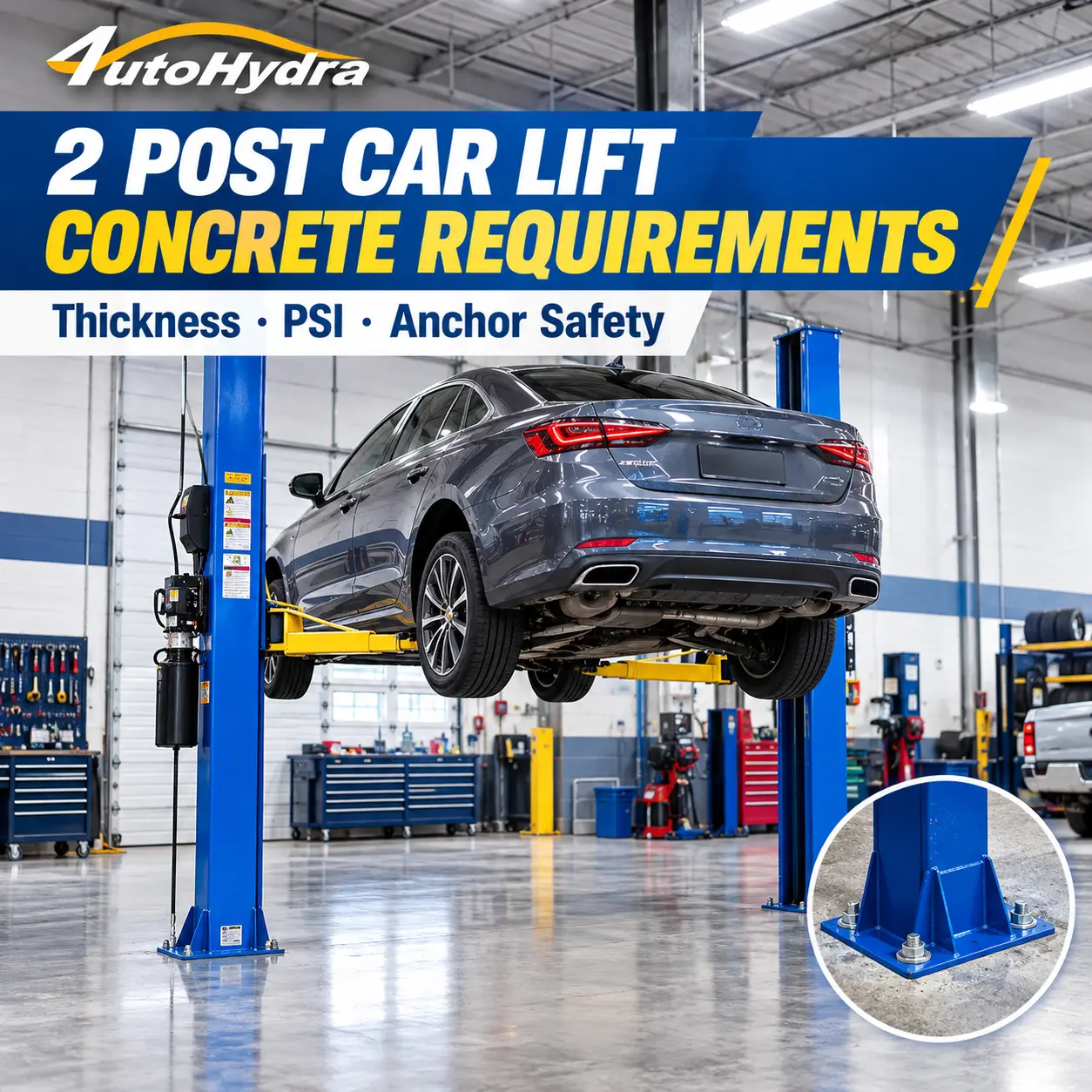
Your concrete floor must support the substantial loads generated by any auto lift. For two-post lifts, professional installation requires a minimum of 4 inches of reinforced concrete at 3,000 PSI. Many 12,000 lb capacity and higher two-post lifts require 6 inches of reinforced concrete. Four-post lifts have less stringent requirements because they distribute weight across four points, but they still demand solid, level flooring.
Always consult a structural engineer if you are unsure about your concrete slab‘s condition.
📒2.3 Working Space Around the Lift
A two-post lift generally occupies less floor space than a four-post lift. Two-post lifts can be much shorter front-to-back than the vehicle itself, allowing you to reclaim floor space when the lift is not in use. Four-post lifts occupy a footprint roughly the size of your vehicle and use the same space whether in use or not.
Recommended clearances: Allow 2 to 3 feet of side clearance to walls or cabinets for door swing and tool access. Ensure adequate space for walking routes and temporary workstations around the lift area.
3. Choosing the Right Capacity for Your 2 Post vs 4 Post Lift
Selecting the appropriate lifting capacity protects your investment and ensures technician safety.
3.1 Weight Capacity Guidelines
Two-Post Lift Capacity Recommendations:
● Light-duty home garage: 6,000 – 8,000 lbs
● Professional auto shop: 9,000 – 12,000 lbs
● Truck and SUV specialist: 12,000 – 15,000 lbs
Four-Post Lift Capacity Recommendations:
● General service: 9,000 – 12,000 lbs
● Heavy-duty commercial: 15,000 lbs and above
When evaluating capacity, consider the heaviest vehicle you will ever lift, including EV battery mass, upfits, toolboxes, and cargo loads. A 10,000 lb capacity two-post lift handles everything from compact cars to full-size trucks. Four-post lifts generally support higher capacities than two-post lifts because of the additional support columns.
3.2 Power Requirements
Before purchasing any auto lift, verify your electrical setup. Many two-post lifts require 220-240V single-phase power on a dedicated 30-amp circuit, though some lighter units run on 110-120V at slower speeds. Four-post lifts are often more accessible for residential installation because many models operate on standard 115-volt power.
For 220V two-post lift installations, always consult a licensed electrician to ensure proper wiring, grounding, and code compliance. Find the right lift for your power setup here.
4. Maintenance and Safety for Your 2 Post vs 4 Post Lift
Proper maintenance is critical regardless of whether you choose a 2 post vs 4 post lift. AUTO HYDRA INC has previously published comprehensive maintenance guidelines for automotive equipment—we recommend reviewing our previous news articles for detailed service schedules. Following a consistent maintenance routine prevents breakdowns and extends equipment life.
📌4.1 Daily Pre-Operation Safety Checks
● Inspect structural components for deformation or excessive wear
● Check lift contact points, hoses, wires, and drive chains
● Test controls, emergency stops, and lift arm movement
● Examine safety locks, hose connections, and hydraulic fittings
📌4.2 Proper Lifting Technique: Always Use Safety Locks
After raising the vehicle to working height, lower it onto the mechanical safety locks before beginning any repair work. This eases the load on the lift‘s hydraulic system—the lift is used just to raise the vehicle, not to bear the load continuously throughout the repair. Most lifts have automatic locking systems that engage as the vehicle is raised.
📌4.3 Regular Lubrication and Cleaning
Apply lubricant to all rollers and pivot points to prevent premature wear. Keep the area around your lift free of obstacles, grease, and debris. Inspect bolt torque, pivot pins, and check cable tension regularly. Browse garage maintenance essentials here.
📌4.4 Annual Professional Inspection
Schedule a comprehensive professional inspection annually to ensure compliance with safety standards. A competent person should issue a Report of Thorough Examination, identifying potential issues before they lead to failures.
5. Making the Right Choice Between 2 Post vs 4 Post Lift for Your Shop
The decision ultimately comes down to your primary shop activities. If your garage focuses on comprehensive mechanical repairs—engine work, transmission jobs, brake services, and suspension overhauls—a two-post lift is likely your best choice. Two-post lifts are the most common choice for automotive shops due to their versatility and space-saving design.
If your priorities include wheel alignment services, long-term vehicle storage, and routine maintenance like oil changes, a four-post lift may better suit your needs. Four-post lifts excel in larger workshops or specialist centers where stability and accuracy are essential.
Some shops operate both types. A two-post lift for major repair work paired with a four-post lift for alignment services and storage can maximize your garage‘s capabilities. Explore our full range of professional garage equipment.
6. Frequently Asked Questions About 2 Post vs 4 Post Lift
Q: Which is better for a home garage—a 2 post or 4 post lift?
A: For a home garage, it depends on your intended use. Two-post lifts are excellent for DIY mechanics who perform major repairs like engine work or suspension overhauls, but they require higher ceilings (11–12 feet) and reinforced concrete floors (4–6 inches). Four-post lifts are often easier to install in home garages because some models work with standard 115V power and have less stringent floor requirements. However, four-post lifts occupy a larger footprint and restrict wheel access unless equipped with a bridge jack.
Q: Can I perform wheel alignments on a two-post lift?
A: While it is possible to perform alignments on a two-post lift, four-post lifts are specifically designed for alignment work. Four-post alignment lifts come equipped with integrated rear slip plates and front turn plates, making them the preferred choice for precision alignment services. If your shop prioritizes alignment work, invest in a four-post alignment lift rather than attempting alignments on a two-post lift.
Q: How much does a professional auto lift cost?
A: Two-post lifts are generally more affordable than four-post lifts. Entry-level two-post lifts start around $3,000, with professional-grade models ranging from $5,000 to $15,000 depending on capacity and features. Four-post lifts typically range from $4,000 to $20,000 or more for heavy-duty commercial models. Installation costs vary by region but typically add $500 to $1,500.
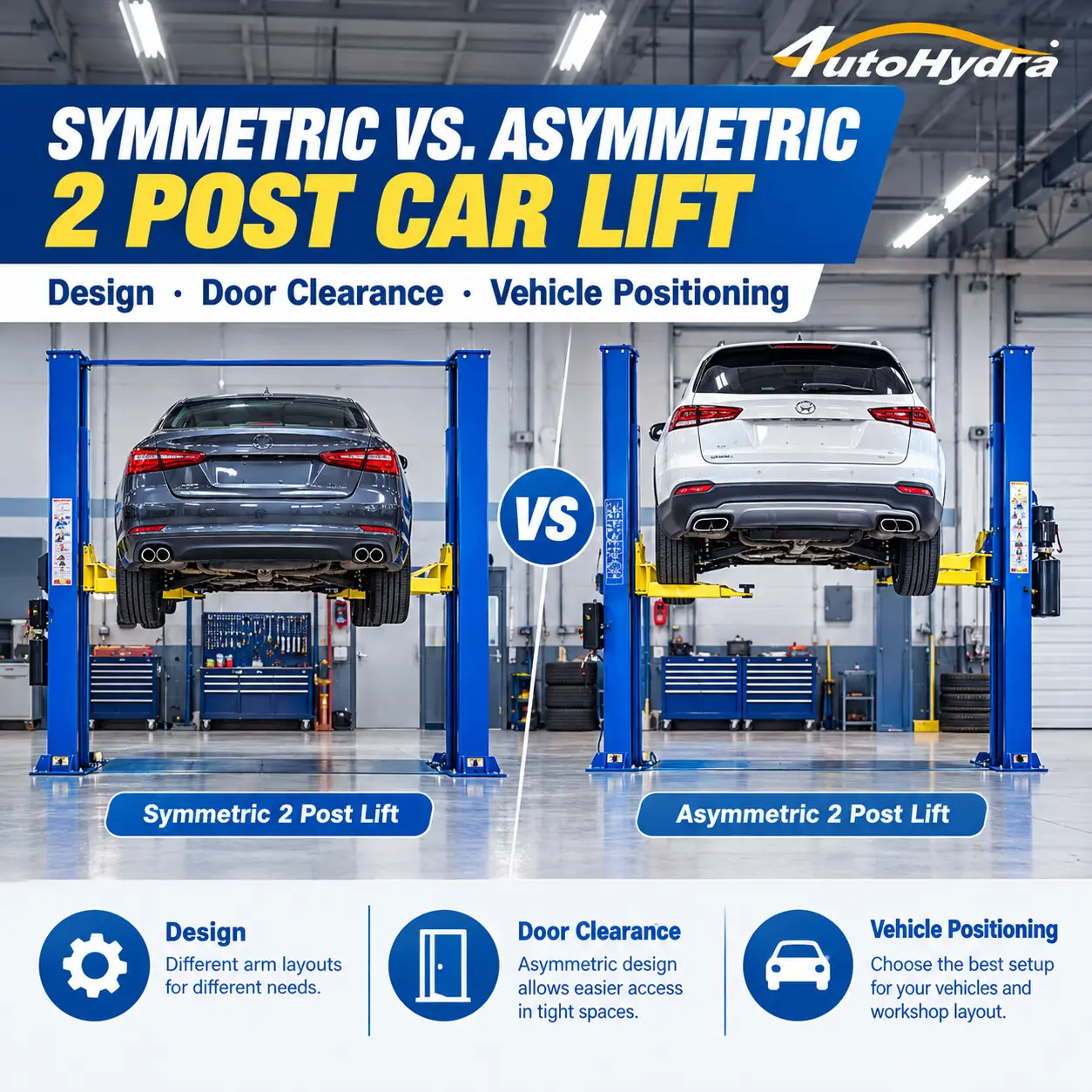
Q: What is the difference between symmetric and asymmetric two-post lifts?
A: Symmetric two-post lifts position the vehicle centered between the posts, making them well-suited for trucks and heavier vehicles. Asymmetric two-post lifts position the vehicle slightly forward relative to the posts, providing easier door access and better ergonomics for passenger car service. Most professional shops prefer asymmetric designs for daily repair work on cars and light trucks.
Q: Does AUTO HYDRA provide installation and warranty support for auto lifts?
A: Yes. AUTO HYDRA INC provides professional installation services through our nationwide network of certified technicians. With strategically located warehouses and offices across the United States, we ensure fast delivery and professional installation to meet the diverse needs of our customers. For warranty terms on specific auto lift models, please contact our sales team directly.
7. Complete Your Garage with Premium Equipment from AUTO HYDRA INC
Ready to upgrade your auto repair shop? Browse AUTO HYDRA‘s curated selection of professional garage equipment designed to work seamlessly with your new auto lift.
● 🛒 Heavy-Duty Tire Changer with Tire Balancer — Professional tire changer paired with automatic tire balancer featuring intelligent self-calibrating capabilities. Essential for any shop installing a two-post or four-post lift.
● 🛒 Heavy-Duty Rolling Utility Cart – 500 lbs Capacity — Two-tier service cart with ergonomic handle design and industrial-strength wheels. Keep tools organized and accessible around your new auto lift.
● 🛒 Heavy Metal Garage Storage System — Complete organization system featuring all-welded cold-rolled steel construction with wall cabinets and workbenches. Maximize efficiency around your 2 post or 4 post lift installation.
8. Explore More Automotive Equipment Solutions at AUTO HYDRA INC
● 💡 Visit Our Main Website — Discover our full range of automotive, garage, and warehouse equipment, featuring cost-effective solutions through direct manufacturer pricing.
● 💡 Explore Our Online Store — Browse professional tire changers, balancers, garage cabinets, work carts, and more to complement your new 2 post or 4 post lift.
Contact AUTO HYDRA INC
For technical support, product inquiries, or order assistance:
Phone: (626) 888-0601
Address: 1344 W Foothill Blvd, Azusa, CA 91702
Trust AUTO HYDRA INC for quality automotive equipment solutions and exceptional service for all your garage needs.
Recommended News
View all