2 Post vs 4 Post Lift: Which Car Lift Is Right for Your Shop or Garage?
The decision between a 2 post lift and a 4 post lift shapes how your entire shop operates — from the types of jobs you can take on to how efficiently your technicians move. Both designs are proven, both are widely used, and both have distinct advantages. This guide covers every meaningful difference so you can choose the right automotive lift for your exact workflow, space, and budget.
Car lifts are among the highest-impact equipment investments a professional shop or serious home garage will make. Unlike consumables or hand tools, a quality lift stays in service for 20 or more years, directly influencing your daily productivity, job capability, and technician safety on every vehicle that comes through the bay. Getting the selection right from the start matters.
Among all lift configurations available today, the two-post car lift and the four-post car lift dominate the market for professional and home-garage use. They are often sold side by side, and buyers frequently underestimate how different they are in practice. This guide provides a full, honest comparison — not a simplified checklist — so you leave with a clear answer for your specific situation.
How a 2 Post Car Lift Works
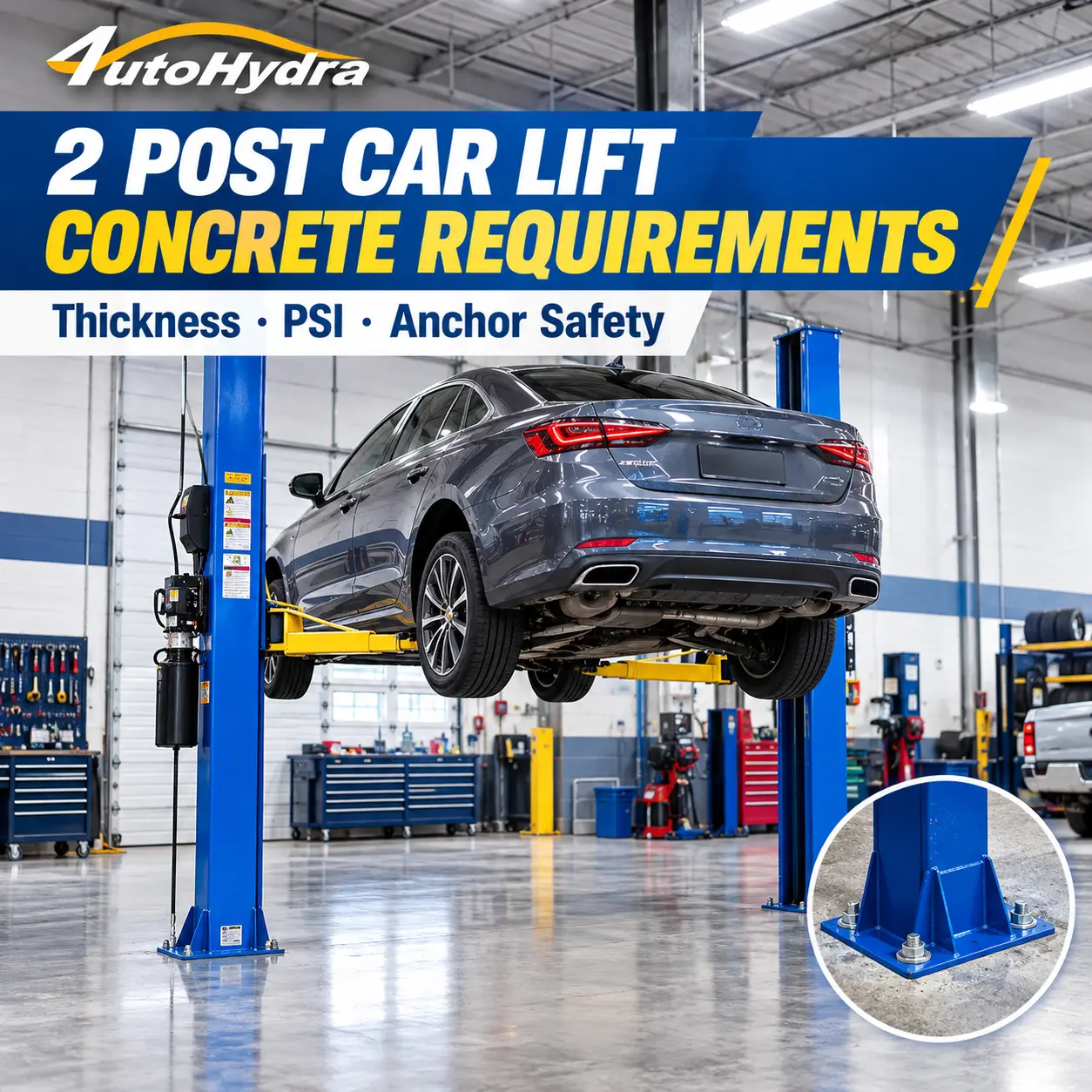
A two-post lift consists of two vertical steel columns anchored to the concrete floor on opposite sides of the vehicle. Hydraulic cylinders — located either in the column base or overhead in the crossbar, depending on the design — drive the lifting carriages up and down each column. Adjustable swing arms extend from each carriage and are positioned beneath the vehicle's designated frame contact points or pinch-weld seams.
When the lift rises, the vehicle is carried entirely by its frame or lift points. All four wheels hang freely in open air. This is the defining characteristic of the two-post design and the reason it dominates professional repair environments: nothing obstructs access to the wheels, brakes, suspension, axles, or any part of the undercarriage.
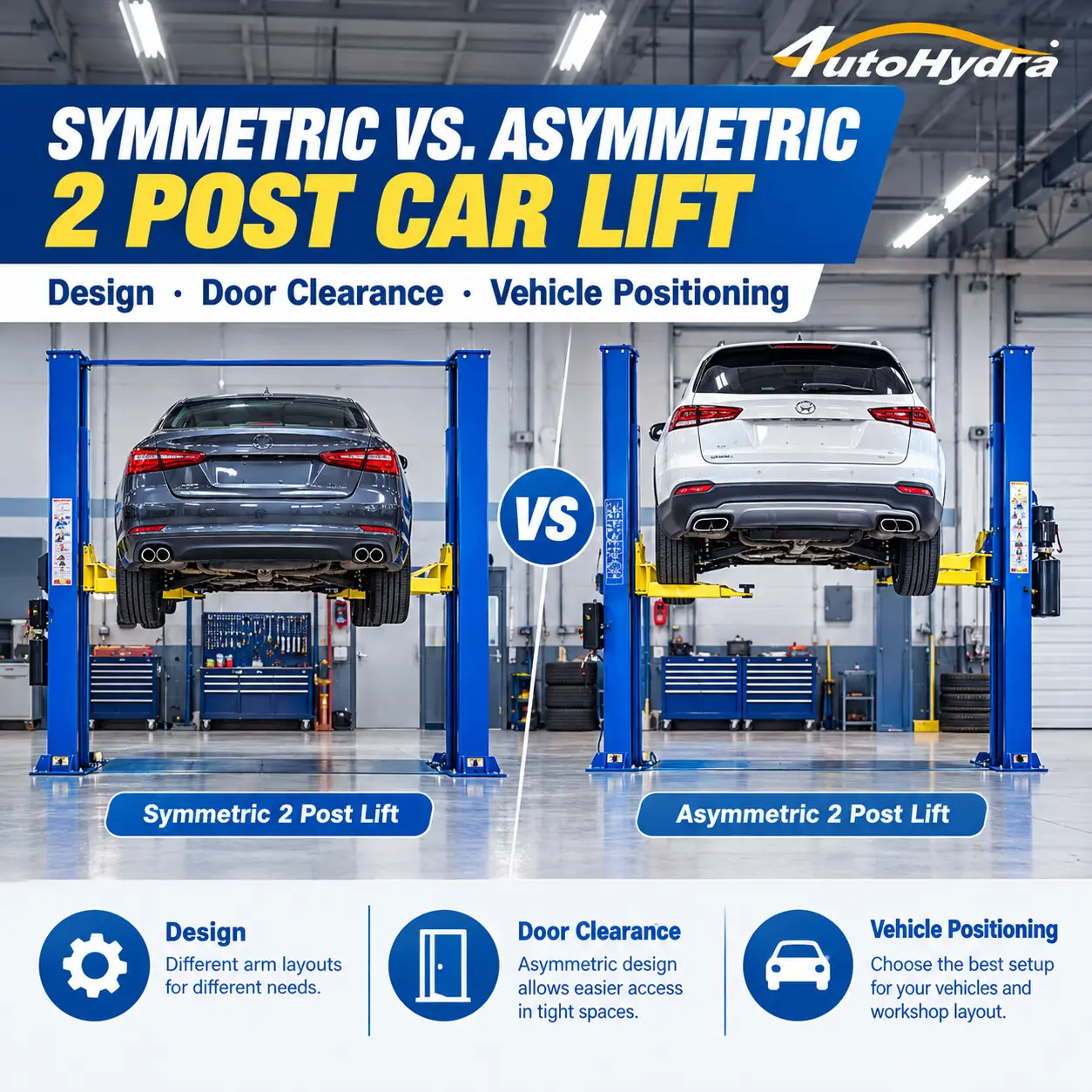
Symmetric vs. Asymmetric Arm Configurations
Two-post lifts are manufactured in two arm arrangements, and the distinction matters more than most buyers expect.
● Symmetric lifts use equal-length front and rear arms, positioning the vehicle centered between the columns. This configuration handles trucks, vans, and larger vehicles well, as their weight distributes naturally over a centered load point.
● Asymmetric lifts use shorter front arms and longer rear arms, rotating the vehicle slightly rearward of center. The practical benefit is significant: the driver's door can open fully without contacting the front column, which matters in high-volume service bays where technicians move in and out of vehicles constantly. Asymmetric lifts are the preferred choice for shops servicing a majority of passenger cars and crossovers.
When browsing Auto-Hydra's car lift inventory, pay attention to the arm configuration spec — it is listed for each model and directly determines how the lift fits into your bay layout.
How a 4 Post Car Lift Works
A four-post lift places four steel columns at the corners of a platform structure. Two steel runways bridge the front and rear crossbeams, forming a drive-on track the vehicle rolls onto under its own power. The platform rises as a unit, lifting the vehicle by its tires and wheels rather than by its frame contact points.
The fundamental difference in loading method shapes everything else about the four-post design. Because no arm positioning is required, any driver can load the vehicle quickly and without mechanical knowledge. The trade-off is that the vehicle's wheels rest on the runway surface — which restricts direct wheel and brake access unless an optional rolling bridge jack is added to the setup.
Optional Accessories That Expand 4 Post Capability
● Rolling bridge jack: A hydraulic floor jack that slides along the runways and lifts individual axles off the platform surface, restoring wheel access for brake and tire service.
● Alignment turnplates: Rotating plates installed in the runway surface that allow full four-wheel alignment work to be performed at height.
● Drip trays: Catch oil and fluid runoff from stored vehicles, protecting the shop floor and simplifying cleanup.
● Caster kit: Some four-post lift models support optional caster sets for repositioning the lift within the shop without anchoring.
2 Post vs 4 Post Lift: Full Specification Comparison
| Specification | 2 Post Lift | 4 Post Lift |
|---|---|---|
| Vehicle loading method | Manual swing arm positioning under lift points | Drive-on runways — no arm setup |
| Wheel access | Full — all 4 wheels free | Limited — bridge jack required |
| Undercarriage access | Complete — no obstruction | Complete — full view and reach |
| Best primary use | Mechanical repair, suspension, brakes, exhaust | Storage, alignment, inspection, detailing |
| Floor footprint | Compact — 2 anchor columns only | Larger — 4 columns + runway width |
| Minimum ceiling height | 11 – 12 ft recommended | 10 – 11 ft (varies by model) |
| Typical weight capacity | 7,000 – 12,000 lbs | 8,000 – 14,000 lbs |
| Long-term vehicle storage | Not recommended | Excellent — stable platform |
| Wheel alignment | Not suitable without add-ons | Yes — with alignment turnplates |
| Ease of loading | Requires arm setup per vehicle | Drive-on — fastest loading |
| Concrete requirement | 4 – 6 in., min. 3,000 PSI | 4 – 6 in., min. 3,000 PSI |
| Entry-level price range | $1,500 – $3,500 | $2,500 – $5,500 |
| ALI certification available | Yes — look for ALI-certified models | Yes — look for ALI-certified models |
Wheel and Undercarriage Access: The Most Important Difference
Of all the ways these two lift types differ, the question of wheel and undercarriage access is the one that most directly determines which lift belongs in your shop. It is worth going beyond the table and understanding exactly what each design allows and restricts in real service conditions.
What a 2 Post Lift Lets You Do
When a vehicle is raised on a two-post lift, all four wheels hang freely at whatever height the technician sets. There is no platform beneath the car, no runway surface under the tires, and nothing impeding access from any angle. A technician can remove a wheel in under two minutes, pull a caliper, replace rotors, service hub bearings, swap out struts, or drop a transmission without repositioning the vehicle or adding any secondary equipment. This open-platform design is why two-post lifts are the global standard in professional automotive service bays — they eliminate the most common access bottlenecks in repair workflow.
What a 4 Post Lift Requires for Wheel Work
On a four-post lift, the vehicle's tires rest on the steel runway surface. The undercarriage — exhaust system, oil pan, transmission, differentials, frame — is entirely visible and reachable. But the wheels and brake assemblies are on the platform. To remove a wheel or service brake components, a technician must either lower the vehicle onto jack stands or use a rolling bridge jack to lift an axle off the runways at height.
A good rolling bridge jack addresses this limitation effectively. But it adds cost (typically $300–$800 for a quality unit), requires a correct runway width match to the lift model, and adds a setup step each time wheel access is needed. For shops where brake and tire work represent a significant portion of job volume, this is a material workflow difference compared to a two-post lift.
⚙️ Workflow note: If your shop performs 10 or more brake jobs or tire services per week, the cumulative time difference between a two-post lift and a four-post lift with a bridge jack is measurable over a working month. High-volume repair shops almost universally use two-post lifts for this reason.
Floor Space and Garage Layout Requirements
The physical footprint of each lift type is a real constraint that many buyers underestimate until they measure their actual floor plan.
Two-Post Lift Space Requirements
A two-post lift's footprint is determined primarily by the column spacing, which typically ranges from 10 to 12 feet center-to-center for standard-width vehicles. Each column has a small base plate that requires solid concrete anchoring, but the total floor area consumed by the lift hardware is minimal. More importantly, there is no overhead structure extending forward or rearward of the vehicle — a technician can walk freely around all four sides of a raised car without obstruction. This makes two-post lifts the most space-efficient option for multi-bay shops.
Four-Post Lift Space Requirements
A four-post lift requires a substantially larger floor area. A typical residential-duty model occupies approximately 103 to 115 inches in width and 170 to 210 inches in length, depending on the runway length. The four corner columns and the structural crossbeams between them define a fixed zone on your shop floor that cannot be used for anything else. In a tight two-car garage, a single four-post lift may consume most of the available floor space when accounting for safe working clearance around the perimeter.
Ceiling Height: Both Types Have Real Requirements
Ceiling clearance requirements depend on both the lift's maximum rise height and the height of the tallest vehicle you plan to service. For two-post lifts, an 11-foot ceiling is the practical minimum for comfortable working height on passenger vehicles; 12 feet is preferred. For four-post lifts, the maximum platform height is generally lower, making 10 to 11 feet a workable minimum — but if you are storing an SUV or pickup on the upper level of a two-post storage scenario, calculate the total stacked height carefully before purchasing.
Weight Capacity and Vehicle Compatibility
Both lift types span a wide range of rated capacities, from light-duty residential models to heavy commercial equipment. Selecting the right capacity is not simply a matter of matching your heaviest vehicle — it is a matter of building in adequate safety margin.
The industry-standard recommendation is to choose a lift with a rated capacity at least 25 to 30 percent above your maximum expected vehicle weight. A lift operating at or near its rated limit experiences accelerated wear on hydraulic seals, structural welds, and safety lock mechanisms. The modest additional investment in a higher-capacity unit extends service life considerably and eliminates risk when heavier vehicles are brought in unexpectedly.
Capacity Guidance by Vehicle Type
● Passenger cars, compact sedans, and hatchbacks: 7,000 lb capacity is typically sufficient. Either lift type handles this vehicle class with ease.
● Crossovers, mid-size SUVs, and minivans: 9,000 to 10,000 lb capacity recommended. Asymmetric two-post lifts work well; wide-track four-post runways provide additional stability for wider vehicles.
● Full-size trucks and large SUVs: Minimum 10,000 lb capacity; 12,000 lb preferred. Wide-stance vehicles benefit from four-post lifts with extended runway width or heavy-duty two-post lifts with long arm adapters.
● Diesel pickups and dually trucks: 12,000 to 14,000 lb minimum. The wider track width of dually configurations requires careful arm or runway width verification before purchase.
● Classic and low-clearance vehicles: Low-profile adapter pads and low-entry ramps (for four-post models) are necessary. Confirm minimum approach clearance with the manufacturer before ordering.
Installation Requirements for Both Lift Types
Proper installation is the single most important factor in long-term lift safety. Both two-post and four-post lifts require a structurally sound concrete floor and correct anchor bolt placement. No amount of quality in the lift itself compensates for a compromised installation.
Concrete Slab Specifications
Most lift manufacturers specify a minimum slab thickness of 4 inches for light-duty residential lifts and 6 inches for commercial-grade equipment, with a minimum compressive strength of 3,000 PSI. If your garage floor does not meet these specifications — common in older residential builds — a concrete reinforcement pour may be required before installation. This is not optional: anchor bolt failure in an undersized slab is a well-documented cause of lift collapse.
Electrical Service
Hydraulic car lifts are powered by electric motors that drive the hydraulic pump. Most residential-duty models operate on 110V single-phase service; commercial models typically require 220V single-phase or 220V three-phase. Verify that a dedicated circuit of the correct amperage is available at the installation location before ordering. Running an extension cord to a car lift is not a compliant or safe practice.
Professional Installation
While experienced shop owners sometimes perform self-installation, professional installation is recommended for any car lift rated above 7,000 lbs. Certified installers verify level placement, confirm anchor torque specs, test hydraulic equalization, and conduct a load test before signing off — steps that directly affect your safety and, in most cases, your warranty coverage. Auto-Hydra's team provides support guidance for installation questions; reach out via the contact page before scheduling installation.
Safety Standards: What to Verify Before You Buy
A car lift is a life-safety device. Verifying the safety systems of any unit you consider is not a secondary concern — it is the primary due-diligence step that should precede any other evaluation.
Mechanical Safety Locks
Both lift types must incorporate automatic mechanical safety locks that engage at incremental height positions as the lift rises. These locks hold the lift in position independently of the hydraulic system, meaning a hydraulic seal failure does not result in the lift descending. The locks should engage audibly and positively at each notch, and the lift should not be able to descend from a locked position without a deliberate operator release. Never use a lift that lacks this feature regardless of price.
Hydraulic Synchronization (4 Post)
Four-post lifts rely on an equalization mechanism — cable, chain, or hydraulic circuit — to keep all four corners rising and falling at the same rate. A failed or worn equalization system can allow one side to rise faster than the other, tilting the platform and potentially unloading the vehicle. Inspect the equalization system during any pre-purchase demonstration and confirm it is inspectable and serviceable on the model you are considering.
Arm Locking Mechanisms (2 Post)
The swing arms of a two-post lift must lock firmly in their extended position under load. Arms that can rotate or retract while a vehicle is elevated represent an immediate hazard. Confirm that the lift model includes positive arm restraints, preferably with a physical pin or latch system in addition to friction-based resistance.
ALI Certification
The Automotive Lift Institute (ALI) independently tests and certifies car lifts that meet ANSI/ALI ALCTV safety standards for structural integrity, hydraulic performance, safety lock function, and labeling. ALI certification is recognized by insurance carriers, OSHA compliance programs, and commercial property assessors. When comparing models, prioritize ALI-certified units — the independent verification provides a level of confidence that manufacturer-only claims do not.
⚠️Safety reminder: Always consult the manufacturer's vehicle positioning instructions and load charts before raising any vehicle. Improperly positioned vehicles — those balanced over an arm adapter rather than a rated lift point — can shift or fall even on a properly functioning lift. Positioning errors are a leading cause of lift-related accidents in professional shops.
Cost Comparison: What to Budget for Each Type
Price transparency helps buyers avoid both overspending on unnecessary capacity and false economy on units that will fail to meet daily demands. The following ranges reflect the U.S. market as of 2025 for reputable manufacturer-direct and authorized distributor pricing.
Two-Post Lift Price Ranges
● Residential light-duty (7,000–8,000 lb): $1,500 – $2,800
● Professional mid-duty (9,000–10,000 lb): $2,800 – $4,500
● Heavy-duty commercial (12,000 lb+): $4,500 – $8,000+
● Professional installation (estimate): $300 – $800 depending on region and site conditions
Four-Post Lift Price Ranges
● Residential storage/light service (8,000–9,000 lb): $2,500 – $4,000
● Professional service (10,000–12,000 lb): $4,000 – $6,500
● Heavy-duty commercial (14,000 lb+): $6,500 – $12,000+
● Rolling bridge jack accessory: $300 – $800
● Alignment turnplates (pair): $150 – $500
For current pricing on specific models, browse the Auto-Hydra car lift collection, which offers manufacturer-direct pricing across both lift types with multiple U.S. warehouse locations to minimize shipping lead times.
Frequently Asked Questions: 2 Post vs 4 Post Lift
What is the main difference between a 2 post and 4 post car lift?
The primary functional difference is vehicle support method and wheel access. A two-post lift contacts the vehicle's frame or lift points, leaving all four wheels free in open air — ideal for repair and wheel service. A four-post lift supports the vehicle on drive-on runways, which provides stable storage and easy loading but restricts direct wheel access without an accessory bridge jack.
Which lift is better for a home garage — 2 post or 4 post?
It depends on your primary purpose. If you perform your own mechanical work — brakes, suspension, oil changes, exhaust — a two-post lift is the more versatile choice and takes up less floor space. If your main goal is storing a second vehicle overhead and performing light maintenance, a four-post lift is better suited. Many home enthusiasts with space for both eventually own one of each.
How much ceiling height do I need for a car lift?
For a two-post lift, a minimum clear ceiling height of 11 feet is standard, with 12 feet preferred for comfortable working clearance on taller vehicles. For a four-post lift, 10 to 11 feet is the practical minimum for passenger cars. If you plan to stack vehicles — raising one vehicle to store another beneath — calculate the combined heights of both vehicles plus the lift platform height and confirm the total fits within your available ceiling clearance.
Do I need a rolling bridge jack with a 4 post lift?
If you intend to perform brake service, tire rotations, or wheel bearing work at height, yes — a rolling bridge jack is a practical necessity. Without it, you must lower the vehicle and work at floor level, which largely defeats the purpose of having the lift elevated. For storage-only use or basic undercarriage inspection, a bridge jack is not required.
What concrete thickness is required for installing a car lift?
Most manufacturers specify a minimum of 4 inches of concrete at 3,000 PSI compressive strength for residential-duty lifts, and 6 inches or greater for commercial models. Always verify the specific requirements in the installation manual for your chosen model before ordering. Installing a lift on undersized concrete is unsafe and will void the warranty on virtually all major brands.
Can a 4 post lift be used without permanent floor anchors?
Some four-post lift models are available with optional caster kits that allow repositioning without permanent anchoring, marketed for use in home garages or facilities where drilling is not permitted. However, these configurations typically carry lower weight ratings and are suitable only for light storage use — not for active service work. For any professional repair application, permanent anchor bolts are required.
What is ALI certification and why does it matter for car lifts?
ALI (Automotive Lift Institute) certification means the lift has been independently tested and verified by a third-party laboratory against ANSI/ALI ALCTV safety standards. Certification covers structural load capacity, hydraulic performance, safety lock function, and labeling accuracy. For commercial shops, ALI certification is frequently required by liability insurance carriers and may be referenced in OSHA compliance guidelines. It is the most reliable independent quality indicator available when comparing car lift models.
How long does a car lift last?
A properly installed and maintained car lift from a quality manufacturer typically has a service life of 20 to 30 years. Hydraulic seals and fluid are the primary consumable components and should be serviced on a regular schedule. Structural components on certified lifts are designed for multi-decade service under rated loads when anchor integrity is maintained and the lift is not overloaded.
Find the Right Car Lift for Your Shop
Auto-Hydra carries professional-grade 2 post and 4 post car lifts at manufacturer-direct pricing, backed by multiple U.S. warehouse locations, dedicated technical support, and a clear warranty program.
Browse Car Lifts Talk to a Lift Specialist View Warranty Policy
Recommended News
View all