Hydraulics Raise It, Steel Holds It: The Mechanical Car Lift Explained
Summary
Search for any car lift and the listing will tell you the motor's horsepower, the lifting speed, and the capacity in pounds. What it rarely explains is the part that actually matters once the vehicle leaves the ground: the mechanical system that holds it there. Hydraulics do the lifting, but steel does the holding — and understanding that division of labor is the difference between buying a machine and trusting one.
This article is written from the perspective of the people who spec, test, and field-support these machines. We will walk through every load-bearing mechanical component in a typical mechanical car lift — lock ladders, pawls, lift chains, equalizer cables, and the manual release — explain what each one does, how it fails, and how to inspect it. No marketing gloss, just the mechanics.
📌 Short version: a hydraulic cylinder raises the carriage, but a steel pawl dropped into a lock ladder is what keeps your car in the air. The chain or cable that pulls the carriage up is a lifting member; the lock is a holding member. They are inspected differently, and they fail differently.
Not Sure Which Mechanical Car Lift To Trust?
Review lock type, release design, lifting member, and test margins in Auto-Hydra's two-post car lift lineup.
👉 Explore Two-Post Car Lift Solutions1. What "Mechanical" Actually Means in a Car Lift
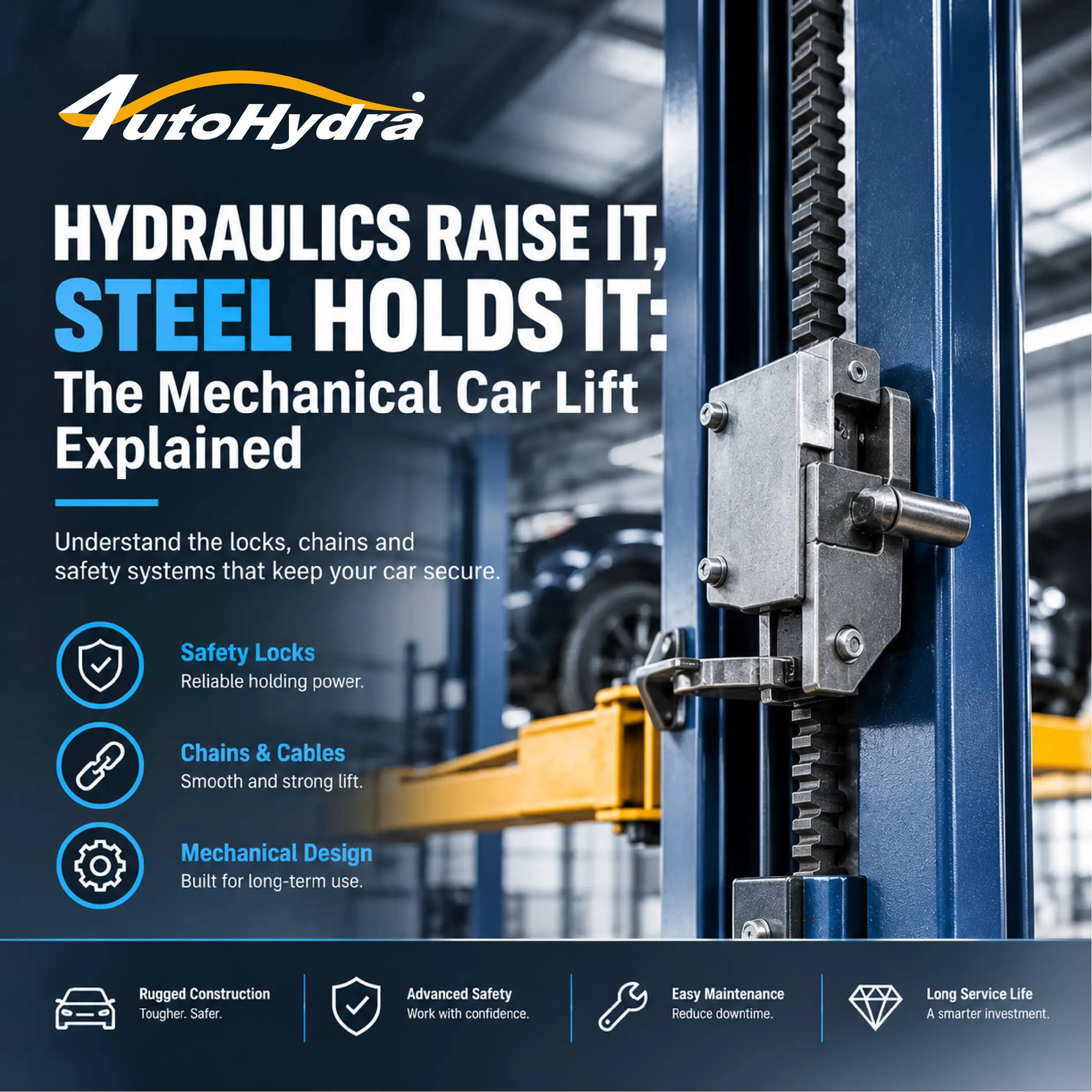
The phrase mechanical car lift causes confusion because almost every modern two-post and four-post lift uses a hydraulic cylinder as its source of force. The "mechanical" part is not about how the lift goes up — it is about how the lift stays up. Once the carriage reaches a working height, a mechanical locking device takes the entire load off the hydraulic circuit and carries it in steel.
That distinction is not a technicality; it is the core safety architecture of the machine. Hydraulic systems hold pressure only as long as every seal, hose, and fitting remains perfect. A mechanical lock does not care about seal condition. A pawl engaged in a ladder rung is a physical interference — metal against metal — and it will hold the load even if the hydraulic system loses every drop of fluid.
The two jobs inside every lift, kept strictly separate
● Lifting duty — the cylinder, chain, and cables that convert motor power into upward motion; loaded only while the lift is moving.
● Holding duty — the lock ladder, pawl, and latch mechanism that carry the parked load; loaded the entire time the vehicle is in the air.
● Release duty — the manual release that disengages the locks so the lift can descend; the one mechanism that must work perfectly every single cycle.

When a buyer asks whether a lift is "hydraulic or mechanical," the honest answer is: both, doing different jobs. The quality of a mechanical car lift is determined by how generously each of those three systems is built, and how well they are maintained.
2. The Lock Ladder and Pawl: The Click You Hear Is Doing the Work
Raise a two-post lift and you hear a rhythmic clicking from each column. That sound is the pawl — a spring-loaded steel lever — riding over the teeth of the lock ladder as the carriage climbs. The moment the lift stops rising, the pawl drops into the nearest tooth notch under gravity and spring force, and the carriage can no longer move down.
Two design details decide whether that click is trustworthy. First, engagement must be gravity-assisted: the pawl drops into place by its own weight plus spring assist, so it engages even if the operator does nothing. Second, the lock spacing — the distance between teeth — determines how far the carriage can settle before the pawl catches. Shorter spacing means the vehicle rests closer to the height you intended, and the drop onto the lock is gentler on the structure.
The failure modes are equally specific. A pawl spring that has lost tension can let the pawl rest half-engaged on a tooth tip. Dirt and dried grease in the ladder channel can slow the pawl's drop. And a lock that was bent by an overloaded or off-center lift will never seat fully again. All three are visible in a thirty-second inspection — which is exactly why they are on every professional inspection checklist.
⚠️ Rule of the trade: if the lift does not click, it does not hold. A carriage parked between locks is parked on hydraulics, and no technician should ever work under it.
3. Chain vs. Wire Rope: How the Carriage Gets Pulled Up
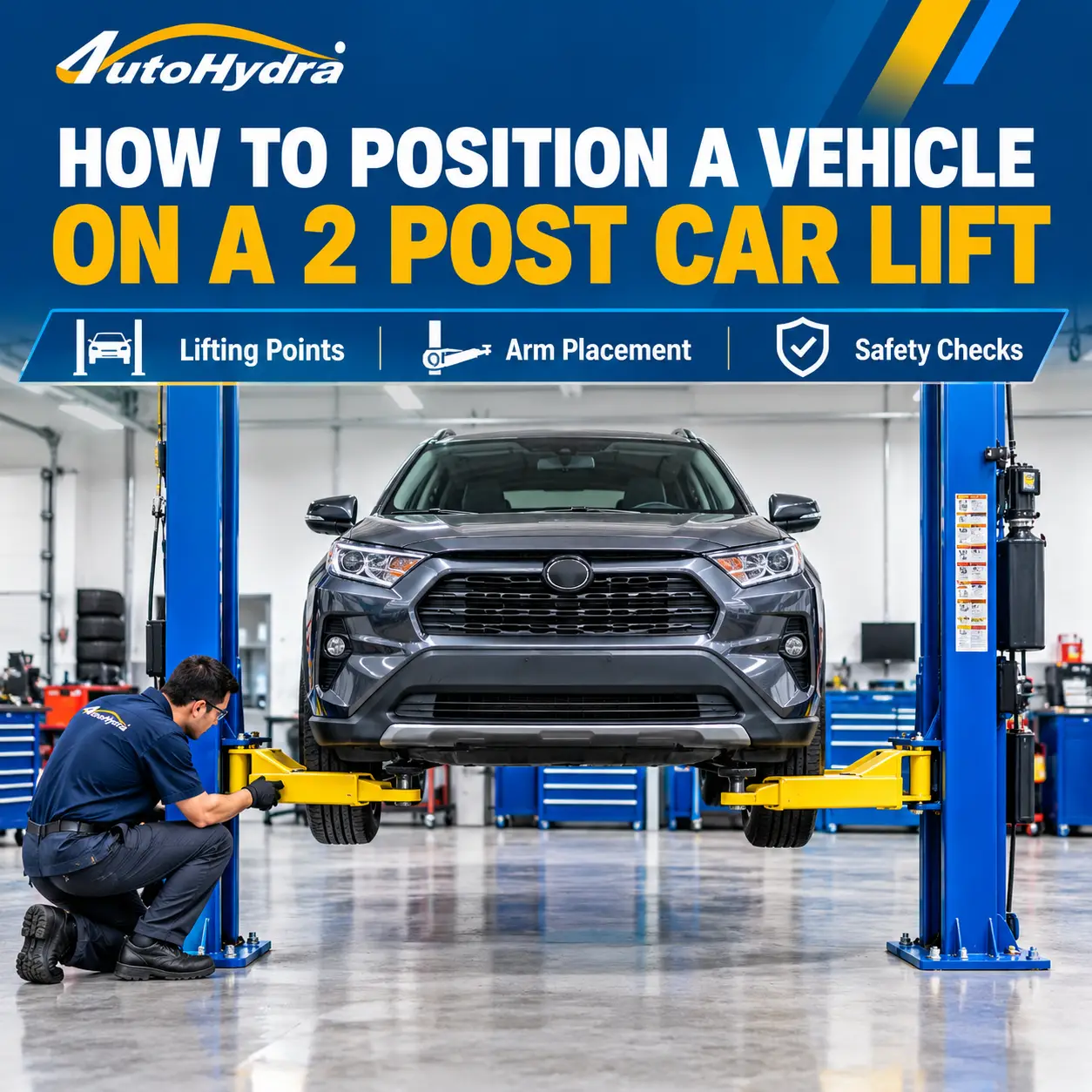
Inside each column of a two-post lift, the hydraulic cylinder does not push the carriage directly. It pulls a chain — or, on some designs, a wire rope — that runs over a sheave at the top of the column and connects down to the carriage. This arrangement multiplies the cylinder's travel and keeps the lifting member in pure tension, which is the strongest way to load steel.
Chain drive is the workhorse of the category. A properly lubricated lift chain stretches slowly and predictably over years, gives visible warning long before it becomes a problem, and tolerates the dirty, high-load environment inside a column. Wire rope equalizer cables serve a different job on most two-post designs: they tie the two carriages together so they rise level, and they act as the secondary suspension if the primary path ever went slack.
You can see both systems specified side by side on a production model. The 10,000 lb chain-drive lift pairs a chain-type lifting system with steel wire rope equalizing cables, and its listing spells out the holding side of the architecture too: a mechanical locking system with safety latches in each column and a single-point manual safety unlock. It is CE certified, load-tested to 115 percent dynamic and 150 percent static capacity, and carries a 36-month parts replacement term — a useful benchmark for what a complete mechanical package looks like at the 10,000 lb class.
The maintenance implication is simple and non-negotiable: chains and cables are consumables in the truest sense. They are cheap relative to everything else on the lift, and they give the owner every opportunity to replace them on schedule. A stretched chain that jumps a sprocket tooth, or a frayed equalizer cable, is always an ownership failure, never a surprise.
4. The Manual Release: One Motion, Done Right
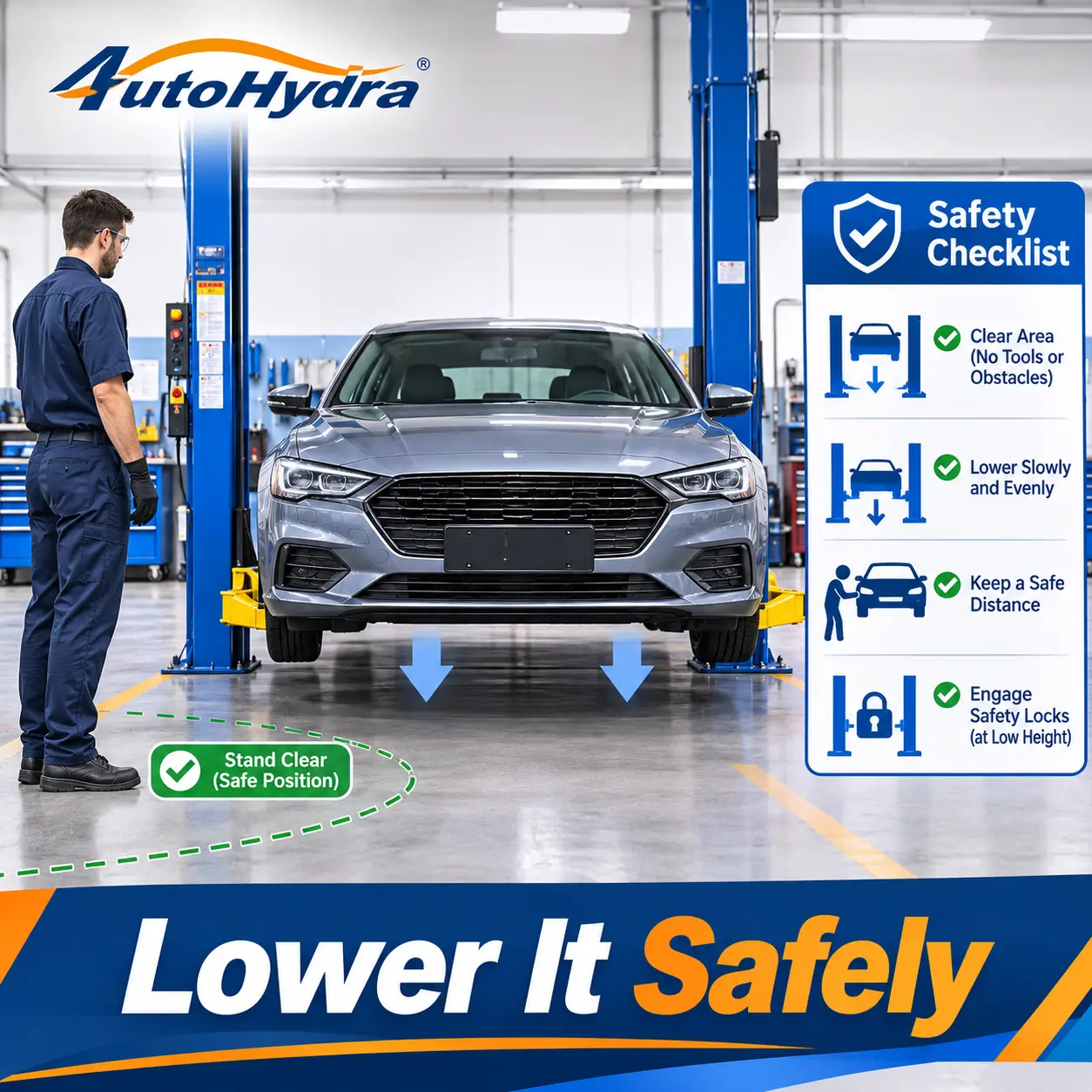
Every mechanical lock needs a way to let go, and that job belongs to the manual release. On descent, the operator raises the lift slightly to unload the pawls, pulls the release, and lowers. The design question is where that release lives and how many motions it takes.
Two-post designs split into two camps. Per-column releases put a lever or cable at each column; the operator must confirm both sides are free before lowering, which is safe but slow and easy to do halfway. Single-point releases run one cable from a reachable position to both columns, so one pull frees both locks and — just as importantly — one check confirms the whole system. Shops that lower vehicles dozens of times a day overwhelmingly prefer single-point, because a release that is quick to check actually gets checked.
Higher-end clear-floor designs take the redundancy approach. The 12,000 lb clear-floor lift provides a manual safety release on both sides of the machine, so the locks can be verified and freed from whichever column the operator is standing at. The same listing reads like a tour of mechanical safety hardware: dual hydraulic chain-drive cylinders, symmetric arms, an overhead safety shutoff bar that stops upward travel before the carriage reaches the top works, and foot-protection guardrails at the base. CE certified, tested to 115 percent dynamic and 150 percent static load.
One inspection habit covers almost every release failure: after any descent, watch the pawls re-engage on the next ascent. A release cable that is routed too tight will hold the pawls slightly open, and the lift will climb without clicking. Silent ascent means the locks are not engaging, full stop.
5. Mechanical Hold vs. Hydraulic Hold: Why It Decides Where You Stand
Here is the comparison that matters in daily use. A carriage resting on its mechanical locks is supported by steel that cannot creep, cannot leak down, and does not depend on any seal in the system. A carriage held by hydraulic pressure alone will settle as fluid migrates past seals — slowly on a healthy lift, quickly on a tired one — and it has no backup if a hose fails.
⚠️ The rule is absolute: never work under a vehicle supported by hydraulics alone. Raise, settle onto the locks, and confirm engagement on both sides before anyone puts any part of their body under the vehicle. This is not a recommendation; it is the operating discipline that every lift standard and every shop insurer assumes.
Four-post lifts apply the same principle at a larger scale. Because the vehicle sits on runways rather than hanging from arms, the lock set carries the load in a different geometry, and on storage-oriented machines the locks spend far more time loaded — days or weeks at a stretch — than they do on a service lift that cycles hourly.
The 15,000 lb 4-post lift illustrates that duty well: a 92.52-inch maximum lifting height built for parking one vehicle above another, a 6,000 lb rolling jack included so the upper vehicle's wheels can still be serviced, and alignment turntables for shops that want the runway to do double duty. When a lift is asked to hold a car for a week, the mechanical lock set is the entire story — which is why long-duration parking is exactly where lock condition deserves the most attention.
Which architecture fits your bay is a separate question with its own trade-offs, and our 2-post vs 4-post guide compares them across access, stability, storage, and cost. For this article the point is narrower: whichever layout you choose, confirm what its locks look like and where its release is before the lift is ever loaded.
6. The Four Mechanical Systems at a Glance
What holds the car, what to check, and how each system warns you before it fails
| Mechanical system | Job it does | What to check | Warning signs |
|---|---|---|---|
| Lock ladder and pawl | Catches and carries the parked load at each stop | Pawl tip wear, spring tension, full engagement at working height | Missing clicks, carriage drifts down, half-engaged pawl |
| Lift chain | Transfers cylinder force to the carriage on ascent | Link wear, stretch over sprocket, lubrication, anchor pins | Squeal under load, visible stretch, rust or dry links |
| Equalizer cable | Keeps both carriages level and provides secondary suspension | Tension balance side to side, broken strands, sheave condition | Carriage tilts, slack cable, fraying at fittings |
| Manual release | Disengages the locks for controlled descent | Cable routing and tension, lever return, full disengagement | Lift will not lower, pawls held partly open, silent ascent |
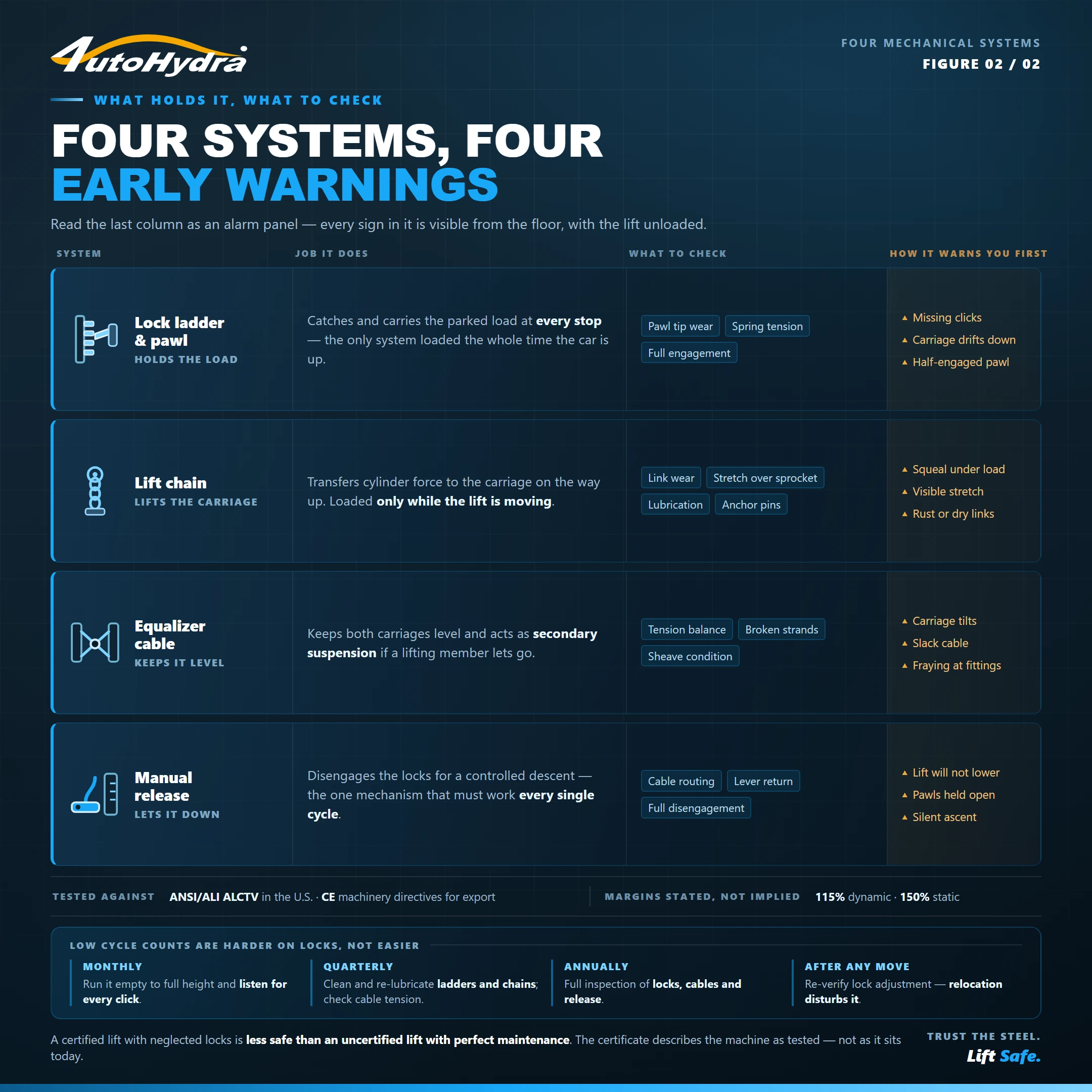
Read the warning-sign column as an early-alarm system. Every entry in it is observable from the floor with the lift unloaded, and every one of them appears weeks to months before the corresponding component would become a safety problem. That lead time is the entire point of inspection.
7. Low Cycle Counts Are Harder on Locks, Not Easier
A home garage lift may run twenty cycles a month where a shop lift runs forty a day, and the intuitive assumption is that less use means less maintenance. The mechanical reality is the opposite. Idle mechanisms collect dust, lubricant migrates off chain links, pawl springs sit in one position for weeks, and a half-engaged lock can go unnoticed simply because nothing exercises the system between uses.
🔧 The practical schedule: monthly, run the lift empty through its full height and listen for every click on the way up; quarterly, clean and re-lubricate the lock ladders and chains and check cable tension side to side; annually, do a full lock-engagement and release-function inspection the way a professional installer would.
That last item matters more than it sounds, because lock adjustment is set at installation and disturbed by anything that moves the columns — settling anchors, an impact, a relocation. If the lift was ever moved or bumped hard, inspect the locks before the next loaded use rather than waiting for the annual date.
If you are setting up a lift for the first time, lock testing belongs to the installation sequence itself, and our car lift installation guide walks the full order of operations — anchoring, plumbing, electrical, then the no-load test where lock engagement, cable tension, and synchronization get verified before any vehicle is lifted.
8. Standards, Certification, and What the Percentages Mean
Mechanical holding systems are exactly what third-party lift standards exist to verify. In the United States, automotive lifts are tested against ANSI/ALI ALCTV, the safety standard administered by the Automotive Lift Institute, and ALI's ALOIM document sets the ongoing inspection and maintenance expectations for lifts in service. When a lift carries ALI certification, its structural and locking systems have been load-tested against defined criteria by an independent body.
European-market and export machines carry CE marking under the applicable machinery directives, and the test figures quoted in product literature trace back to the same idea: prove the machine beyond its nameplate. The 115 percent dynamic figure means the lift raised and lowered an overload while every lock and cable did its job; the 150 percent static figure means it held an overload at rest without structural distress. Those margins exist precisely because the mechanical parts — not the hydraulics — are what stand between the vehicle and the floor.
🛡️ Buy the certification, then keep it honest: a certified lift with neglected locks is less safe than an uncertified lift with perfect maintenance. The certificate describes the machine as tested; inspection describes the machine as it stands in your garage today.
On the operating side, OSHA's general machine-guarding requirements at 29 CFR 1910.212 place responsibility for safe equipment condition on the employer — and the same duty of care applies to a household that invites friends or employees under a lifted vehicle. In practice that means documented lock checks, a release procedure every operator actually follows, and zero tolerance for working under a hydraulically-held load.
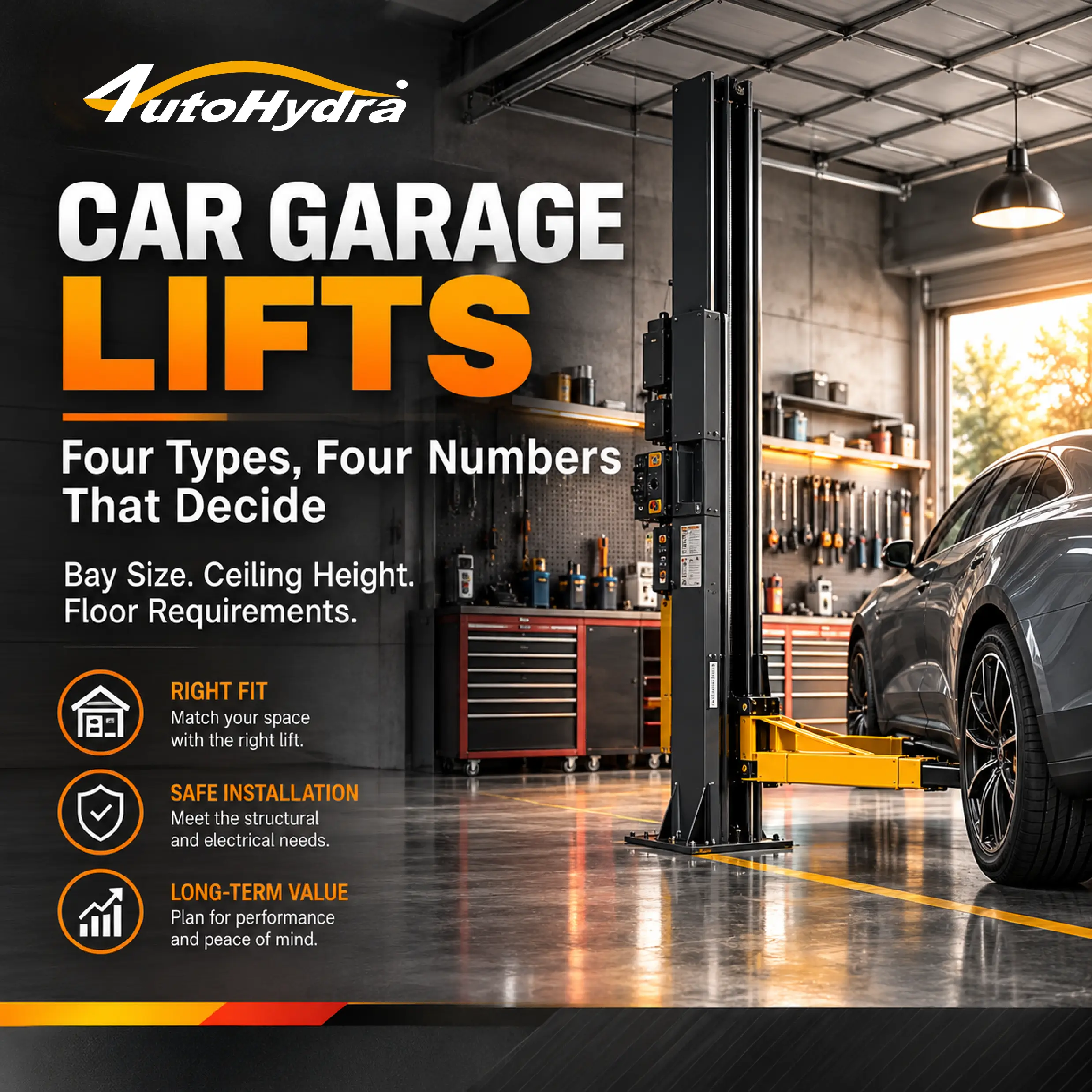
9. Choosing a Mechanical Car Lift: What to Look for on the Spec Sheet
Once you can read the mechanical architecture, comparing lifts becomes straightforward. Ignore the horsepower race and interrogate the holding system instead — it is the part you will depend on every single day.
The mechanical checklist, in order of importance
● Lock type and engagement — gravity-drop pawls into a ladder, engaged automatically on every stop; ask how many lock positions the travel provides.
● Release design — single-point or per-column, and whether you can verify full engagement from the operator's normal standing position.
● Lifting member — chain drive with serviceable anchors; on two-post designs, confirm the equalizer cable arrangement and whether slack detection is fitted.
● Certification and test margins — CE or ALI certification, with the 115 percent dynamic / 150 percent static test figures stated, not implied.
● Parts horizon — a stated parts replacement term, because the first things to wear on any lift are the mechanical and electrical consumables, not the steel.
Not every lifting job needs columns at all. For quick tire rotations on a driveway or a tight bay, a compact mechanical lifting device can cover the task without an installation project.
The portable tire service lift is that middle option: a mini side lift built for quick tire changing, small enough to store on a wall and priced like an accessory rather than a machine. It will not replace a full-height two-post for underbody work, and it is not meant to — its job is to lift one corner safely and mechanically, without a slab requirement or a dedicated circuit.
The through-line of this whole article is short enough to memorize: force comes from the hydraulics, safety comes from the steel. Buy the lift whose steel you can inspect, understand, and maintain — and then actually maintain it.
Frequently Asked Questions
Is a mechanical car lift safer than a lift that holds hydraulically?
Yes, and the comparison is not close. A mechanical lock carries the load in steel with no dependence on seals, hoses, or fluid condition, and it cannot creep or leak down. Hydraulic holding should be treated as a temporary state during positioning, never as the parked condition of a loaded lift.
What does the clicking sound mean when my lift goes up?
Each click is the pawl passing a tooth on the lock ladder. When the lift stops, the pawl drops into the nearest notch and holds the carriage. If the lift ascends silently or the clicks sound uneven between columns, stop and inspect the lock engagement before loading the lift again.
How often should locks, chains, and cables be inspected?
For a home lift, a monthly no-load run to listen for lock engagement, quarterly cleaning and lubrication of ladders and chains, and an annual full inspection of locks, cables, and release function is a sound baseline. Follow the lift manufacturer's schedule and ALI ALOIM guidance where they are stricter, and inspect after any impact or relocation.
Can a mechanical car lift hold a vehicle for weeks at a time?
Yes — parked on its locks, a lift is designed to hold indefinitely, which is why four-post parking lifts store cars seasonally. Confirm both sides are fully engaged before leaving the vehicle, keep the area under the carriage clear, and re-check lock condition if the lift sits unused for long stretches between loads.
What happens if a lift chain breaks?
On a properly maintained lift it almost never does, because chains stretch and wear visibly long before failure and are inexpensive to replace. If a lifting member did fail, the carriage would drop to the nearest lock position on the ladder — the mechanical lock is the backup the design relies on. That is precisely why lock condition must be verified on its own schedule, independent of the chain.
Trust the Steel: Find Your Mechanical Car Lift
Every lift in the Auto-Hydra catalog lists its locking system, lifting member, and test certification on the product page, so you can compare the holding system — not just the horsepower — before you buy.
✔ Factory-direct pricing · ✔ 20+ years in lift manufacturing · ✔ In-stock U.S. warehouses · ✔ Lifetime technical support
Recommended News
View all