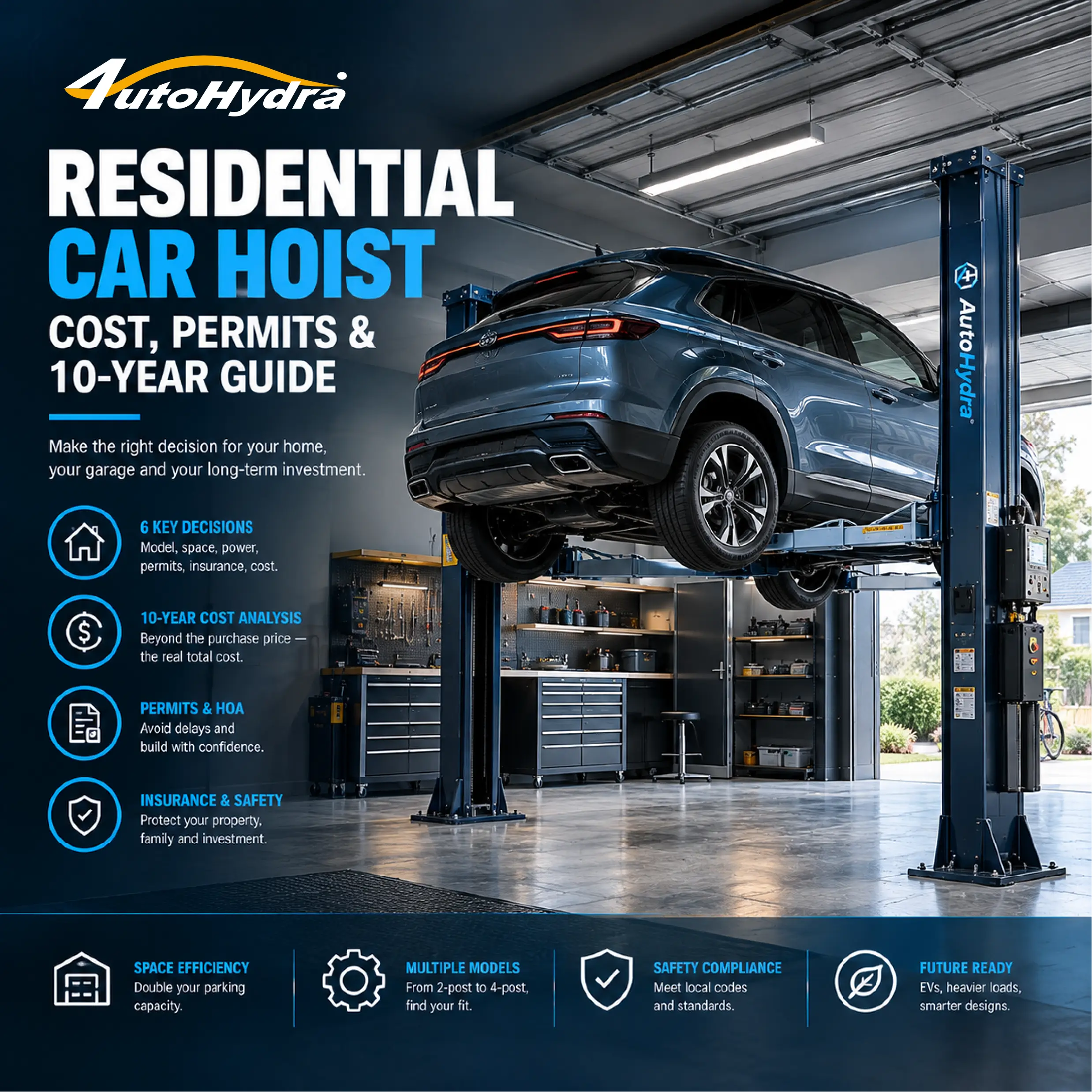
Residential Car Hoist: 6 Decisions Showrooms Never Mention
Summary
A residential car hoist is not a workshop gadget. It is a permanent change to your property’s structure, electrical capacity, insurance policy, and the way your household uses the garage. Most buying guides stop at “which model fits my ceiling” and skip the part that actually determines whether the purchase pays off: the ten years that follow installation.
This guide is written by Auto-Hydra’s residential lift advisory team for U.S. homeowners who have moved past the model-shopping stage and into the harder question — is this the right addition for my property, my family, and my budget? We cover the six decisions only a homeowner faces, the true ten-year cost of ownership (including the line items nobody quotes), the permit and insurance conversations most buyers discover too late, and how a residential hoist behaves when it runs ten cycles a week instead of twenty cycles a day.
1. What Makes a Hoist “Residential”? Not Capacity — Duty Cycle and Ownership Path
Homeowners routinely assume that a residential car hoist is simply the smaller, cheaper version of a commercial lift. That framing leads to the wrong purchases. The real dividing line is not lifting capacity — a 12,000 lb four-post parking hoist sold for home garages is a residential product through and through.
📌 Four criteria separate residential from commercial equipment:
● Duty cycle: residential units are typically rated near 20% of a ten-minute window; commercial units sit at 50% or higher. A home hoist that runs four cycles a morning never touches its thermal limit.
● Inspection obligation: commercial bays carry a documented annual inspection under ANSI/ALI ALOIM and OSHA. At home, the schedule is yours to set — and yours to neglect.
● Ownership path: a home hoist is a property fixture you finance, insure, and eventually sell with the house. A commercial hoist is plant equipment on a depreciation schedule.
● Power and crew: residential installs almost always run single-phase 110V or 220V and are handled by the owner plus a hired installer — not a maintenance department.
Understanding that difference reframes the purchase. You are not shopping for lifting force. You are shopping for a decade of safe, self-managed use inside a building you already own.
2. Four Household Use Cases — and What Each Really Asks of You
Residential hoist purchases are driven by household motivation, not by specification charts. Each motivation carries a different hidden workload.
🏠 Use case 1: Vertical vehicle storage for a two-car household
The most common residential motivation in the U.S. is not repair work — it is reclaiming floor space. A four-post runway hoist lets one vehicle park above another in the same footprint. The workload here is almost zero: drive on, raise, lock, walk away.
The 12,000 lb 4-post parking hoist is purpose-built for this — 86.9 inches of rise, 112.81 inches of clearance between columns, pneumatic unlocking so the release is a single action, four mechanical locks, and a secondary slack-cable safety system that engages automatically if a cable ever fails. It is CE-certified and load-tested at 115% dynamic and 150% static capacity, which is the documentation an insurer will actually want to see. For a household buying storage rather than service, that is the correct architecture.
🛠 Use case 2: Routine DIY maintenance
Oil changes, brake pads, tire rotations, underbody inspection — the homeowner who does their own work needs wheels-free access, not a full commercial bay. A four-post hoist alone only gets you a creeper. The decisive accessory is the rolling jack that sits on the runways and lifts by the frame.
The 4-post hoist with rolling jack arrives configured for exactly this household — 79 inches of standing clearance, full height in about 50 seconds, and a 7,000 lb jack integrated into the package. If you already own a runway hoist and want to convert it, the rolling bridge jack adds wheels-free lifting with three locking height positions and a 6.3-inch lowered pad that still fits under a low-slung car.
🔧 Use case 3: Full undercarriage access
A homeowner who intends to drop a transmission or replace exhaust components eventually needs a two-post architecture. Here residential buyers face a genuine constraint: a typical two-post wants twelve feet of ceiling, which most home garages do not have. Lower-rise two-post designs are the honest answer.
The AM120SD 2-post hoist is a realistic residential candidate precisely because its rise tops out at 70.87 inches and its collapsed height is just 4.25 inches. That lower working height is a limitation in a commercial bay and an advantage in a home garage — it is the difference between fitting under a residential ceiling or not.
⚡ Use case 4: Servicing an electric vehicle at home
EV owners face a constraint gasoline owners do not: the battery pack occupies the underbody, so lift points move and require adapter pads. For households uncertain about their own EV lift-point data, a four-post runway hoist is the conservative choice — it lifts by the tires and never contacts the frame at all.
3. Six Decisions Only a Homeowner Faces
Commercial buyers argue about duty cycle and throughput. Homeowners argue about garage doors and family members. These six items decide whether a residential hoist installation goes smoothly or becomes an expensive retrofit.

(1) The garage door — not the ceiling — is the real obstruction
Homeowners measure the ceiling height and stop there. The volume a hoist actually competes for is occupied by the door’s torsion spring, the opener rail, and the curved door track. A high-lift door conversion is a real cost line, and it must be priced before the hoist is ordered.
(2) The electrical panel, not the outlet, is the constraint
A 220V single-phase hoist needs a dedicated circuit and spare breaker capacity. Older residential panels are frequently full. Have an electrician confirm available amperage before purchase — panel upgrades run well beyond the cost of the hoist’s wiring.
(3) The slab you did not pour
Existing residential garage slabs are often four inches, sometimes less, and occasionally post-tensioned. Core-drill a test hole and confirm thickness and PSI. A four-post runway hoist distributes load across four base areas and tolerates a thinner slab; an anchored two-post does not.
(4) The HOA and the neighbor
Some associations classify a vehicle-stacking hoist as prohibited storage equipment. Read the covenant before you buy, not after. Neighbor notification also matters where a raised vehicle is visible above a fence line.
(5) The household itself
Kids, pets, and visiting adults will find the controls. A residential hoist needs a control location that is physically out of reach when not in use, and an operating rule the whole household understands.
(6) The exit plan
Ask before you buy: can this be removed if I sell, and will the next owner want it? An anchored installation becomes part of the property; a caster-mounted runway hoist can leave with you. That answer changes what you should buy.
4. Matching the Household Use Case to the Right Architecture
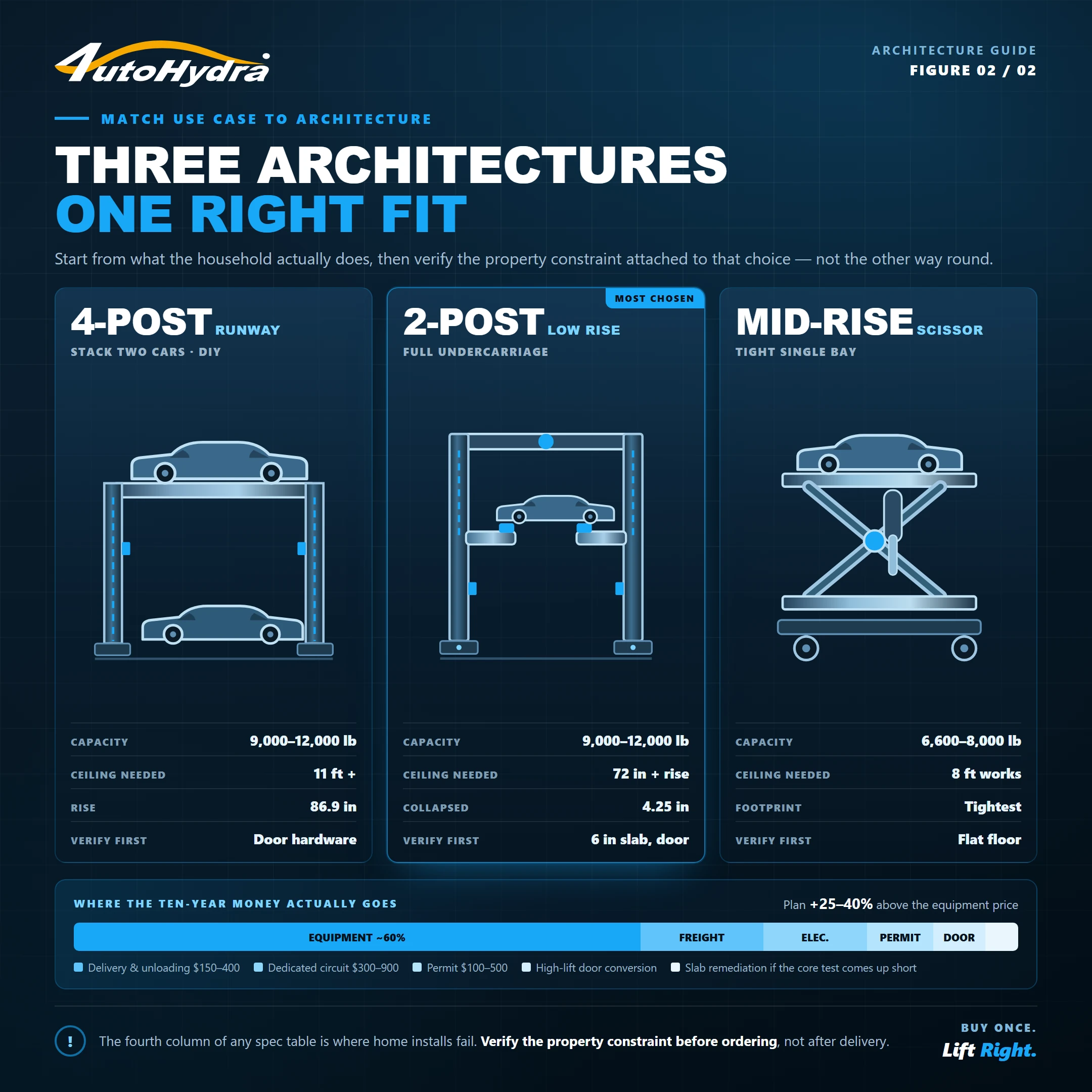
Start from what your household actually does, then verify the property constraint attached to that choice. The table below is organized by use case rather than by specification, because that is how home purchases are actually decided.
| Household Use Case | Architecture | Typical Capacity | What You Must Verify |
|---|---|---|---|
| Stacking two vehicles | 4-post runway hoist | 9,000–12,000 lbs | Ceiling 11 ft+, door hardware |
| DIY maintenance | 4-post + rolling jack | 12,000 lbs + 7,000 lb jack | Standing clearance, jack fit |
| Full undercarriage work | 2-post (lower rise) | 9,000–12,000 lbs | 6 in slab, 72 in+ rise, door track |
| Collector rotation | 4-post parking hoist | 10,000–12,000 lbs | Drive-through length, drip trays |
| Tight single bay | Mid-rise scissor | 6,600–8,000 lbs | Flat floor, no ceiling obstruction |
📊 Table: Residential use case mapped to hoist architecture. The fourth column is where home installations fail — verify it before ordering, not after delivery.
5. The Ten-Year Cost of Ownership Nobody Quotes
Sticker price is roughly two-thirds of what a residential car hoist actually costs in year one, and it says nothing about the following nine years. Here is the full picture for a typical U.S. home installation.
💰 One-time costs beyond the hoist:
● Delivery and unloading: freight arrives on a truck that requires forklift unloading. Liftgate service or a rental forklift is a real line item, frequently $150–$400.
● Electrical work: dedicated circuit and breaker, typically $300–$900 depending on panel capacity.
● Slab remediation: if the test hole comes up short, a reinforced pad pour can add four figures.
● Permit fees: varies by jurisdiction, commonly $100–$500 where a permit is required.
● Door conversion: high-lift track and opener relocation where ceiling clearance is marginal.
Recurring costs across ten years:
● Hydraulic oil and filter changes on a low-cycle unit: usually two to three services total, not annual ones.
● Seals, hoses, and equalizing cable tension adjustment: the wear items that actually consume budget.
● Insurance rider: a modest annual addition to a homeowners policy, or a separate scheduled item.
● Your own inspection time: an hour a year, plus a documented record you will want at resale.
⚠️ Budget 25–40% above the listed price for a residential installation, and treat that range as a planning number rather than a worst case. The homeowners who end up unhappy are almost never the ones who paid too much for the hoist — they are the ones who did not price the door, the panel, and the unloading.
6. Household Safety: Managing a Lift Around a Family
Commercial risk management assumes trained technicians and posted signage. Residential risk management assumes children, pets, and a brother-in-law who wants to borrow the garage. The hoist itself is not the hazard — unsupervised access is.
🛡 Practical controls for a home installation:
● Locate the control box so it cannot be reached from floor level when the unit is parked; a keyed or lockable switch is a small cost with outsized value.
● Establish one household rule in plain language: nobody raises the hoist without a second adult present, ever.
● Never allow work under a vehicle unless the mechanical locks are fully engaged — hydraulic pressure alone is not a holding device.
● Keep the carriage lowered when the hoist is not in use; an elevated vehicle invites climbing.
● Store nothing on the runways or platforms that could fall during a cycle.
⛔ Two things a homeowner should never do:
● Never modify the structural components, anchors, or safety lock geometry. Any load-path change voids certification and your insurer’s comfort.
● Never lift a vehicle beyond the rated capacity “just this once.” Residential margin exists precisely for the day you misjudge a load.
7. Permits, HOA, and Insurance: The Three Conversations to Have First
These three conversations cost nothing and prevent the two most common residential outcomes: an order that has to be cancelled, and a claim that gets denied.
The building department
Requirements vary widely. Some jurisdictions treat an anchored hoist as a structural alteration requiring a permit and inspection; others do not regulate it at all but still expect the electrical work to be permitted. Ask the specific question: “Does a vehicle lift in a private residential garage require a permit here?” Get the answer in writing.
The HOA
Read the covenant sections on vehicle storage, structures, and prohibited equipment. Where stacking hoists are restricted, the restriction usually applies to vehicles stored at height, not to the equipment itself — which changes how you use the machine, not whether you can own it.
The insurer
Call your homeowners carrier before installation and describe the equipment plainly: permanently installed, anchored or caster-mounted, certification held. Many policies cover it as an appurtenant structure or scheduled item; some require third-party certification such as ALI. Keep the certificate, the manual, and dated installation photos — they are what an adjuster will ask for.
8. Does a Residential Car Hoist Add Property Value?
Honest answer: usually not dollar-for-dollar. This is the section commercial-leaning content tends to skip, and homeowners deserve it stated plainly.
● A hoist is a use-value purchase. The return arrives as capability and floor space, not as appraisal line items.
● A buyer who wants a lift may pay a modest premium; a buyer who does not may see it as a liability to remove. Both are common.
● Anchored installations become part of the property and generally convey with the sale — which creates a disclosure obligation in most U.S. transactions.
● Caster-mounted runway hoists are removable, which preserves your negotiating position and lets the equipment follow you to the next house.
Buy for the decade of use, not for the resale multiple. A homeowner doing their own brakes and oil for ten years will recover the cost in labor avoided; a homeowner buying it as an investment will be disappointed.
9. The Maintenance Rhythm of a Low-Cycle Residential Hoist
Residential hoists are not worn out by cycles — they are worn out by time, humidity, and neglect. A home unit running ten cycles a week lives in a completely different wear regime than a shop unit running twenty cycles a day.
What actually degrades at home
● Seals and hydraulic fluid: moisture and inactivity age them faster than use does. A machine that sits for months is not “fresh” — it is stagnant.
● Equalizing cable tension: slow stretch over years, detectable only by measuring rise height on both columns at full lock.
● Lock pawls and ratchet strips: corrosion in an unheated garage is the leading residential failure cause.
● Rollers and guides: dust and grit accumulate when the unit is idle, then bite on the first cycle of the season.
📖 A residential schedule that works:
Monthly — one full cycle under no load; listen for lock engagement on both columns
Quarterly — measure rise height at full lock on both sides; note any drift
Every 6 months — clean and lubricate rollers, inspect cables for fraying or corrosion
Annually — documented full inspection: anchors, welds, lock pawls, hose condition, oil level
Every 2–3 years — hydraulic oil service based on condition, not calendar alone
Two companion reads are worth your time before you commit. Our compact garage lift guide covers how mid-rise and portable designs solve tight residential footprints, and our garage space guide walks through the ceiling-height and floor-strength measurements that decide whether a full-height hoist is realistic at your address.
Frequently Asked Questions
How much does a residential car hoist cost in total?
Plan on 25–40% above the equipment price once delivery, unloading, electrical work, permits, and any garage door conversion are included. On a four-post parking hoist, that overhead is often the difference between a smooth install and a stalled one. If your existing slab needs remediation or your electrical panel needs an upgrade, budget higher and get quotes before ordering rather than after.
Do I need a permit for a residential car hoist?
It depends entirely on your jurisdiction, and asking is the only reliable answer. Some building departments treat an anchored hoist as a structural alteration requiring a permit and inspection; others do not regulate the equipment itself but still require the electrical circuit to be permitted. Contact your local building department with the specific question and keep the response on file.
Can a residential car hoist fit under a standard 8-foot garage ceiling?
A full-height two-post or four-post hoist generally cannot — those architectures want eleven to twelve feet of clear vertical space once vehicle height is added. Lower-rise two-post designs with a more modest maximum rise, portable mid-rise scissor hoists, and low-rise platforms are the realistic options. Measure to the lowest obstruction, which is usually the garage door’s torsion spring or opener rail rather than the ceiling itself.
Will my homeowners insurance cover a residential car hoist?
Usually it can be covered, but you must disclose it before installation rather than after a loss. Carriers most often treat a permanently installed unit as an appurtenant structure or a scheduled item, and some ask for third-party certification such as ALI. Keep the certificate, the installation manual, and dated photos of the completed installation — that documentation is what supports a claim.
Is a residential car hoist worth it if I only work on my car a few times a year?
If the only motivation is occasional maintenance, the payback is slow and you should consider whether a portable mid-rise option or paying a shop is the rational choice. The purchase makes clear financial sense in two situations: you are reclaiming floor space by stacking two vehicles in one bay, or you genuinely perform your own brake, exhaust, and underbody work several times a year. Be honest about which household you are.
Ready to Bring a Residential Car Hoist Home?
Auto-Hydra’s residential advisory team works with homeowners on the whole picture — use case, ceiling and door constraints, slab condition, panel capacity, and the accessory mix that turns a storage hoist into a service hoist. Every unit ships from U.S. warehouses with certification documentation and lifetime technical support.
🏠 Visit the Auto-Hydra Online Store
📞 Ask a Residential Lift Specialist
✔ CE / ALI-standard builds · ✔ 110V & 220V options · ✔ U.S. warehouse stock · ✔ Lifetime technical support
Recommended News
View all