Car Garage Lifts: Four Types, Four Numbers That Decide
Introduction
Every buyer starts with the same question: which car garage lift is best? It is the wrong first question, because no lift type is "best" in the abstract — each one is governed by a single physical number in your building. Get that number right and the decision becomes arithmetic. Get it wrong and you spend the next ten years working around a machine that never quite fits.
📌 Short version: two-post lifts live or die by your slab. Four-post lifts live or die by overhead clearance. Portable units live or die by runway length and floor flatness. And every electric lift lives or die by the branch circuit you can actually dedicate to it.
➡️Planning a Home Garage Lift Installation?
Your slab decides before your budget does. Confirm thickness, compressive strength and anchor condition first, then compare two-post lifts built to match your bay.
Explore Two-Post Car Lift Solutions1. Four Types, Four Limits: Why the Question Is Backwards
A lift is a structure, and every structure transfers load into something that already exists — concrete, joists, a breaker panel. The machine is the easy part to choose. The building is the part you cannot change afterwards, or can change only at real cost.
That is why a buyer who compares capacity and price first usually ends up compromising on installation: a lift that lifts 10,000 lb but cannot reach its top lock under a door header, or one that fits the bay but cannot share a circuit with anything else in the garage.
What the four families actually are
● Two-post lifts — vehicle supported on four arms from two columns; best underbody access, heaviest slab demand.
● Four-post lifts — vehicle driven onto runways; storage plus service, but governed by height above the top lock.
● Portable four-post and caster-equipped units — the same runway idea on wheels; governed by usable bay length.
● Mid-rise and scissor lifts — low pickup height, no columns; governed by floor condition and clearance between runway and chassis.
Notice that capacity appears nowhere in that list. Capacity tells you what the lift can carry. The building tells you whether the lift can be installed, certified, and used at full height. Those are different questions, and only the second one causes expensive mistakes.
2. Two-Post Lifts: The Deciding Number Is Your Slab
A two-post lift concentrates a vehicle's weight into two base plates and their anchors. That is a point load, not a distributed load, and the slab has to resist it. The governing figures are compressive strength in psi, slab thickness, and anchor embedment depth — all three specified by the lift manufacturer, not by the buyer's intuition.
Published minimums across the category commonly land in the 3,000–4,000 psi range with a slab of roughly 4 to 6 inches, but that range is not a design rule. The installation manual for the specific model governs, and many manufacturers state a higher figure. A floor that looks and feels solid can still fail the requirement: thin pour over a hard base, a slab with a control-joint crack running through the anchor zone, or asphalt over gravel will all read as "concrete" to a casual inspection and as "unsuitable" to an engineer.
⚠️ The practical test: a 4-inch core sample tells you thickness, and a rebound-hammer reading tells you strength. Neither is expensive, and both are cheaper than a failed anchor inspection.
This is the point at which a professional evaluation changes the answer more than a spec sheet does. Our concrete requirements guide walks through thickness, PSI, anchor placement, and slab condition in the order an inspector will ask about them.
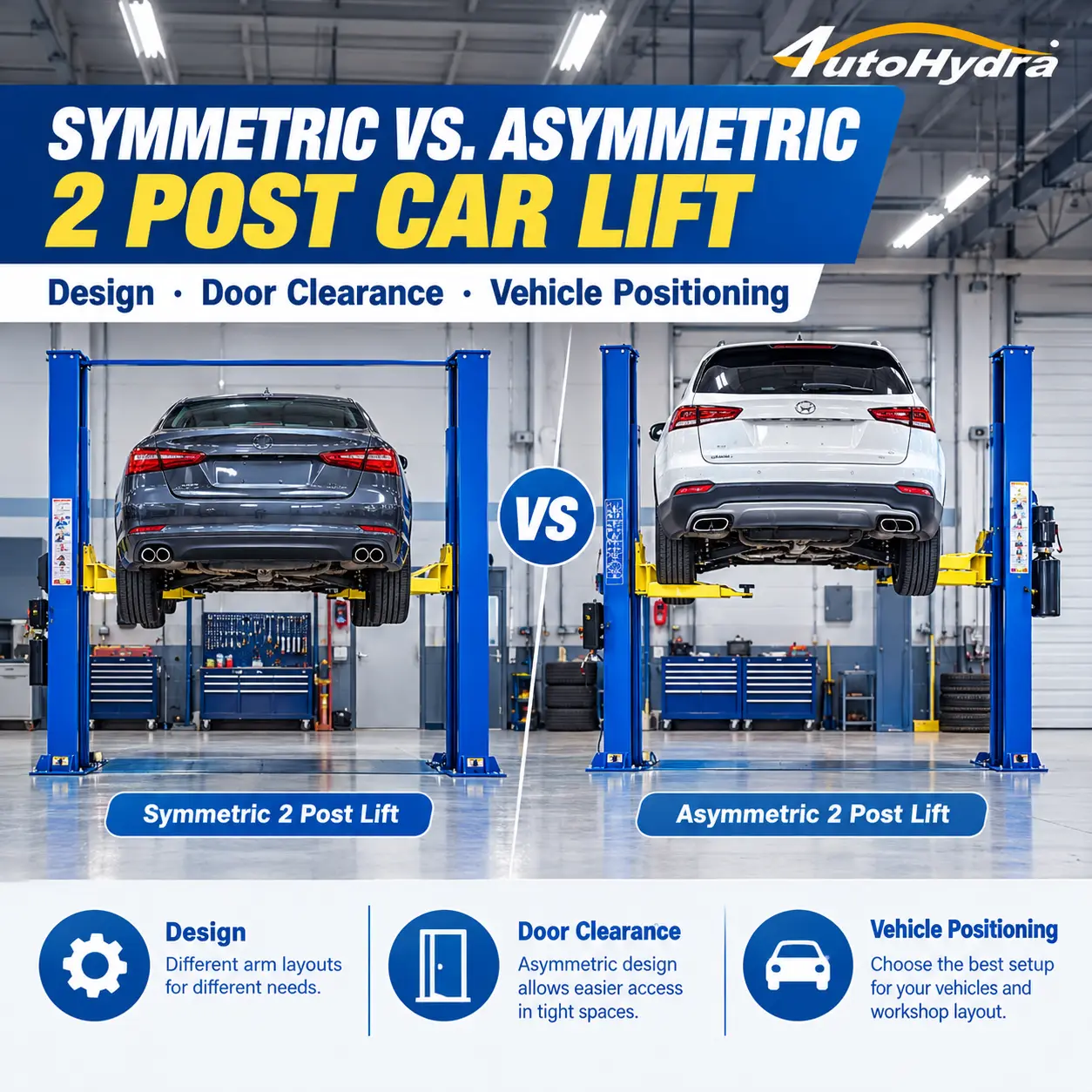
If the slab passes, the next decision is arm geometry rather than capacity — and that choice has its own trade-offs, covered in our symmetric vs asymmetric guide.
Once the floor qualifies, the entry point into this family is usually an overhead clear-floor model with a usable capacity margin. The 10,000 lb 2-post garage lift is representative of what a well-equipped home bay looks like: dual hydraulic cylinders, chain drive with steel wire rope equalizing cables, mechanical latches in each column, adjustable pads and adapters, and a CE-certified structure rated for 115 percent dynamic and 150 percent static load testing. Its 36-month parts replacement term matters more than buyers expect, because the parts that fail first on a low-use lift are usually electrical, not structural.
3. Four-Post Lifts: The Deciding Number Is the Air Above the Top Lock
A four-post lift spreads load across four feet and a long footprint, which is why it tolerates slabs that a two-post would reject. Its constraint is vertical instead: the carriage has to reach its highest lock with a vehicle on it, and nothing above may obstruct that travel.
The arithmetic is unforgiving and easy to do badly. Start with the lift's maximum lifting height, add the height of the tallest vehicle you will ever park, then add a working reserve of about six inches so you are not threading a hood ornament past a door header. If that total exceeds the distance from floor to the lowest overhead obstruction, the lift is not usable at full height — and a four-post lift that cannot reach its top lock loses most of its reason to exist.
Overhead obstructions buyers forget to measure
● The garage door's torsion spring and track assembly, which typically hang lower than the door itself.
● The door opener rail and its hanging bracket.
● Light fixtures, shelving, and any storage hung from the ceiling.
● A structural beam or a step in the ceiling that shortens one bay only.
Where clearance is generous, capacity can be pushed higher. The 11,000 lb 4-post parking lift reaches an 84.5-inch maximum lifting height on a four-post frame with four mechanical locking devices, each carrying a primary and a secondary lock, plus a single-point manual safety release. It also accepts an optional caster kit and optional rolling jacks — which means the same frame can be repositioned or converted into a wheel-service platform later, and that optionality is worth more than a small capacity difference on a lift you will keep for a decade.
4. The Portable Four-Post: When Mobility Beats Capacity
A caster-equipped four-post lift answers a different problem: a bay that must serve two purposes. In a garage where the lift is in the way nine months of the year, the ability to roll it into a corner is not a convenience feature, it is the difference between owning a lift and owning an obstruction.
Mobility changes the governing number from height to length and flatness. Runway length plus a realistic approach run has to fit inside the bay with the door closed; the slab has to be flat enough that the casters do not bind or walk; and the driveway side of the door has to be long enough to line the vehicle up before the front wheels reach the ramp.
The 9,500 lb portable 4-post is built around that use case — 79 inches of clearance working height, a full ascent in roughly 50 seconds, drip trays, drive-on ramps, a jack tray for wheel service, and casters included rather than sold separately. Two practical notes from its listing deserve attention: it arrives requiring forklift or tractor unloading, and it is a 110V unit, which keeps the electrical decision simple.
A rolling lift also has a maintenance implication that buyers rarely price in: every time the unit moves, the floor and the casters take the wear, and every move is an opportunity to knock a lock out of adjustment. If you move it weekly, budget for an annual inspection of locks and cables rather than an occasional glance.
5. 110V or 220V: The Number Most Buyers Forget
Almost every lift in this category runs a hydraulic power unit driven by an electric motor, and the motor's supply is a hard constraint that shows up after the lift is already in the garage.
A 2.0 hp motor is roughly 1.5 kW. At 110V that is a substantial continuous current, which means a dedicated 20-amp circuit rather than a shared receptacle; at 220V the same motor draws about half the current on a dedicated circuit that is usually easier to keep exclusive. The decisive question is not which is "better" but which one your panel can give you exclusively, with a run long enough for the lift's cord and without borrowing capacity from a freezer, a welder, or an EV charger on the same leg.
⚡ Two rules worth following: never share a lift circuit with anything that cycles on its own, and confirm the receptacle protection your local authority requires — NEC 210.8(A) calls for GFCI protection on 125-volt receptacles in garages, and inspectors enforce it.
This is also where a catalog detail becomes a buying advantage. The 10,000 lb overhead two-post platform is offered in both supply versions, so the electrical decision does not force a change of lift: the same 10,000 lb lift wired for 220V carries the same dual-cylinder architecture, CE certification, and 36-month parts term as its 110V counterpart. Choose the voltage your panel can dedicate, then buy the model that matches it — not the other way around.
6. Four Architectures, Four Critical Numbers
What actually governs each lift type, and what fails first when the number is wrong
| Lift type | The deciding number | Typical published threshold | What fails first if it is wrong |
|---|---|---|---|
| Two-post | Slab compressive strength at the anchor | 3,000–4,000 psi over roughly 4–6 in, per the model manual | Anchors pull, columns lean, locks never sit level |
| Four-post parking | Clear height above the top lock | Lift max height + vehicle height + about 6 in reserve | Top lock unreachable; roof or hood meets the door track |
| Portable four-post | Runway plus approach run, and floor flatness | Runway length + 3 ft of approach inside the closed door | Casters bind and walk; unit loads unevenly |
| Any electric lift | Dedicated branch capacity at your voltage | About 20 A dedicated at 110V for a 1.5 kW motor | Nuisance trips, motor overload, disputed warranty |
Read the table as a sequence, not a menu. The left column is what you want to do; the second column is what your building has to allow before the first column becomes relevant.

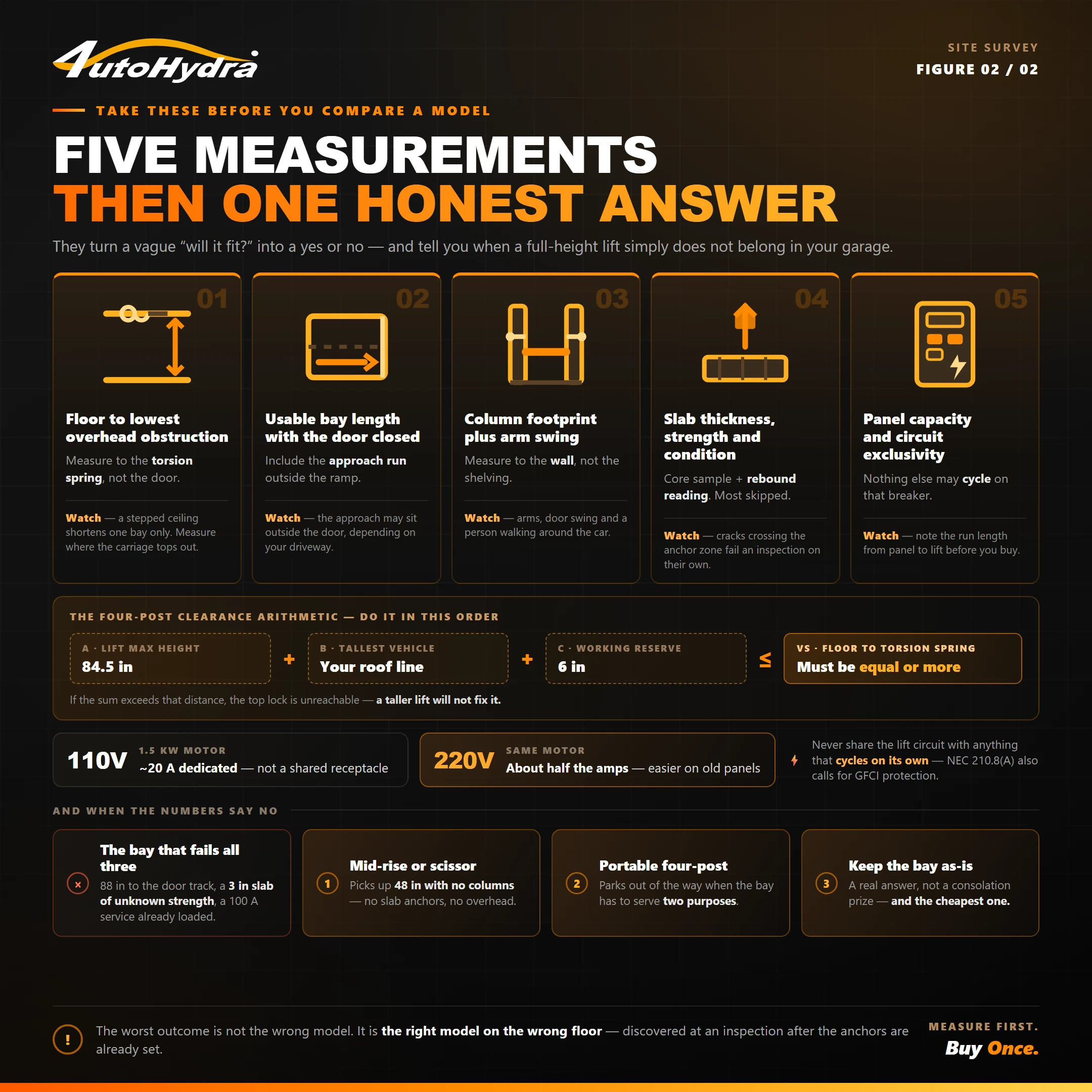
7. The Five Measurements That Settle the Argument
Take these five numbers before you compare a single model. They convert a vague "will it fit?" into a yes or no.
(1) Floor to lowest overhead obstruction
Measure to the torsion spring, not the door. If the ceiling is stepped, measure in the bay where the lift will stand, at the point where the carriage will reach its top lock.
(2) Usable bay length with the door closed
Include the approach run. A four-post lift needs the vehicle lined up before the front wheels touch the ramp, and that happens outside or inside the door depending on your driveway.
(3) Column footprint plus arm swing
Two-post lifts need space behind and beside the columns for arms, door opening, and a person walking around the vehicle. Measure to the wall, not to the shelving.
(4) Slab thickness, strength, and condition
Core sample and rebound reading, plus a look for cracks crossing the anchor zone. This is the one measurement most buyers skip and most installers ask for first.
(5) Panel capacity and circuit exclusivity
Identify the breaker that will serve the lift and confirm nothing else cycles on it. Note the run length from panel to lift.
8. Safety Systems That Earn Their Place at Low Cycle Counts
A home lift may run a few dozen cycles a month, which creates a specific risk profile: mechanisms sit idle, lubricants migrate, and a slack cable or a partially engaged lock can go unnoticed for a long time because nothing is exercising the system.
🛡 Three features are worth paying for on that basis alone: mechanical locks that hold at every stop, a secondary slack-cable or lock-detection device, and a single-point release that makes a full lock check quick enough that you will actually do it.
This is the logic behind ANSI/ALI ALCTV, the safety standard that third-party certification bodies test automotive lifts against, and behind ALI's ALOIM guidance for ongoing inspection and maintenance. Certification is not paperwork: a CE-marked or ALI-certified lift has been load-tested against defined criteria, and the 115 percent dynamic and 150 percent static figures quoted in product literature trace back to those test protocols.
Operational discipline matters more than the certificate in daily use. Under OSHA's general machine requirements at 29 CFR 1910.212, the employer — and by extension the household — is responsible for guarding and maintaining equipment in safe condition. In practice that means: never walk under a vehicle supported only by hydraulics, always confirm the mechanical locks have engaged before releasing pressure, and keep the area under the carriage clear before lowering.
9. When the Numbers Say No
Sometimes the honest answer is that a full-height lift does not belong in a particular garage. A bay with 88 inches to the door track, a 3-inch slab of unknown strength, and a 100-amp service already feeding an EV charger is not a candidate for a 10,000 lb two-post, and no amount of specification shopping changes that.
The workable alternatives are real, not consolation prizes: a mid-rise or scissor platform that picks up 48 inches without columns, a portable four-post that parks out of the way, or a decision to keep doing oil changes on ramps and spend the budget on a lift-ready slab and panel upgrade first. Sequence matters. Pour the slab once, correctly, and the lift decision becomes easy in year two.
The worst outcome in this category is not buying the wrong model. It is buying the right model and installing it on the wrong floor, then discovering the problem during an inspection after the anchors are already set.
Frequently Asked Questions
Do I need a permit to install car garage lifts at home?
Requirements vary by jurisdiction. Many municipalities treat a vehicle lift as equipment rather than a structural addition and require only an electrical permit, while others require a building permit, a plan review, and an inspection of the slab. Confirm with your local building department before ordering, and keep the manufacturer's installation instructions available for the inspector.
How much ceiling height do I need for a four-post lift?
Add the lift's maximum lifting height, the height of the tallest vehicle you will park, and a reserve of about six inches, then compare that total to the distance from floor to the lowest overhead obstruction. Measure to the door's torsion spring and track, not to the ceiling itself.
Can car garage lifts be installed on an existing concrete slab?
Often yes, but only if the slab meets the model's published requirements for thickness, compressive strength, and condition. A core sample and a strength reading are the reliable checks; visual inspection alone is not, because a thin pour over a hard base or a crack through the anchor zone can look acceptable and fail under load.
Is 110V enough for a home garage lift?
It can be, provided the lift's motor is matched to a dedicated circuit of adequate amperage. A roughly 1.5 kW motor on 110V needs a substantial dedicated circuit; many owners prefer 220V because the same motor draws about half the current and the circuit is easier to keep exclusive. Buy the model that matches the supply your panel can dedicate.
How often should a home lift be inspected?
Follow the manufacturer's schedule and ALI ALOIM guidance, and treat an annual inspection of locks, cables, and hydraulic fittings as a baseline for a lift that runs frequently. After any relocation, impact, or unusual noise from the locking system, inspect before the next use.
Match the Lift to Your Building, Not the Other Way Around
Start with the four numbers in this article, then compare models against them. Every specification you read afterwards will mean something — and you will stop paying for capacity your garage cannot use.
✔ Factory-direct pricing · ✔ 20+ years in lift manufacturing · ✔ In-stock U.S. warehouses · ✔ Lifetime technical support
Recommended News
View all