2 Post Car Lift Adapters: A Complete Guide to Types and Uses
A 2 post car lift is designed to support vehicles at specific lifting points using adjustable arms and contact pads. However, the standard lift pads supplied with a lift may not be suitable for every vehicle.
Different vehicle designs require different contact solutions:
- A low-profile passenger car may need a slotted pinch-weld adapter.
- A pickup truck with a separate frame may require a frame cradle adapter.
- Some SUVs and vans also need additional height to provide proper clearance between the lift arms and the vehicle body.
This is where 2 post car lift adapters become important.
Choosing the correct adapter helps establish proper contact with the vehicle's approved lifting points and supports a stable lifting setup. Choosing the wrong one can damage vehicle components or create an unsafe lifting condition.
In this guide, we explain the common types of two-post lift adapters, how they are used, what to check before purchasing them, and how to select compatible accessories for your vehicles.
⚠️ Important safety note: Always use adapters approved by the lift manufacturer and suitable for the exact lift model and vehicle application. Follow the vehicle manufacturer's lifting-point instructions and the lift manufacturer's operating manual. Never use homemade or improvised adapters.
1. What Are 2 Post Car Lift Adapters?
A 2 post car lift adapter is an accessory fitted to the end of a lift arm or contact pad. Its purpose is to provide an appropriate contact surface, height, shape, or support arrangement for a vehicle's approved lifting points.
The standard contact pads on a lift are not necessarily suitable for every chassis design. Adapters help accommodate differences in vehicle construction and lifting-point geometry.
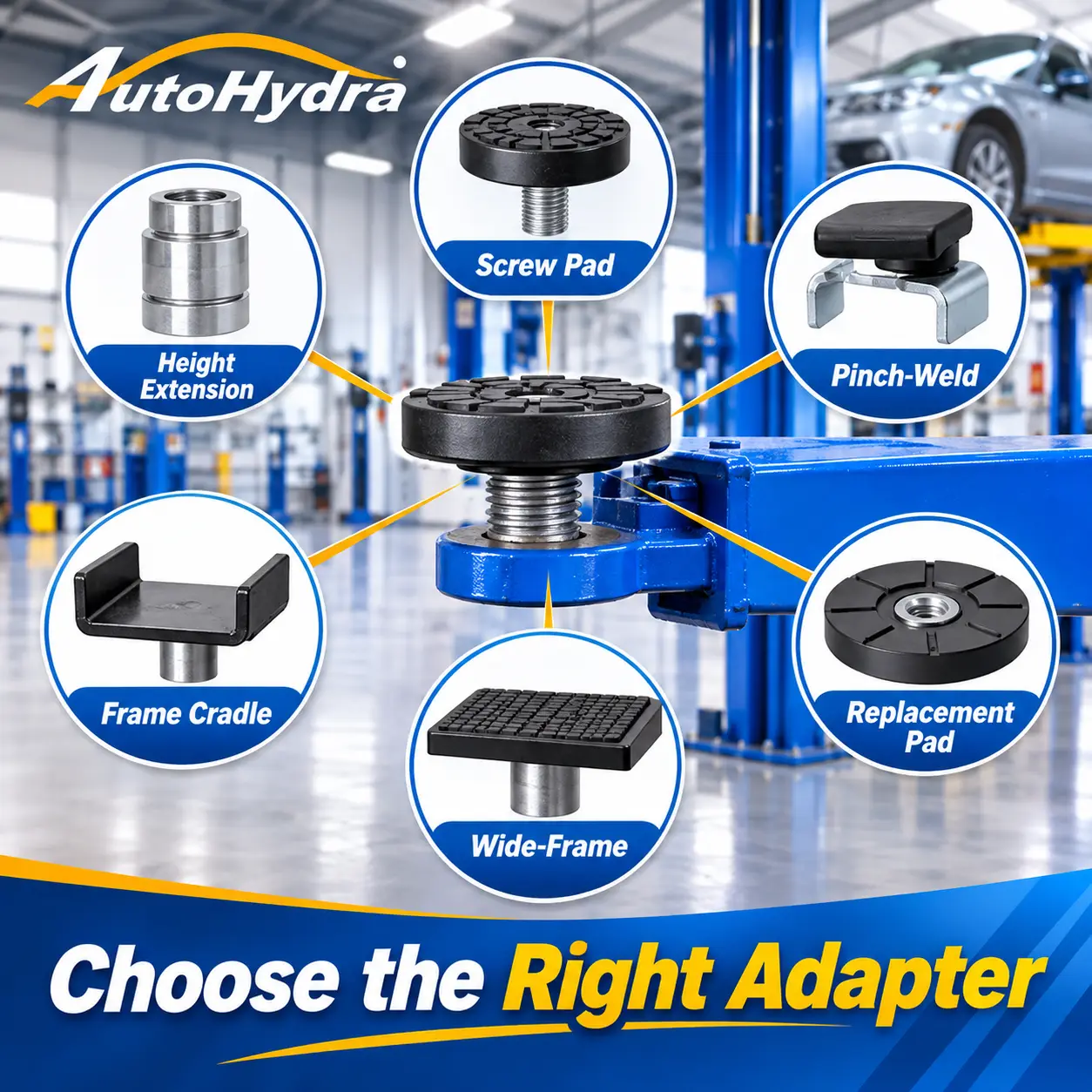
Depending on the lift model and application, common adapter categories include:
✅Screw lift pads
✅Height extension adapters
✅Pinch-weld adapters
✅Frame cradle adapters
✅Wide-frame adapters
✅Replacement rubber or polyurethane contact pads
⚠️ These accessories are not interchangeable by default. Each adapter must be compatible with the lift arm, the vehicle's approved lifting point, and the manufacturer's instructions.
2. Common Types of 2 Post Car Lift Adapters
Understanding the differences between adapter types makes it easier to select the right accessories for your workshop.
2.1 Screw Lift Pads
Screw lift pads are commonly used on two-post lifts with adjustable threaded pad assemblies.
The threaded mechanism allows the operator to adjust the contact pad height within the range specified by the lift manufacturer. This helps accommodate differences in vehicle ground clearance and lifting-point height.
Typical applications:
- Passenger cars
- Many unibody vehicles
- Vehicles with designated reinforced lifting points
- Applications requiring fine pad-height adjustment
What to check before choosing:
- Thread diameter and pitch
- Compatible lift-arm design
- Pad diameter and material
- Available adjustment range
- Manufacturer-approved vehicle applications
⚠️ A screw pad that looks similar to another model's pad may still have a different thread or mounting design. Confirm compatibility before ordering replacement parts.
2.2 Height Extension Adapters
Height extension adapters, also called auxiliary adapters, extenders, or lift blocks, increase the contact height between the lift arm and the vehicle's approved lifting point.
They can be useful when a vehicle has higher ground clearance or when the standard pad cannot reach the required contact point while maintaining suitable arm clearance.
Typical applications:
- Certain SUVs
- Pickup trucks
- Vans
- Vehicles with elevated chassis or specific underbody configurations
Important considerations:
- Choose an extension designed for the exact lift and pad assembly
- Confirm the permitted adapter height and configuration
- Check that all required contact points can be reached correctly
- Follow the manufacturer's restrictions on stacking adapters
⛔ Never assume that adding more height is automatically safer or more effective. Excessive extension can change the lifting geometry and increase the risk of vehicle instability.
2.3 Pinch-Weld Adapters
Many unibody passenger vehicles use designated pinch-weld lifting points. These are specific reinforced areas identified by the vehicle manufacturer.
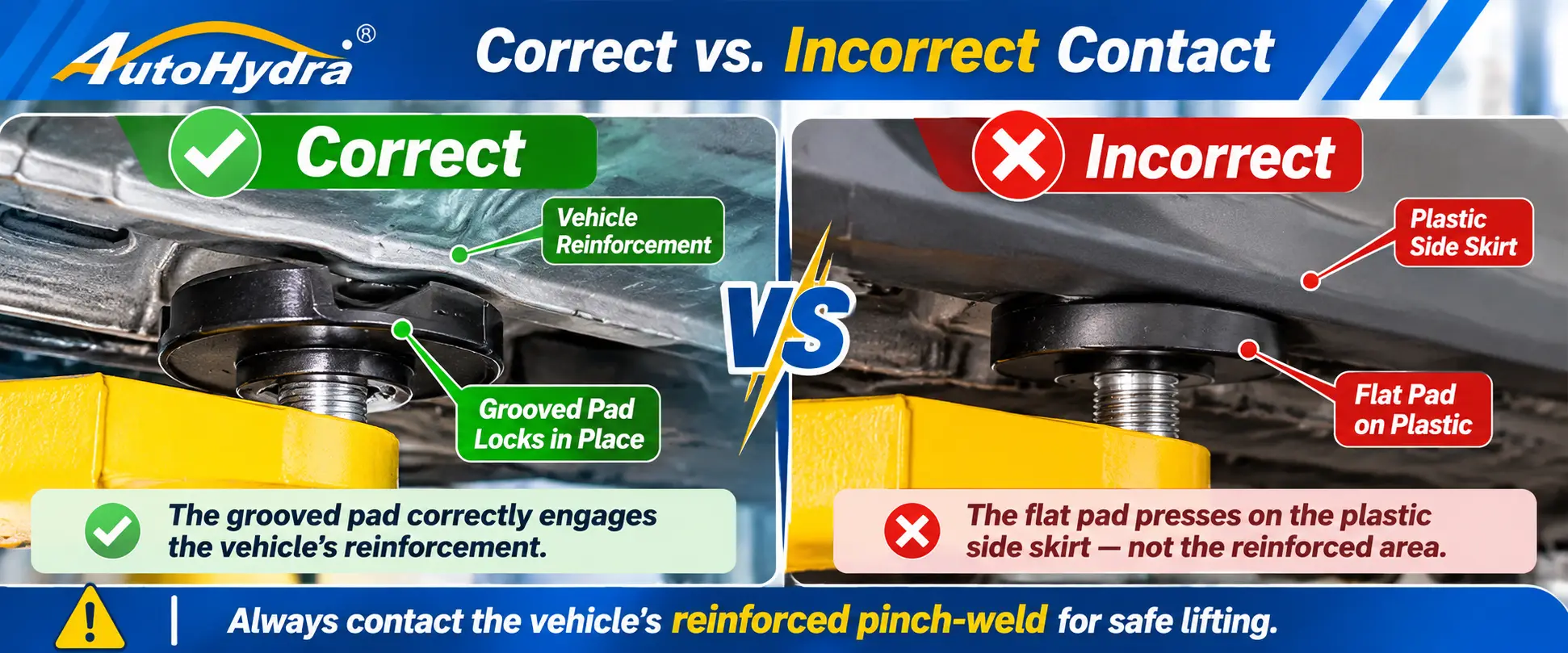
Pinch-weld adapters often feature a slot or groove that accommodates the approved pinch-weld area while providing a suitable contact surface.
Typical applications:
- Passenger cars with manufacturer-approved pinch-weld lifting points
- Certain compact cars and sedans
- Some crossovers and other unibody vehicles
Why they matter:
A standard flat pad may not provide the correct contact geometry for a designated pinch-weld point. A compatible slotted adapter can help position the pad around the reinforced area.
Before using one, verify that:
- ✅ The vehicle manufacturer identifies the contact point as an approved lifting location
- ✅ The adapter slot matches the required contact geometry
- ✅ The adapter is approved for the lift model
- ✅ The pad is not contacting nearby plastic trim, side skirts, or non-load-bearing body panels
⛔ Do not assume that every visible seam along a vehicle's rocker panel is a suitable lifting point.
2.4 Frame Cradle Adapters
Frame cradle adapters are designed for applications where the vehicle is lifted at approved frame locations.
Unlike a flat contact pad, a cradle-style adapter provides a shaped support surface intended to accommodate a compatible frame section.
Typical applications may include:
- Pickup trucks
- Certain vans
- Body-on-frame SUVs
- Other frame-type vehicles approved for the specific lift and adapter
Before selecting a frame cradle adapter, check:
- Frame dimensions
- Adapter opening
- Contact geometry
- The lift manufacturer's compatibility requirements
⚠️ A cradle adapter designed for one frame width or lift model may not fit another.
2.5 Wide-Frame and Super-Wide-Frame Adapters
Some heavy-duty vehicles have wider frame sections than standard frame cradle adapters can accommodate.
Wide-frame and super-wide-frame adapters are designed for compatible wider frame applications.
Before purchasing, verify:
- The actual frame width at the approved lifting points
- The adapter's specified frame-width range
- The lift arm's mounting compatibility
- The lift manufacturer's approved vehicle and load applications
⛔ Do not use a wide-frame adapter simply because a vehicle is heavy. Frame dimensions and approved lifting locations determine whether it is appropriate.
2.6 Replacement Rubber and Polyurethane Contact Pads
Contact pads are the surfaces that directly meet the vehicle's lifting points. Depending on the lift design, they may be made from rubber, polyurethane, or another manufacturer-specified material.
Over time, pads can become worn, cracked, damaged, or contaminated.
Inspect contact pads regularly for:
- Cracks or missing material
- Uneven or damaged contact surfaces
- Excessive wear
- Oil, grease, or other contamination that could affect grip
- Loose or damaged mounting components
⛔ Replace damaged pads with compatible manufacturer-approved parts. Never operate a lift with missing or damaged contact pads.
3. Which 2 Post Car Lift Adapter Does Your Vehicle Need?
The correct adapter depends on the vehicle's construction and its manufacturer-approved lifting points—not simply the vehicle's name or weight.
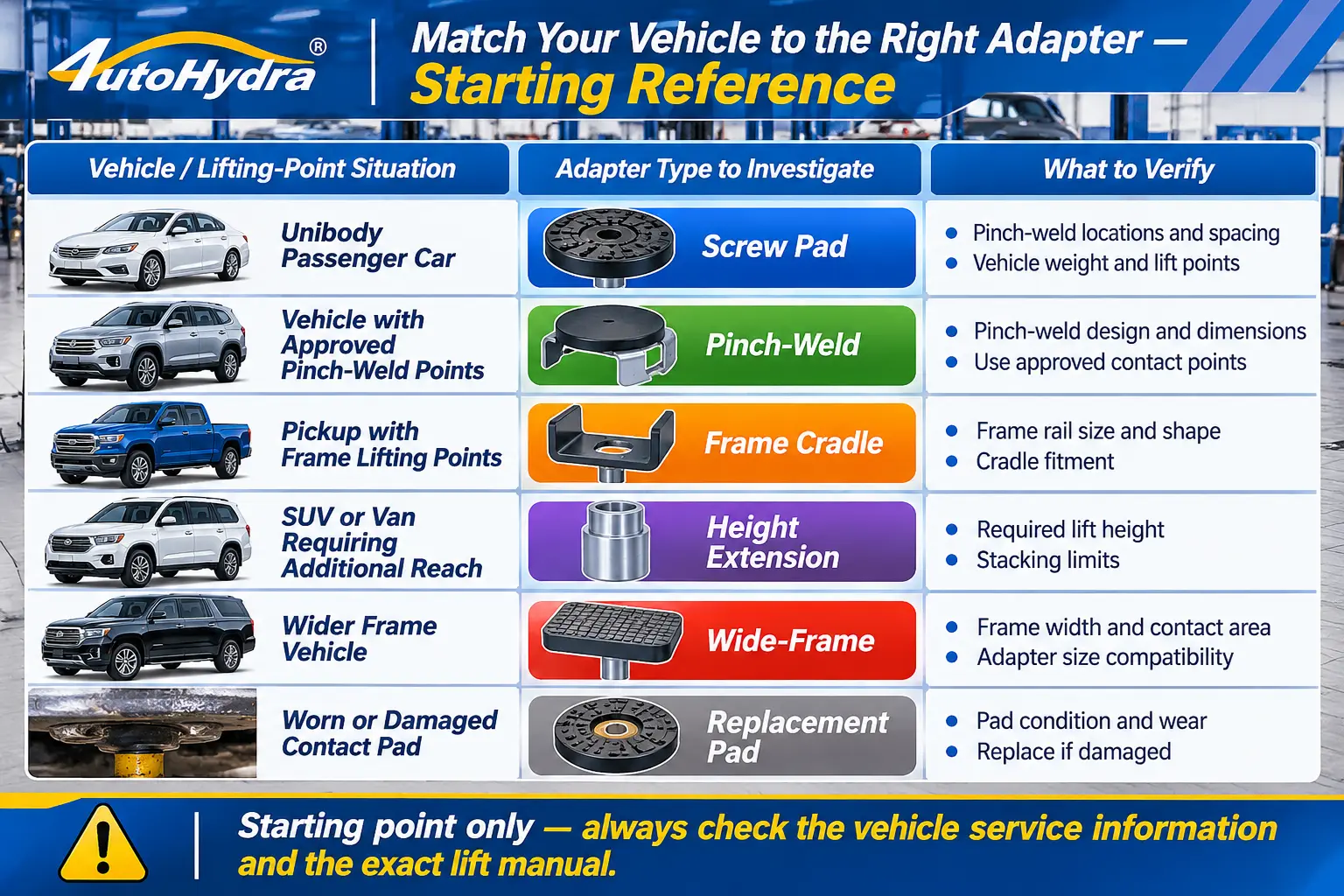
⚠️ This is a starting point, not a universal vehicle-to-adapter compatibility chart. Always check the service information for the specific vehicle and the documentation for the exact lift model.
4. How to Choose the Right 2 Post Car Lift Adapters
Before buying adapters, work through the following selection steps.
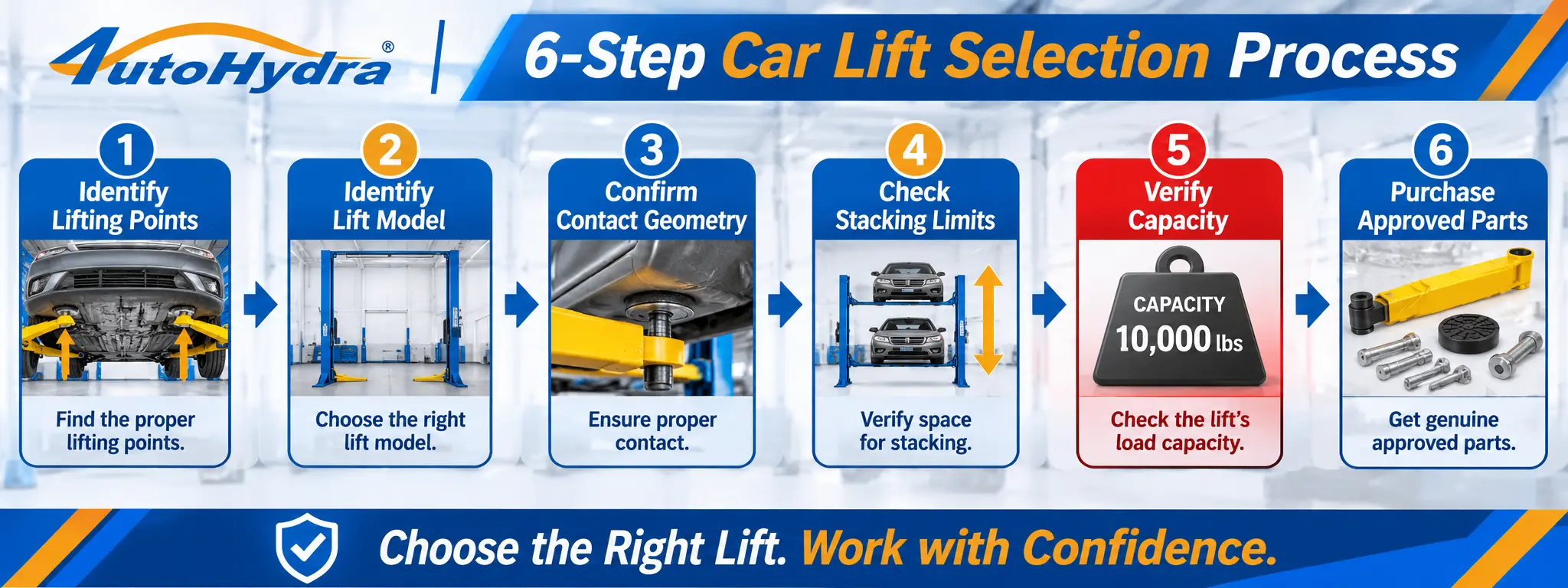
Step 1: Identify the Vehicle's Approved Lifting Points
Start with the vehicle manufacturer's service information or lifting diagram.
Identify whether the vehicle uses:
- Reinforced unibody lifting points
- Approved pinch-weld locations
- Designated frame contact points
- Special lifting locations or vehicle-specific adapters
⛔ Do not choose an adapter based only on appearance.
📖 For more information about locating approved contact points, read AUTO HYDRA's How to Position a Vehicle on a 2 Post Car Lift.
Step 2: Identify Your Lift Model and Arm Design
Different lift manufacturers and models may use different mounting arrangements.
Record the following information:
- Lift brand and model
- Serial number, if required by the parts supplier
- Lift-arm end design
- Existing pad or adapter type
- Thread or mounting dimensions, where applicable
⚠️ Do not assume that an accessory will fit simply because it is described as a "two-post lift adapter."
Step 3: Confirm the Required Contact Geometry
Compare the vehicle's approved lifting point with the adapter's contact surface.
For example:
- A designated pinch-weld point may require a compatible slotted adapter
- A suitable frame contact point may require an approved cradle adapter
- A height difference may require a compatible extension
- A worn standard pad may require a model-specific replacement
💡 The adapter should support the intended contact point without interfering with nearby body panels, wiring, hoses, battery components, or other vehicle parts.
Step 4: Check Height and Stacking Limits
If an extension is required, verify the permitted height and configuration in the lift manual.
Some lift manufacturers allow specific auxiliary adapters to be stacked within a stated limit. Others may have different restrictions.
⛔ Never transfer a stacking limit from one brand or model to another. Do not exceed the limit specified for your exact equipment.
Step 5: Verify Capacity and Compatibility
Check the adapter's rated application and the lift manufacturer's instructions.
⚠️ An adapter does not increase the rated capacity of the lift.
The lift's rated capacity, arm configuration, load distribution, and vehicle lifting points must all remain within the manufacturer's approved operating conditions.
Step 6: Purchase Approved Accessories
When in doubt, provide the lift manufacturer or authorized parts supplier with:
- The model number
- Serial number
- Photos of the existing arm ends and pads
⛔ Avoid generic parts with unclear dimensions, ratings, or compatibility information.
5. Common Mistakes When Using 2 Post Car Lift Adapters
Even a suitable adapter can create problems if it is installed or used incorrectly.
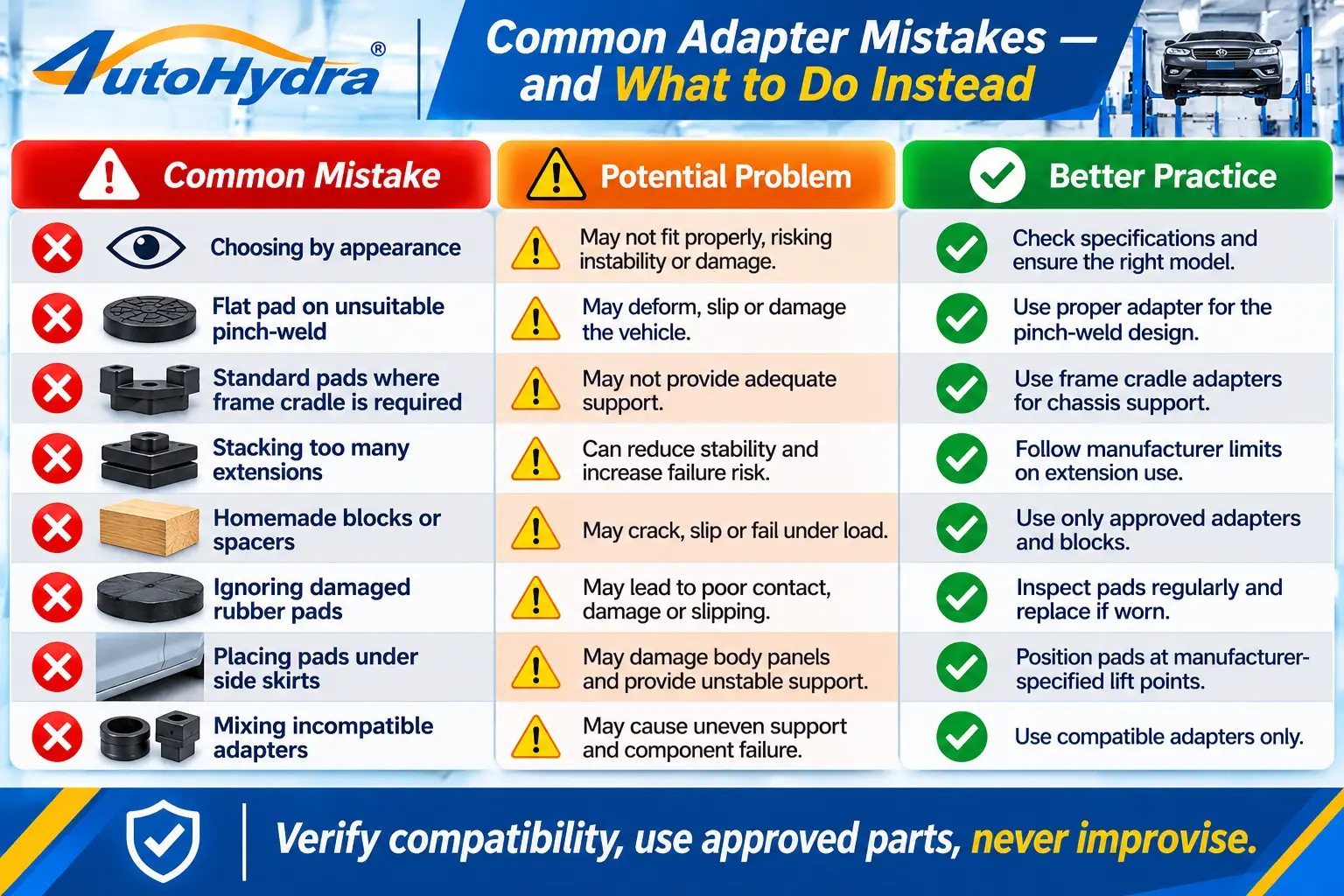
⛔ A two-post lift should never be operated with an improvised adapter arrangement.
6. Adapter Inspection and Maintenance
Lift adapters are load-contact components and should be included in the workshop's regular inspection routine.
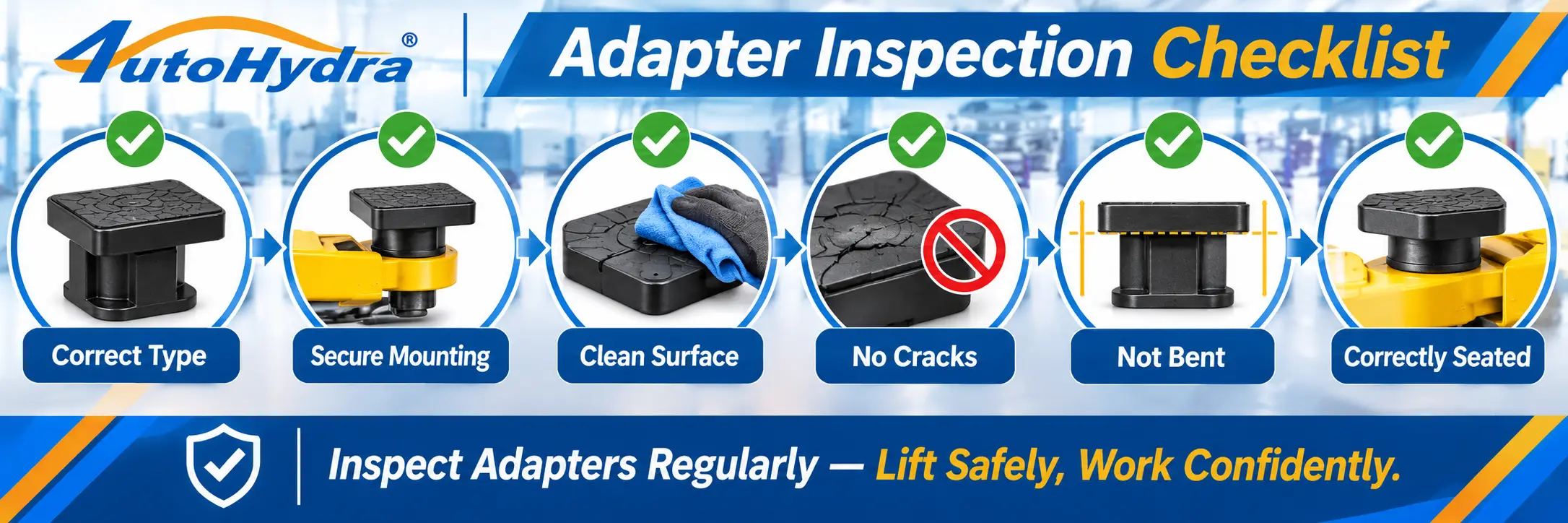
🔍 Inspect Before Use
Check that:
- ✅ Each adapter is the correct type for the intended application
- ✅ Mounting points and retaining features are secure
- ✅ Contact surfaces are clean and free from contamination
- ✅ Rubber or polyurethane pads are not cracked, missing, or excessively worn
- ✅ No adapter is bent, distorted, or visibly damaged
- ✅ Extensions and cradles are correctly seated
🔄 Replace Damaged Components
Do not continue using a pad or adapter that has lost material, become distorted, or no longer fits securely.
Use compatible replacement parts and follow the manufacturer's installation instructions.
📦 Keep Accessories Organized
Store adapters in a designated location so technicians can identify the correct type and avoid mixing incompatible components.
A labeled storage rack can help organize:
- Standard screw pads
- Pinch-weld adapters
- Height extensions
- Frame cradle adapters
- Replacement contact pads
📖 For a broader equipment inspection and maintenance routine, see AUTO HYDRA's Car Lift Maintenance Checklist and Safety Guide.
7. Why Adapter Compatibility Matters When Buying a 2 Post Car Lift
Adapter compatibility should be considered before purchasing a new lift, especially if your workshop services different vehicle types.
A shop that mainly repairs passenger cars may have different accessory needs from a facility that regularly services pickups, vans, SUVs, or commercial vehicles.
Before selecting a lift, consider:
- Vehicle coverage: List the vehicle types and chassis designs you expect to service
- Arm reach: Confirm that the lift arms can access the approved lifting points
- Adapter availability: Check which standard and optional adapters are available for the exact model
- Mounting compatibility: Confirm the accessories fit the arm-end design
- Rated capacity: Ensure the lift is suitable for the intended vehicles and approved load distribution
- Installation requirements: Review floor, anchoring, electrical, and clearance requirements
📖 You can use AUTO HYDRA's Car Lift Buyer's Guide to compare the main factors involved in choosing a lift.
8. Recommended AUTO HYDRA Solutions
Choosing the right two-post lift is only part of building a capable service bay. The available arm configurations, compatible accessories, and manufacturer support also affect which vehicles your shop can service.
When reviewing AUTO HYDRA two-post lift options, check:
- Rated lifting capacity
- Arm design and reach
- Standard contact pad configuration
- Available optional adapters
- Vehicle compatibility
- Installation requirements
- Operating and maintenance documentation
You can also compare different lift capacity ranges in these guides:
❓ Frequently Asked Questions
What are 2 post car lift adapters used for?
They provide a suitable contact surface, height, or support shape between a lift arm and a vehicle's approved lifting point. Different adapters are designed for different vehicle and lift configurations.
Are all two-post lift adapters universal?
No. Adapter mounting styles, dimensions, contact shapes, and approved applications vary by lift manufacturer and model. Always verify compatibility before purchasing or using an adapter.
What adapter should I use for a pickup truck?
Some pickup trucks require compatible frame cradle adapters, but the correct choice depends on the truck's frame design, approved lifting points, and the lift manufacturer's instructions. Do not assume every pickup uses the same adapter.
When should I use pinch-weld adapters?
Use a compatible slotted pinch-weld adapter when the vehicle manufacturer specifies an approved pinch-weld lifting point and the lift manufacturer approves that adapter for the lift.
Do SUVs need height extension adapters?
Some SUVs require additional adapter height to reach approved lifting points or provide suitable clearance. Others may not. Check the vehicle's lifting instructions and the lift manufacturer's accessory requirements.
Can I stack two-post lift height adapters?
Only when the lift manufacturer permits stacking and only within the specified height and configuration limits for the exact model. Never assume a stacking limit applies across different lift brands.
Can I use homemade wood blocks as lift adapters?
No. Homemade blocks and improvised spacers have unverified strength, retention, and contact geometry. Use approved accessories designed for the lift and vehicle application.
How do I know which replacement lift pads to buy?
Check the lift model and serial number, mounting dimensions, thread specifications where applicable, pad design, and manufacturer part information. Photos of the existing pad and arm end can help a parts supplier identify the correct replacement.
Do lift adapters increase the rated capacity of a two-post lift?
No. An adapter does not increase the lift's rated capacity. The lift must always be operated within its published capacity and load-distribution requirements.
Need Help Checking Adapter Compatibility?
Contact AUTO HYDRA with your lift model, vehicle types, and the adapter or lifting-point requirements you need to meet — we'll help you confirm the right accessory before ordering.
🛒 Browse 2 Post Car LiftsRecommended News
View all