Your Car Lift Quote Is Not the Bill: 9 Costs That Change the Total
Summary
A customer sent us a screenshot last month: a two-post lift listed at $1,649.99, add-to-cart button glowing, and one line of text underneath. "So what do I actually pay before this thing lifts a car?" It is the single most common question our installation support desk receives, and it is the question most product pages quietly avoid answering.
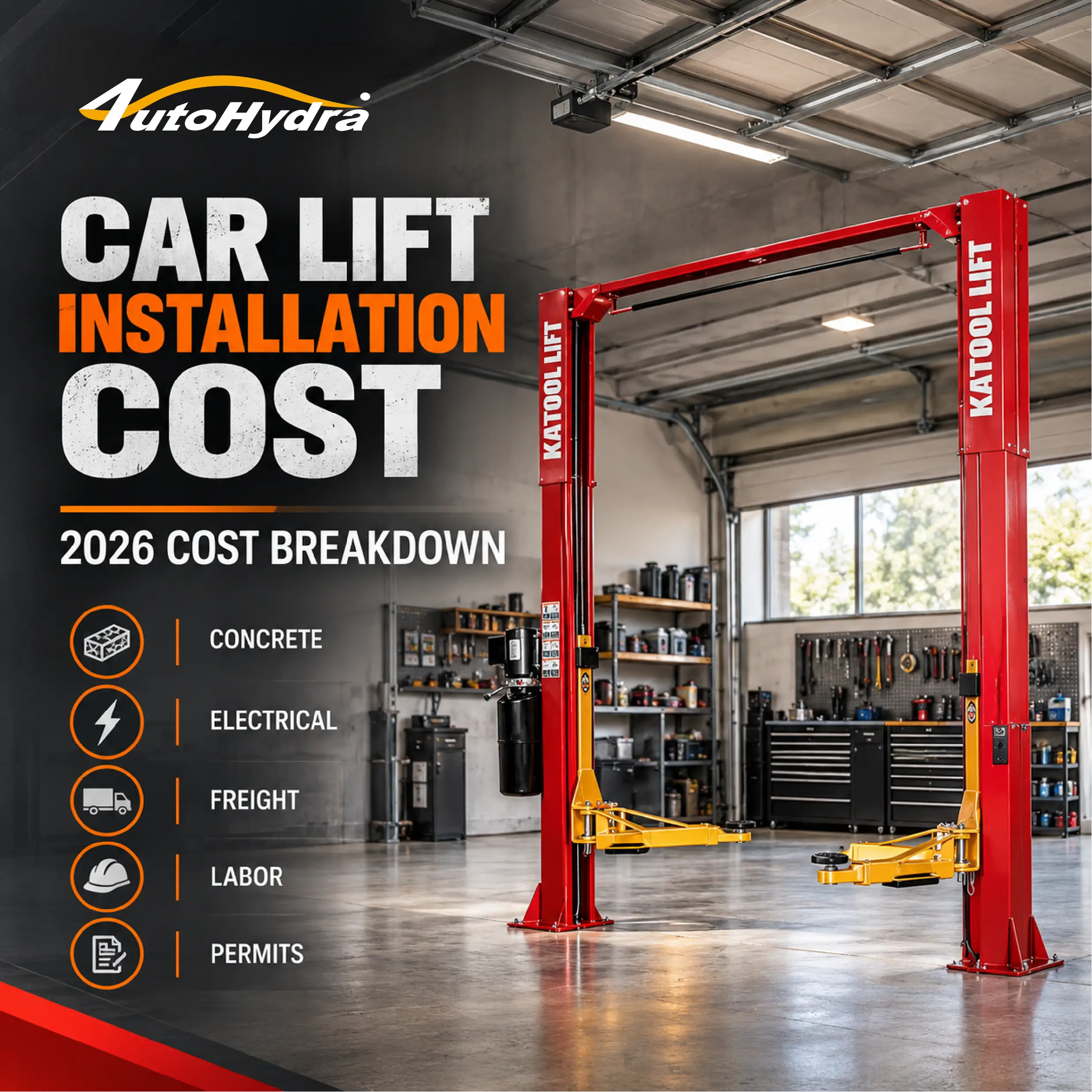
Here is the short version. Across the four real budgets we break down below, the lift itself accounts for roughly 40 to 70 percent of the finished bill. Everything else - freight, concrete, anchors, wiring, labor, permits and the small parts nobody lists - is the other 30 to 60 percent. Car lift installation cost is not a single fee you can look up. It is a stack of nine separate costs, and which ones apply to you depends almost entirely on the building, not the lift.
📌 How we built this guide: every price range below is cross-checked against published 2026 installer pricing and manufacturer installation manuals, and every product specification quoted here was read directly off a live Auto-Hydra product page in November 2026. Sources are listed at the end.
How much does car lift installation cost in 2026?
For installation labor alone - meaning a professional crew unloads, positions, anchors, wires up, levels and load-tests a lift that arrives at a ready site - published 2026 ranges are $900 to $1,800 for a two-post, $700 to $1,200 for a four-post, and $500 to $1,000 for a mid-rise scissor. Installer hourly rates run $75 to $150, with $75 to $100 in lower-cost regions, $100 to $125 in most of the country, and $125 to $175 in large metro areas.
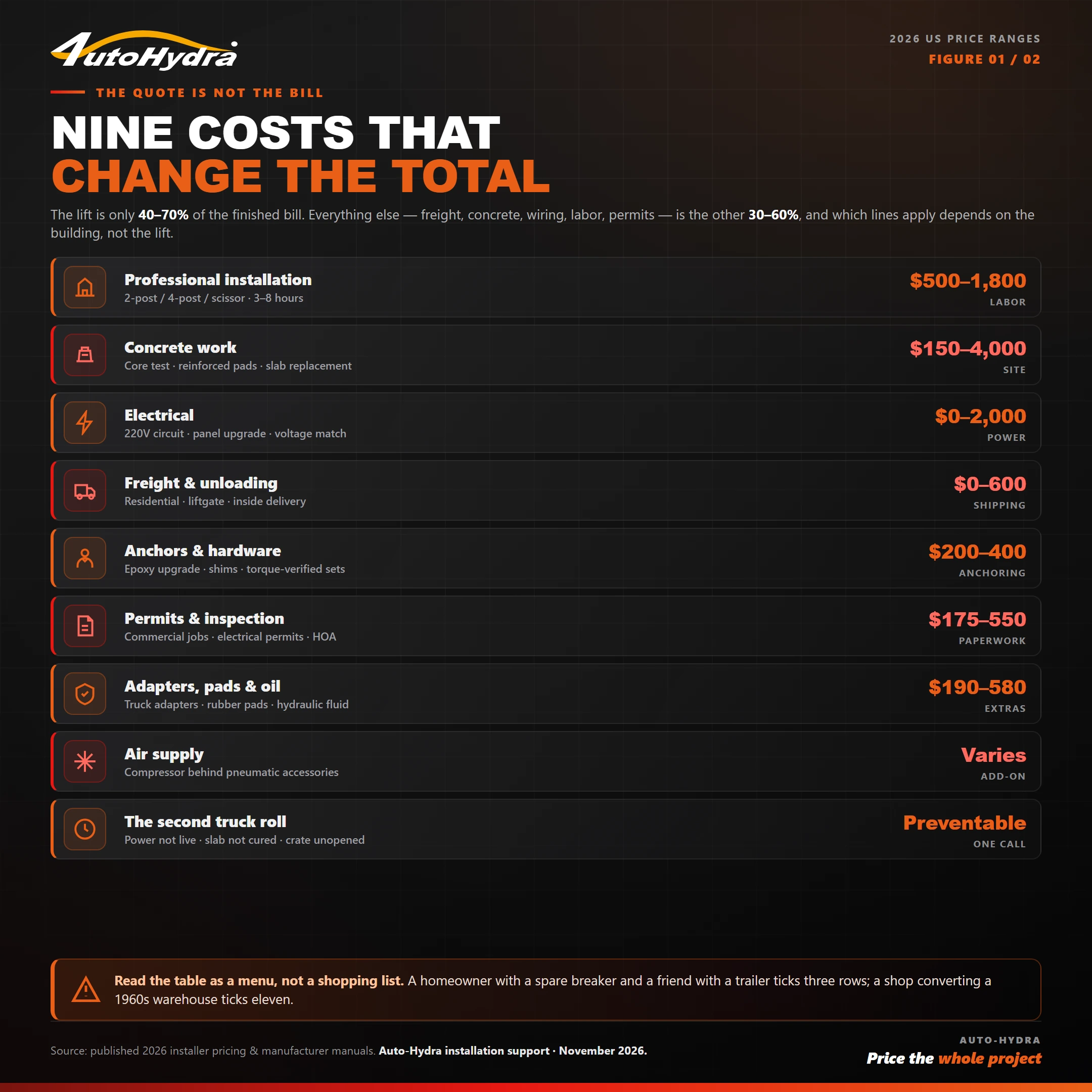
Those numbers assume nothing goes wrong. Once you add site work, the whole project - lift plus everything - typically lands between $3,500 and $10,000 or more. The table below separates every line item so you can build your own number instead of guessing at someone else's.
Table 1. Car lift installation cost by line item (2026 US ranges)
| Cost line | Low | High | What moves the number |
|---|---|---|---|
| Professional install, 2-post | $900 | $1,800 | 4 to 8 hours at $75 to $150 per hour |
| Professional install, 4-post | $700 | $1,200 | 3 to 6 hours, usually no floor anchors |
| Professional install, scissor | $500 | $1,000 | Placement, ramps, power check |
| Concrete core test | $150 | $300 | One core sample plus lab report |
| Two reinforced pads | $800 | $1,500 | 3 ft x 3 ft each, rebar, cure time |
| Full slab replacement | $2,000 | $4,000 | A 12 ft x 24 ft section, removal included |
| Epoxy anchor upgrade | $200 | $400 | Only if the manufacturer approves it |
| New 220V dedicated circuit | $400 | $800 | Run length, conduit, panel space |
| Electrical panel upgrade | $800 | $2,000 | Service capacity and utility lead time |
| Residential delivery | $150 | $400 | Distance from the freight terminal |
| Liftgate service | $75 | $150 | No dock and no forklift on site |
| Inside delivery | $300 | $600 | Door width, stairs, crew size |
| Permits and inspection | $175 | $550 | Commercial jobs and local rules |
| Adapters, pads and oil | $190 | $580 | Truck work, fluid often not included |
Read the table as a menu, not a shopping list. A homeowner with a four-year-old slab, a spare 220V breaker and a friend with a trailer might tick three rows. A shop converting a 1960s warehouse might tick eleven.
What does professional lift installation cost actually include?
When people ask about the cost to install a 2 post lift, they usually picture two technicians and a drill. The real scope is longer. A competent crew confirms the floor layout against the manual, marks and drills 8 to 12 anchor holes at 4 to 6 inches deep, sets and torques the anchors to spec, plumbs and bleeds the hydraulics, levels and shims the columns, runs a full load cycle, and walks you through the locks and the daily checks. That is 4 to 8 hours of work, which is exactly why the labor range is as wide as it is.
Just as important is what the fee does not include. Concrete repair, electrical work, permits, pallet disposal and adapter kits sit outside almost every installation quote. And the manual always outranks generic advice: our KT-M110 two-post lift - an 11,000 lb clear-floor model listed at $1,649.99 - states on its own product page that concrete must be at least 5.9 inches (150 mm) at 3,000 PSI, and that verifying thickness and strength is the customer's responsibility before purchase and installation. That is an inch and a half more than the 4-inch rule you will read everywhere else.
Clear-floor designs are the reason. With no base plate tying the columns together at floor level, every lifting load travels through the anchors into the slab. You are not paying the installer more for that; you are paying the concrete contractor more, before the installer ever arrives.
If you are still choosing between models, our two-post buyer's guide walks through capacity, ceiling height and power options in more detail. Read it before you request installation quotes, because the model you pick determines which rows of Table 1 apply to you.
Why does concrete decide your budget before the lift does?
This is the line item that blows up more projects than any other. For a two-post lift up to about 10,000 lb, the widely published minimum is a 4-inch slab at 3,000 PSI, cured at least 28 days, flat to within 1/4 inch over 10 feet. At 12,000 lb and above, expect 6 inches at 3,000 to 3,500 PSI with reinforcement. Four-post lifts are more forgiving because the load spreads across four feet, but 4 inches at 3,000 PSI is still the baseline. Manufacturer manuals agree: the Atlas 9KBP installation manual specifies 3,000 PSI minimum, 4 inches minimum thickness and at least 3-1/4 inches of anchor embedment.
⚠️ Never assume your slab is thick enough because the garage looks solid. A 4-inch slab and a 6-inch slab look identical from above.
If you genuinely do not know, a core test costs $150 to $300 and answers the question in a week. If the slab fails, you have three options. Two reinforced 3 ft x 3 ft pads under the columns run $800 to $1,500. Replacing a 12 ft x 24 ft section runs $2,000 to $4,000. Epoxy anchoring into marginal concrete costs $200 to $400, but not every manufacturer accepts it, and using it without written approval can void your warranty. Ask before you drill, not after.
One more scheduling trap: new concrete needs cure time. If you pour pads and book the installer for the same week, you will pay for a cancelled visit. Pour first, wait the full cure period the manufacturer specifies, then schedule.
How much electrical work should you budget for?
Voltage is the cheapest lever you have on the whole project. A 110V lift that plugs into an existing dedicated 15 to 20 amp circuit can cost $0 to $200 in electrical work. A 220V lift that needs a new dedicated circuit runs $400 to $800. If your panel is full or your service is undersized, an upgrade adds $800 to $2,000 and can add weeks of utility lead time.
This is why portable and mid-rise machines are so popular in home garages. The X90E mid-rise scissor lift runs on 110V, lifts 8,000 lb to a 47-inch release height, and can be used portable or fixed in place. At $2,389.99 it is not the cheapest lift on the site, but it deletes the electrician line, the anchor line and most of the concrete risk from your budget at the same time.
Two practical notes. First, book the electrician before the lift arrives, not after. Installers who have to leave and come back because power is not ready charge a second trip. Second, if a model offers both 220V and 110V configurations - several of ours do - ask which one ships by default. Ordering the wrong voltage is an avoidable $400 to $800 mistake.
What do car lift freight and install fees add up to?
Lifts ship freight, not parcel. A two-post crate can weigh well over half a ton, and the delivery options you choose at checkout can swing the total by several hundred dollars. Terminal pickup is usually free. Residential delivery adds $150 to $400. A liftgate - the hydraulic tailgate that lowers the crate to the ground when you have no dock - adds $75 to $150. Inside delivery, where the driver brings it into the building, adds $300 to $600.
Our own checkout reflects exactly this structure: you choose Pick Up or Freight Shipping, the basic freight fee is calculated from your address, and additional service options are quoted separately. There is no flat national shipping number, which is why any article that gives you one is guessing.
The hidden half of freight is unloading. Our 8,500 lb four-post lift at $2,439.99 states plainly on its product page that a forklift or tractor is required from the customer for unloading, with nearest-terminal pickup offered as the alternative. If you have neither machine, you either rent one, hire a liftgate truck, or drive to the terminal with a trailer.
That last option is the best-value move in this entire article. A rental trailer costs roughly $75 to $100 for a day and typically saves $200 to $400 versus residential delivery with a liftgate. You do need a vehicle rated for the weight and a way to get the crate off the trailer at home. Plan that before you click order, not while the driver is waiting.
What is the total cost of a car lift installed, end to end?
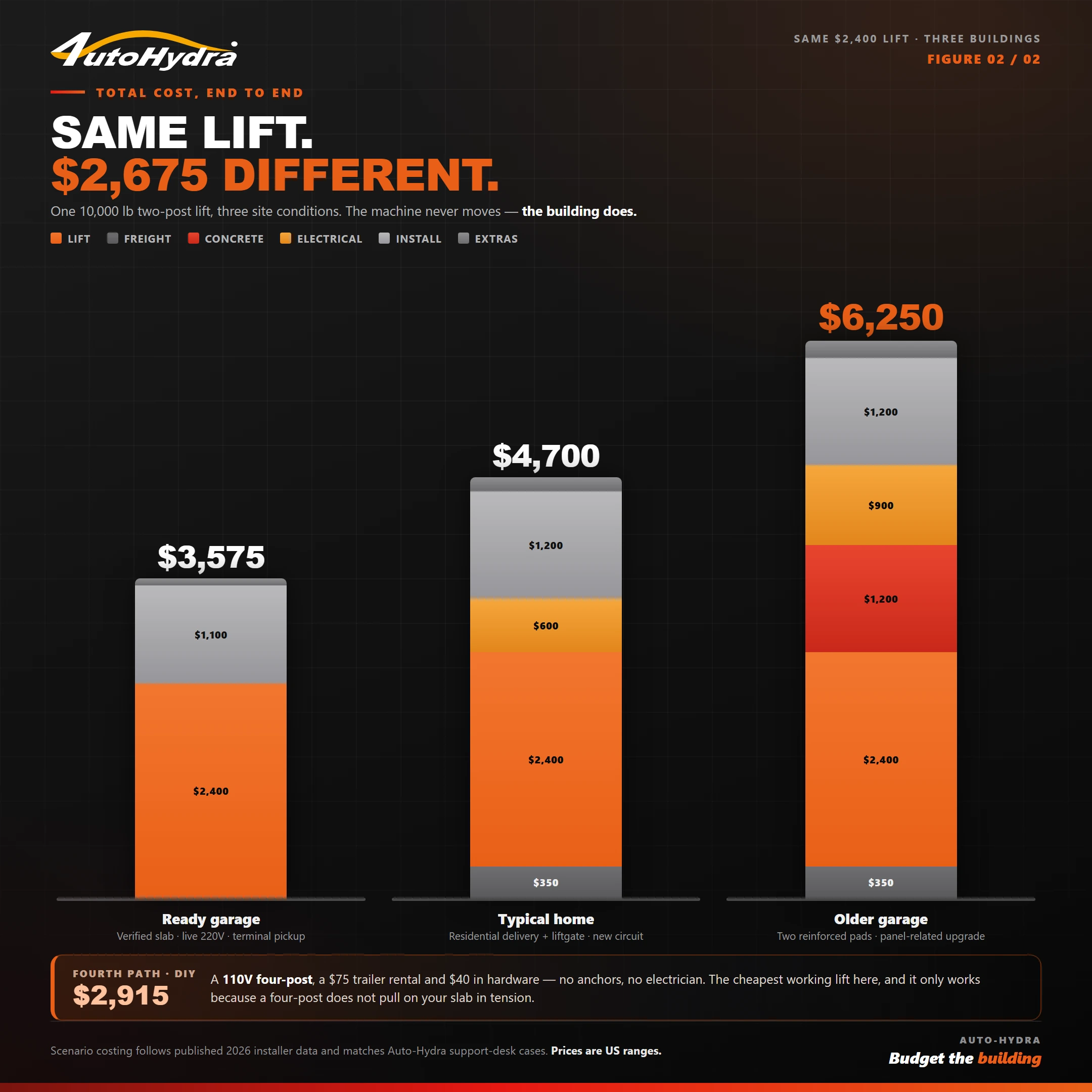
Line items are useful, but people budget in totals. Below are three complete two-post projects using the same $2,400 lift, differing only in the condition of the building. These follow the published 2026 scenario costing from Elite Garage Tools, and they match what our support desk sees week to week.
Table 2. Total cost of car lift installed: three real-world budgets
| Cost line | Ready garage | Typical home | Older garage |
|---|---|---|---|
| Lift (10,000 lb 2-post) | $2,400 | $2,400 | $2,400 |
| Freight and liftgate | $0 | $350 | $350 |
| Concrete work | $0 | $0 | $1,200 |
| Electrical | $0 | $600 | $900 |
| Professional installation | $1,100 | $1,200 | $1,200 |
| Accessories and misc. | $75 | $150 | $200 |
| Installed total | $3,575 | $4,700 | $6,250 |
The ready-garage column assumes terminal pickup, a verified slab and existing 220V power. The typical-home column adds residential delivery with a liftgate and a new circuit. The older-garage column adds two reinforced pads and a panel-related electrical upgrade. Same lift, $2,675 of difference.
A fourth scenario is worth knowing: a DIY four-post install. A $2,800 four-post lift, a $75 trailer rental and $40 in miscellaneous hardware comes to about $2,915 all-in, with no anchoring and no electrician if the unit is 110V. That is the cheapest path to a working lift in this guide - and it only works because a four-post does not depend on your slab in tension the way an anchored two-post does.
Know Your Install Budget — Now Pick the Right Two-Post Lift?
Every Auto-Hydra two-post listing shows the real specs your installer will ask about — concrete thickness, PSI, voltage and anchor requirements. Compare 110V and 220V models with verified specs and published warranty terms before you request a quote.
👉 Explore Two-Post Car Lift SolutionsWhich 4 fees only show up after the invoice?
1. The second truck roll
If the installer arrives and the power is not live, the slab is not cured, or the crate cannot be unloaded, you pay for a return visit. It is rarely quoted upfront and it is almost never cheap. Every one of these is preventable with a five-minute phone call the week before delivery.
2. Accessories and fluids you assumed were included
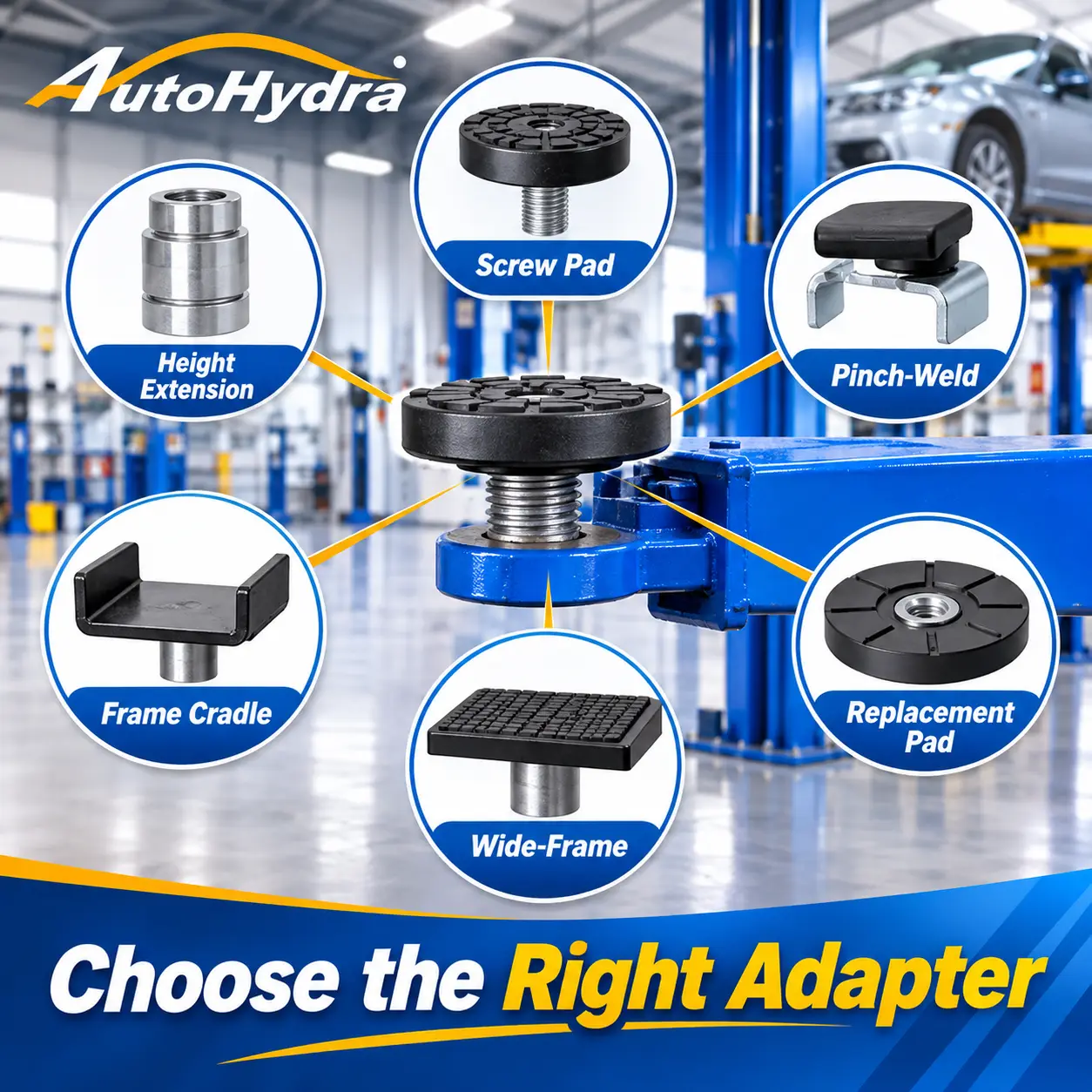
Truck adapters run $150 to $300, rubber arm pads $40 to $80, drip trays $100 to $200, and a rolling bridge jack for a four-post $300 to $600. Hydraulic oil is $50 to $100 and is not supplied with every model. Check the packing list before installation day, because a missing $60 item can idle a $1,200 crew.
3. Air supply for pneumatic accessories
Pneumatic add-ons are the classic surprise. The KT-AJ50 pneumatic air jack is only $149.99 and lifts 5 tons in about five seconds, but its product page recommends an air compressor supplying 8 to 10 atm. If your shop air is undersized or you have none at home, the true cost of that $149.99 tool includes the compressor behind it. Budget the system, not the accessory.
4. Permits, inspection and disposal
Most residential installs need no permit. Commercial jobs commonly do: building permits run $50 to $200, electrical permits $50 to $150, and inspection fees $75 to $200. Then there is the crate itself - pallets, banding, shrink wrap and shipping blocks. Some municipalities charge for bulky waste pickup, and a shop doing several installs a year can end up paying for a dumpster.
Is DIY installation worth the savings?
Sometimes, and the dividing line is anchoring. A four-post or a portable mid-rise scissor is largely a positioning job: level the feet, connect power, cycle the locks, verify the safety devices. A competent owner with a helper can do it, and the $2,915 scenario above is real.
An anchored two-post is a different proposition. You are drilling into a slab whose thickness and strength you probably have not verified, setting anchors whose embedment and torque values determine whether the columns stay put under an off-center load, and doing it on a machine that will hold a vehicle over your head. Get the embedment wrong and the failure mode is not a warranty claim.
💡 Our honest position: DIY the placement, hire the anchoring. If you do install your own anchored lift, follow the manufacturer manual to the letter, use a calibrated torque wrench, and keep the photos and torque records - some warranties ask for them.
Also check two things before you decide. Does self-installation affect your warranty coverage? And does your homeowner or shop insurance policy say anything about self-installed lifting equipment? Both answers are free to obtain and expensive to discover later.
How do you lower your car lift installation price without cutting corners?
● Verify the slab before you buy the lift. A $150 to $300 core test can prevent a $2,000 to $4,000 surprise, and it may tell you a cheaper lift type is the smarter fit.
● Pick up at the terminal. A $75 to $100 trailer rental routinely beats $225 to $550 in residential plus liftgate charges.
● Match voltage to your panel. If a 110V configuration exists and your capacity suits it, you can remove the electrician line entirely.
● Finish all site work first. Concrete cured, power live, unloading arranged, floor clear. One clean visit is the cheapest visit.
● Get an itemized quote. Ask the installer to separate labor, anchors, shims, load testing and travel. Vague quotes are where second-trip fees hide.
● Buy the adapters with the lift. Adding them later means a second freight charge on a small box.
There is a longer view worth taking as well. Our residential car hoist guide covers ten-year ownership costs, HOA and insurance questions, and the electrical capacity decisions that show up long after the installer has gone. Installation is a one-time cost; the building you put it in is a ten-year commitment.
Still have questions about car lift installation cost?
How much does it cost to install a 2 post lift if the garage is already ready?
Budget $900 to $1,800 for professional labor on a two-post, with $1,100 to $1,200 being the common middle. If the slab is verified, 220V power is live and you collect the lift from the terminal, a complete project around $3,575 is realistic on a $2,400 lift.
Is a four-post lift cheaper to install than a two-post?
Usually, yes. Published 2026 ranges put four-post installation at $700 to $1,200 versus $900 to $1,800 for a two-post, mainly because most four-post models are not anchored into the slab. The trade-off is footprint and unloading: heavier crates and, on some models, a customer-supplied forklift or tractor.
Can I pour new concrete and install the lift in the same week?
No. Standard guidance is a minimum 28-day cure before anchoring, and the manufacturer manual takes precedence. Booking an installer before the cure period ends is one of the most common causes of a paid second visit.
Do I need a permit for a home garage lift?
Most residential installations do not require a building permit, but electrical work often does, and HOA rules can apply separately. Commercial installations commonly need building and electrical permits plus an inspection, typically $175 to $550 combined. Always confirm with your local authority.
What is the cheapest sensible way to get a car lift installed?
A 110V four-post or portable mid-rise scissor, collected from the freight terminal with a rented trailer, set up on a verified slab by the owner. That path lands near $2,915 all-in. Do not apply the same logic to an anchored two-post - the anchoring is the part worth paying a professional for.
🔧 Price the whole project, not just the lift
Every Auto-Hydra product page lists the real specifications your installer will ask about: concrete thickness and PSI, voltage and phase, anchor requirements, unloading equipment and warranty terms. Read those first, then request an itemized local installation quote. You will get a far more accurate number than any national average can give you.
🛒 Browse tire and garage equipment
📞 Talk to an equipment specialist
✔ Factory-direct pricing · ✔ 20+ years building lifts and tire equipment · ✔ In-stock U.S. warehouses · ✔ Lifetime technical support
Recommended News
View all