We Went to SEMA to Listen, and Our Booth Turned Into a Q&A
summary
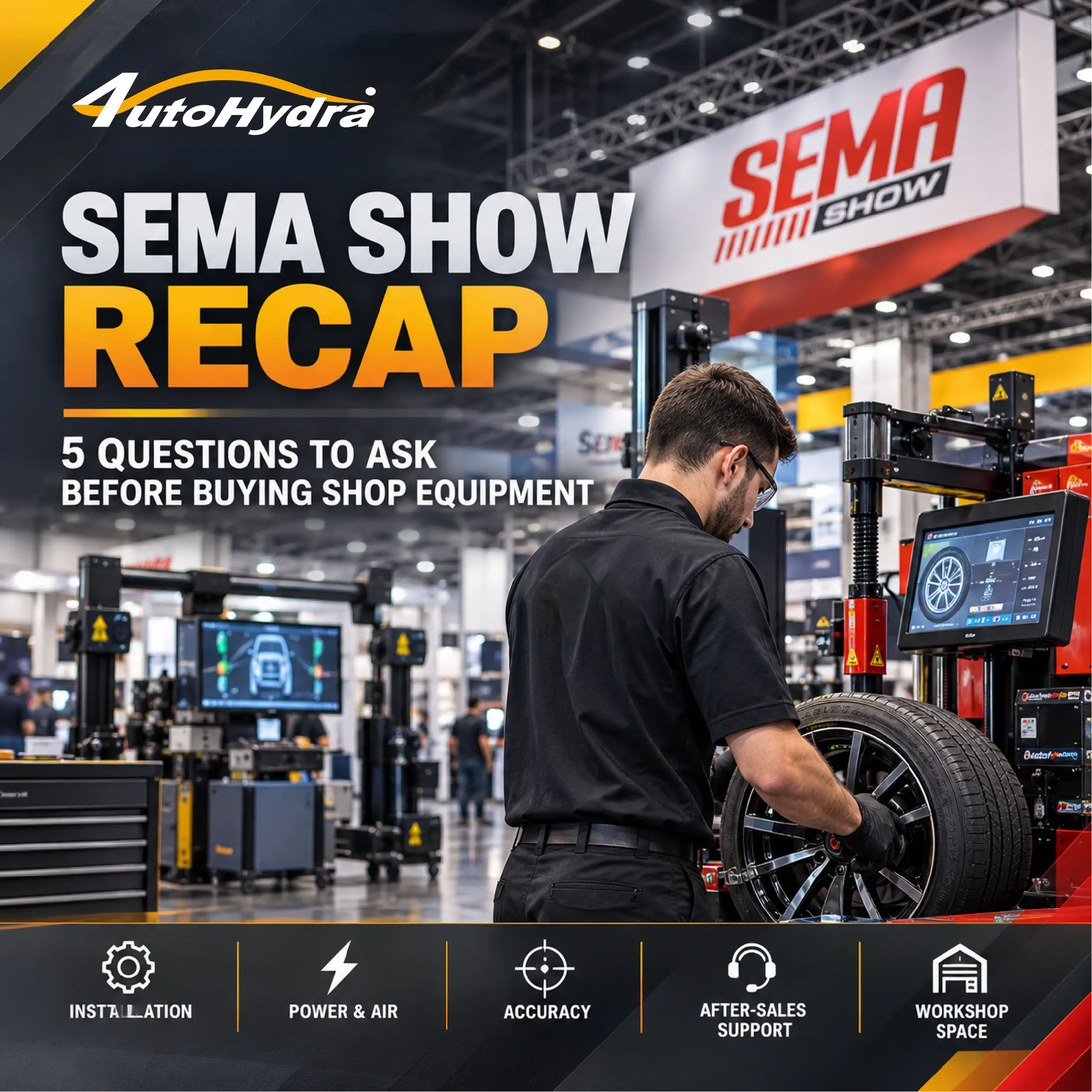
Every trade show produces two stories. One is told by the banners, the product sheets, and the photographs people post from the aisle. The other is told by the questions, and that is the one worth writing down, because questions reveal what owners are actually worried about when the sales pitch is over and the invoice is being signed.
We spent the week at the Las Vegas Convention Center showing our lift and tire equipment lines under the KATOOL and H'DMC names, with an outdoor display running alongside the indoor booths. We did not go looking for applause. We went because the floor is the only place where the people who run shops can corner the engineers who build the machines and ask the awkward questions — and because those questions, collected over four days, are a better buyer's guide than anything we could have drafted at the office.
📌 Short version: the questions shop owners asked at our booth were almost never about horsepower or headline capacity. They were about installation, what the building supplies, tolerance versus marketing numbers, who supports the machine in year three, and whether the equipment earns its square footage. Those five questions turn out to be a usable checklist for anyone buying garage equipment, at a show or off a website.
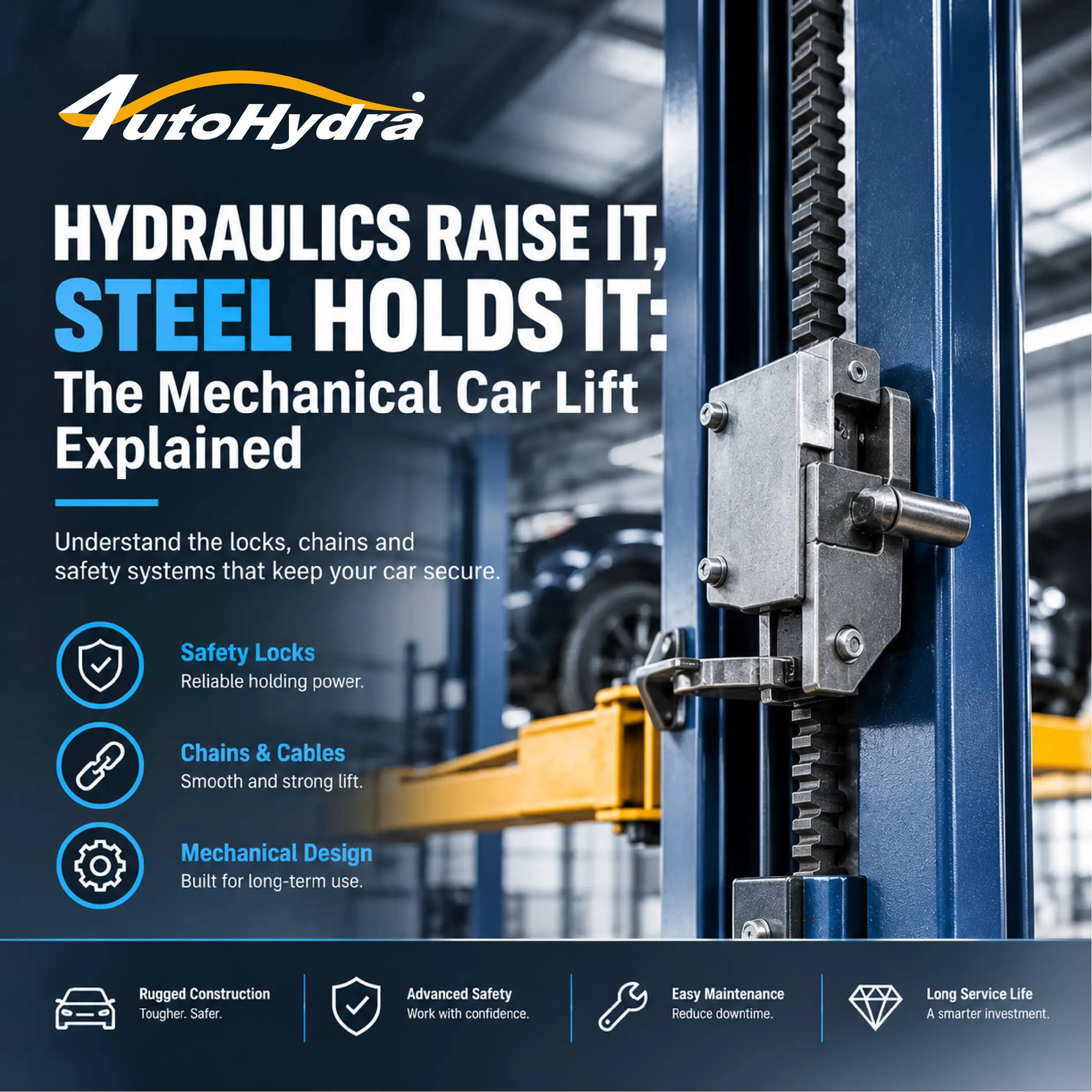
Not Sure Which Mechanical Car Lift To Trust?
Review lock type, release design, lifting member, and test margins in Auto-Hydra's two-post car lift lineup.
👉 Explore Two-Post Car Lift Solutions1. Why the Aisle Is Worth More Than the Catalog
A product page tells you what a machine can do. A shop owner walking past a machine tells you what it has to survive. Standing behind our own display cases, the most instructive moments were not the ones where somebody admired a weld — they were the ones where somebody crossed their arms and asked, in one variation or another, why they should believe the numbers.
That skepticism is healthy, and it is earned. This industry has spent years printing capacity ratings that assume perfect loads, centered pick-up points, level slabs, and clean power. Anyone who has lived with equipment knows that the machine is only as good as the conditions it is installed into. So what follows is not a recap of what we displayed. It is a recap of what we were asked, and the honest answer to each question.
2. "Do I Have to Anchor This to the Slab?"
This was the single most repeated question at the portable mid-rise scissor lift we had set up, the one under the banner that reads Lift Easy. Work Safe. The interest is easy to understand: an anchor bolt is a decision that lasts longer than the lift does. It means a permanent commitment to one bay in one building, a concrete layout you cannot walk back, and a problem if the lease changes or the shop moves three miles down the road.
The real answer is more nuanced than the brochure word "portable." A machine that does not require anchor bolts still requires a slab that can carry the load, a floor level enough that the structure is not sitting on a slope, and a plan for what happens when the lift moves. Mobility is a feature, but only if you use it deliberately.
That trade-off is why wheeled four-post designs exist. The 9,500 lb lift on casters rolls on mobility casters, reaches a 79-inch working height with more than six and a half feet of underbody clearance, lifts a full 9,500 pounds on 110V single-phase power, and completes a full rise in roughly 50 seconds. It ships with drip pans, runway approach ramps, jack trays, and a twelve-month parts term. That is a machine designed for a bay that has to stay flexible — including the common request of parking one vehicle over another when the shop is short on square footage.
⚠️ What we tell anyone who asks: "no anchors" is not the same as "no requirements." Read the floor-loading note, check the door height against the machine's overall height, and decide before delivery whether you want a lift that can move or a lift that will not.
3. "Can My Building Actually Run This?"
The second family of questions was electrical and pneumatic, and it came mostly from owners of small independent shops and mobile fleets — people working in buildings that were never designed as automotive facilities. Voltage came up first. A lift that needs 220V single-phase on a dedicated circuit is not an option in a bay that only has 110V at the wall, and finding that out after delivery is an expensive weekend with an electrician.
Air came up second, and it is the question most often answered badly. A tire machine that wants 116 to 145 PSI and a gun that cycles repeatedly will tell you within a week whether your compressor was sized for the tool list or for the tank it happens to have. The shop air conversation at our booth was surprisingly detailed: duty cycle, storage volume, line length, pressure drop at the tool, and whether a compressor sitting in the corner is being asked to feed a laser table and a tire bay at the same time.
For the many shops whose answer to that question is genuinely 110V, the 11,000 lb two-post lift is a good illustration of how the spec sheet should be read. Ours is a 2.2 kW 220V machine with an 11,000-pound rating, a 3.9-inch minimum pad height for low cars, a 98.4-inch drive-thru clearance, dual-side manual safety release, and CE approval backed by 115 percent dynamic and 150 percent static load testing. Those numbers only matter if they match your building, which is exactly the point our engineers kept making on the floor.
4. "How Level Is Level, and How Accurate Is Accurate?"
A question we liked, because it is the one that separates people who have owned measurement equipment from people who have only bought it. Headline accuracy claims are almost always best-case: the figure a machine produces once, in a quiet room, on a wheel the manufacturer chose. Owners want the repeatable number, obtained at speed, on the dirty rims that arrive on Monday morning.
The reason this question dominated the tire-equipment corner is that balancing time is money. A balancer that is precise but slow gets beaten by a shop that turns four wheels an hour, and a shop that trusts a fast balancer that is not repeatable ends up sending cars back. The two have to be stated together, and the machine should show its work — a measurement cycle the technician can see, not a result that appears from behind a cover.
Both sides of that argument are visible in the tire changer and balancer combo we had running at the booth. The changer takes wheels up to 47 inches on a 110V single-phase supply with a 1.5 kW gear motor, a separate 1.1 kW hydraulic unit, and a working air range of 116 to 145 PSI; it is designed to run without pry bars, with stainless steel clamps and a powered assist arm. The balancer measures in a seven-second cycle to plus or minus one gram on wheels up to 30 inches, spins at 180 RPM on a 3 mm steel-plate frame, and carries a moisture-, dust-, and static-resistant control board plus self-diagnostic calibration.
Precision questions did not stop at the wheel. Alignment drew the most skeptical crowd of all, because alignment is where an owner's reputation is on the table — a car that comes back twice is not a machine problem in the customer's eyes, it is a shop problem. The follow-up question was always some version of "how do you know it is still telling the truth six months from now?"
Which is the reason portable alignment is judged on its setup burden as much as its cameras. The 3D wheel alignment machine is a two-camera 3D system that runs on 100-240V at 50 or 60 Hz, works on either two-post or scissor lifts, handles wheel diameters from 250 to 800 mm and wheelbases from 1.6 to 2.1 metres, installs without periodic recalibration, and ships with a tablet, a 30-inch screen, and a printer. It weighs 200 kg as a package, which matters more than people expect when the machine has to live in a bay that does other things.
5. "Who Supports This Machine in Three Years?"
Nobody asks this question at the moment they are excited. Everyone asks it eventually, usually by phone, on the day something breaks. At the show we heard it in its mature form: owners who had already bought equipment once on price and were now reading the warranty text out loud, comparing what it said about parts, shipping, labor, and structural coverage.
We think this is the fairest test of a manufacturer, and it is the question we would rather answer than any capacity claim. A warranty that covers parts but excludes labor is honest if it says so plainly. A spare-part horizon that is undefined is not a minor omission — it is the difference between a machine that runs for a decade and a machine that becomes a very heavy paperweight when one control board fails.
What we kept telling people to do was simple: before ordering, ask for the parts list, ask what ships free, ask how a claim is documented, and ask whether the supplier will still exist in three years. Those are not hostile questions. They are the same questions we ask our own component vendors.
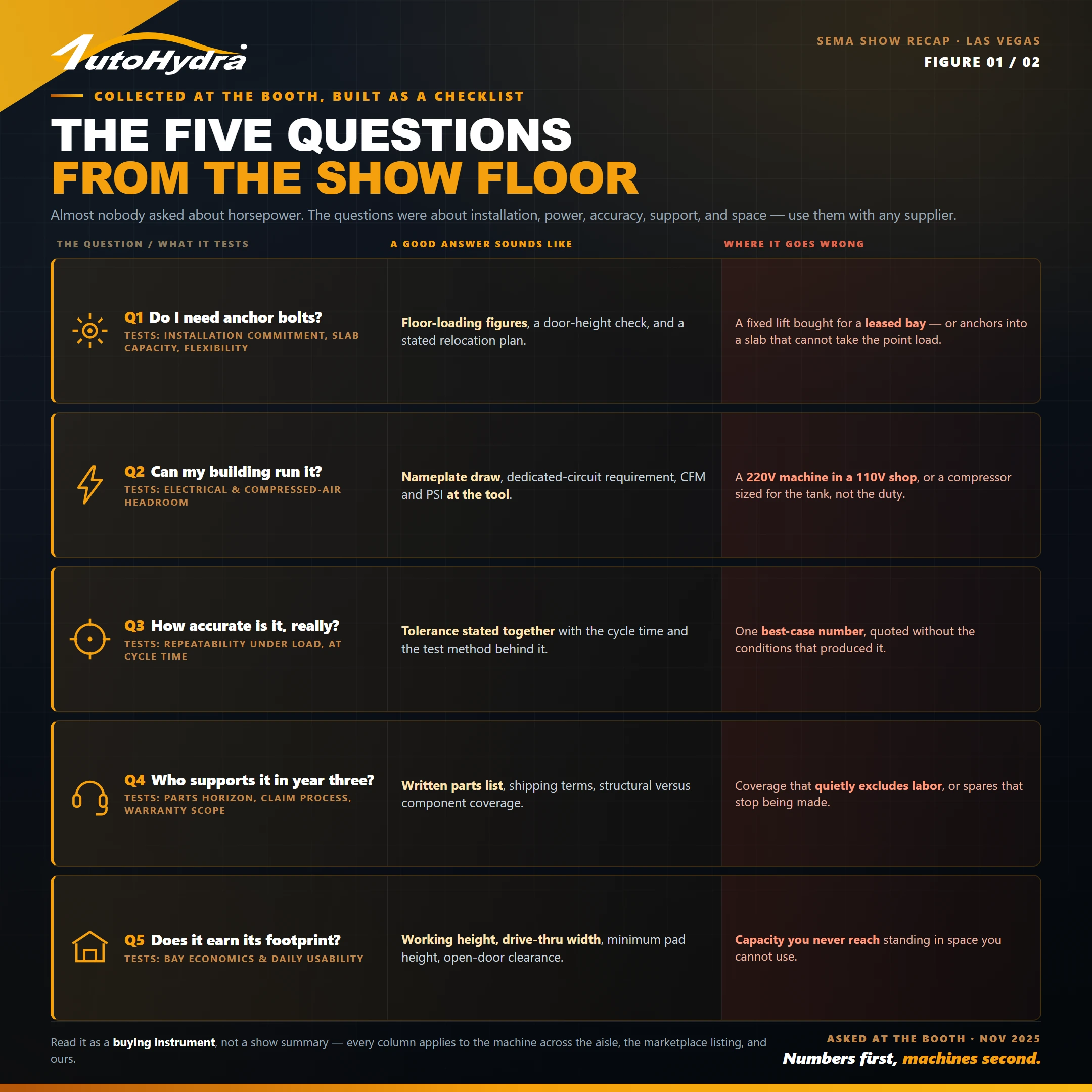
6. The Five Questions, and What a Good Answer Sounds Like
Collected at our booth in Las Vegas, translated into a checklist you can use with any supplier
| Question from the floor | What it really tests | A good answer sounds like | Where it goes wrong |
|---|---|---|---|
| Do I need anchor bolts? | Installation commitment, slab capacity, and future flexibility | Floor-loading figures, door height check, and a stated relocation plan | A fixed lift bought for a leased bay, or anchors into a slab that cannot take the point load |
| Can my building run it? | Electrical and compressed-air headroom | Nameplate draw, dedicated circuit requirement, CFM and PSI at the tool | A 220V machine in a 110V shop, or tools sharing a compressor sized for the tank, not the duty |
| How accurate is it, really? | Repeatability under load and at cycle time | Tolerance stated together with cycle time and the test method | A single best-case number, quoted without the conditions that produced it |
| Who supports it in year three? | Parts horizon, claim process, warranty scope | Written parts list, shipping terms, structural versus component coverage | Coverage that quietly excludes labor, or spares that stop being made |
| Does it earn its footprint? | Bay economics and daily usability | Working height, drive-thru width, minimum pad height, open-door clearance | Capacity you never reach standing in the space you cannot use |
Read that table as a buying instrument, not as a summary of our week. Every column applies equally to the machine across the aisle, to the one on a marketplace listing, and to ours. If a supplier cannot answer the middle two columns, the machine is not the problem.
7. "Does It Earn Its Square Footage?"
The question we least expected was the one about space, and it turned out to be the most useful. Owners do not buy capacity — they buy throughput per square foot. A sixteen-foot bay that can only hold one car at a time is a different business than the same bay with a machine that parks a second vehicle overhead or that rolls out of the way when a bigger job arrives.
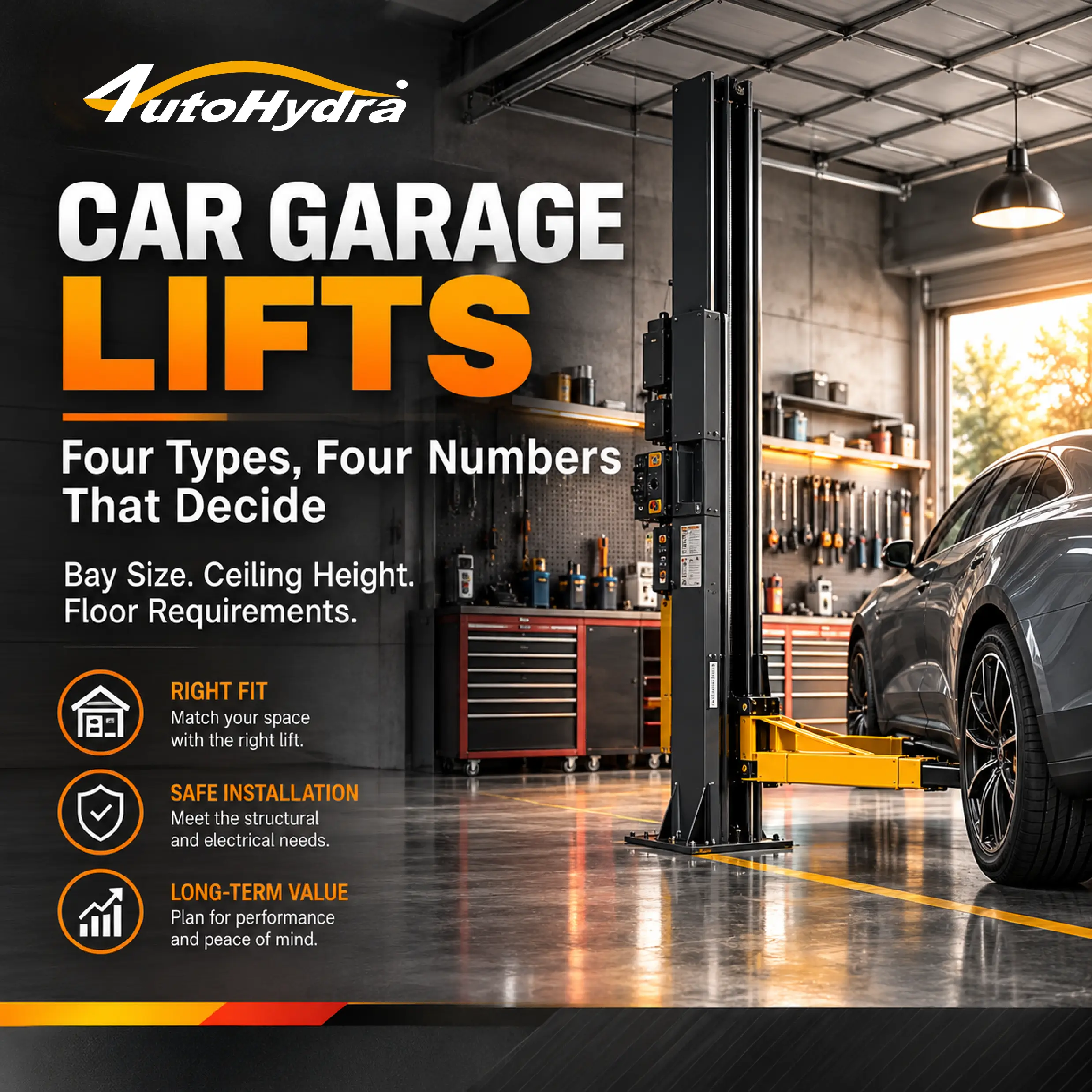
This is also why low-profile and mid-rise designs keep winning ground against full-height machines in tight buildings. A lift that reaches comfortable working height for tire, brake, and underbody service without needing a fourteen-foot ceiling is not a compromise product; for those premises it is the correct one. The corollary is equally true: a machine that stays flat when it is not in use returns floor area to the shop, and floor area is the cost most buyers forget to include.
The honest caveat, and we said this at the booth as often as we said anything, is that space-saving designs have real limits. Mid-rise travel will not give you the underbody access of a full-rise two-post for exhaust or suspension work, and a wheeled four-post will not do drive-thru alignments that a floorplate design handles easily. Buying the right machine means admitting what you will actually do with the bay.
8. What We Are Still Not Trying to Sell
It would be an odd recap that only listed strengths, so here is the part we were candid about on the floor. Several people asked us for equipment we do not build, and the answer every time was a referral rather than a substitute. Others asked about configurations our U.S. inventory does not currently carry, including complete shop air systems sized for industrial loads — a genuine gap for a shop that wants one supplier for lifts, tire machines, and air.
We were also asked, repeatedly, whether a machine that passes a test standard is automatically safe in a given garage. It is not, and no honest answer exists otherwise. Certification describes the machine as tested; it says nothing about the slab, the circuit, the operator, or the maintenance calendar.
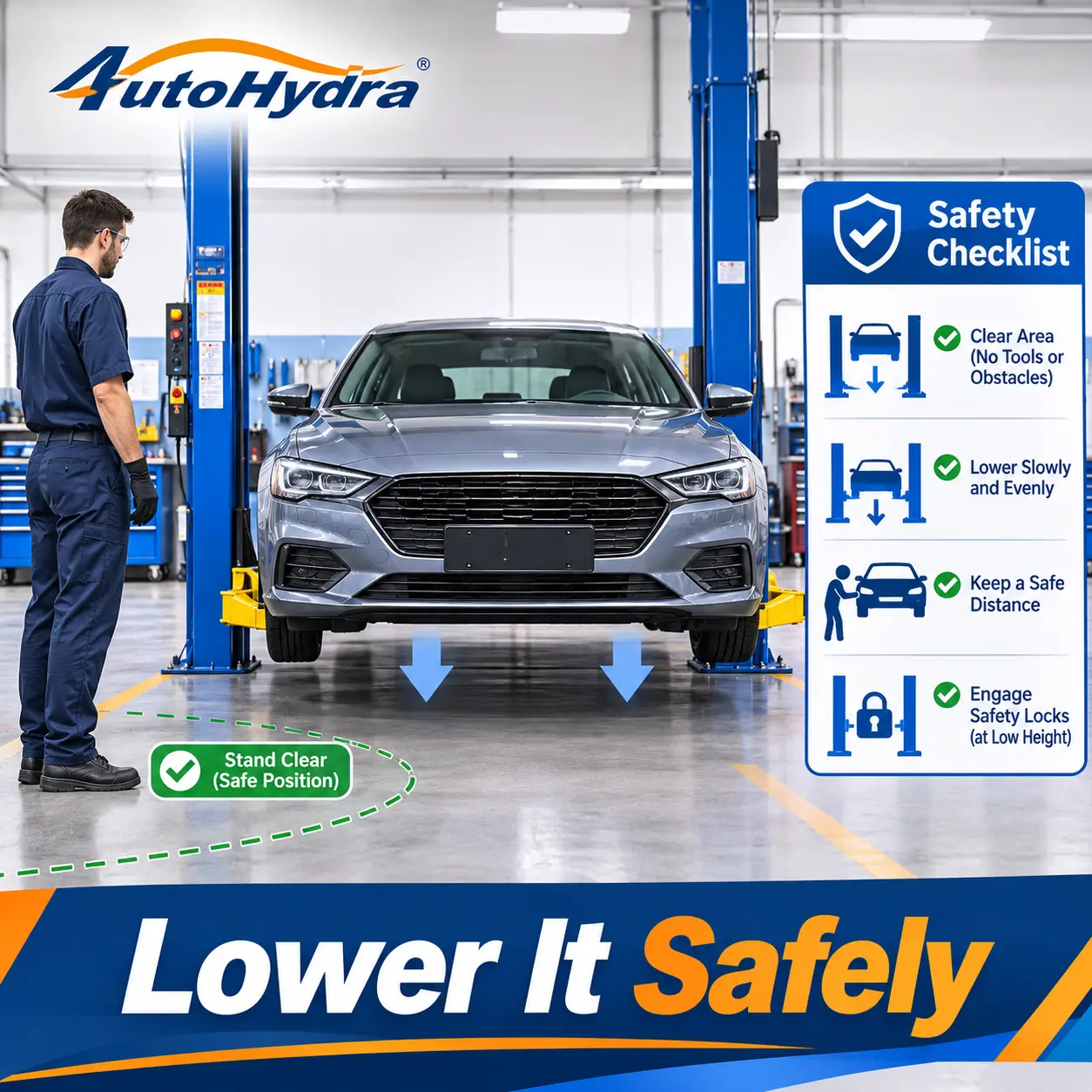
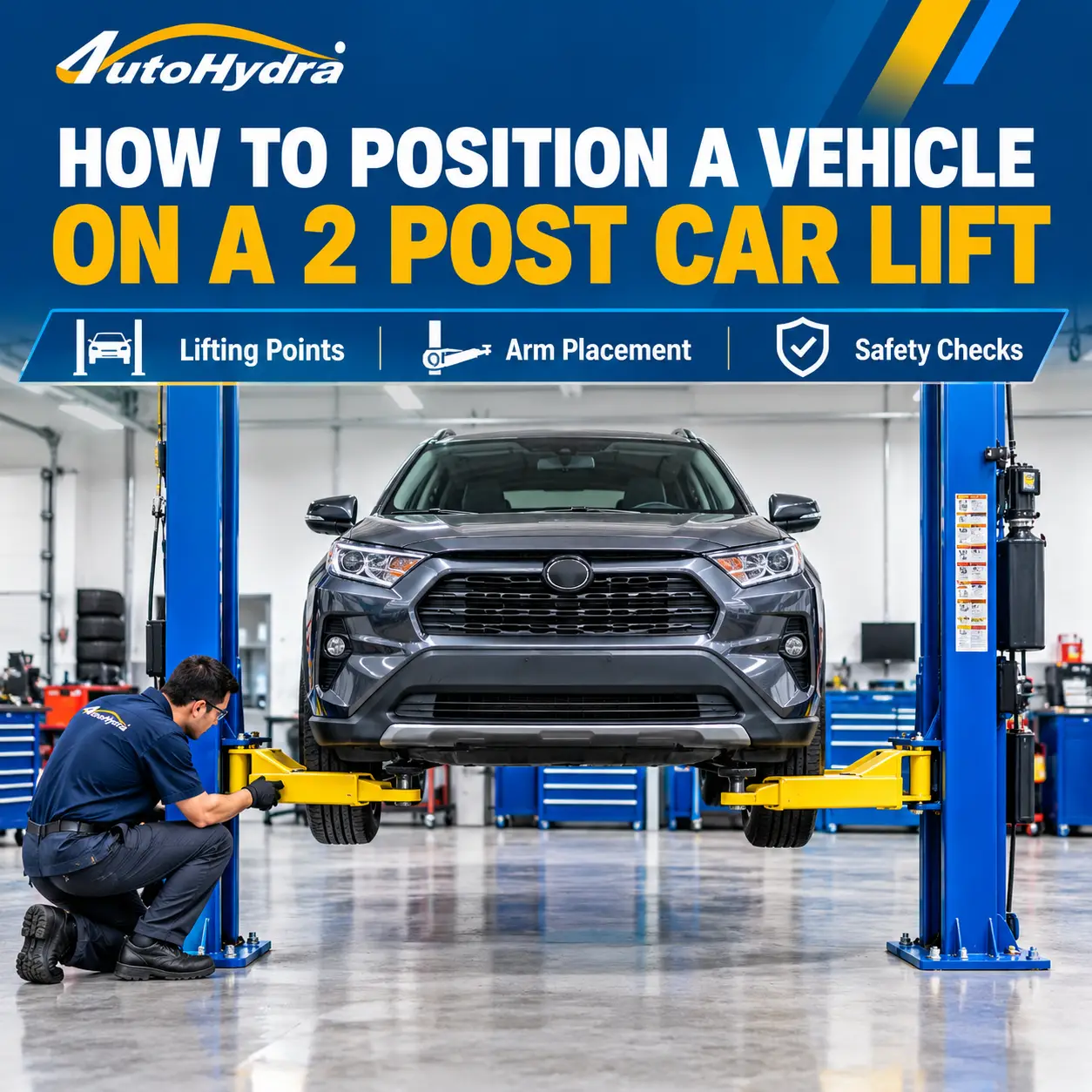
That gap between "certified" and "operated well" is where most real incidents live, and it is the subject of our vehicle positioning guide — the unglamorous work of finding the manufacturer's pick-up points, centering the load, and checking contact under the first few inches of rise. The follow-up matters just as much, which is why our lowering procedure article covers the safety-lock and release habits that decide whether a descent is routine or a very fast event.
🔧 We would rather lose a sale at the booth than make one that ends with a machine sitting unplugged because it needed 220V, a permit, or a floor the owner could not prepare.
9. If You Did Not Stop By the Booth
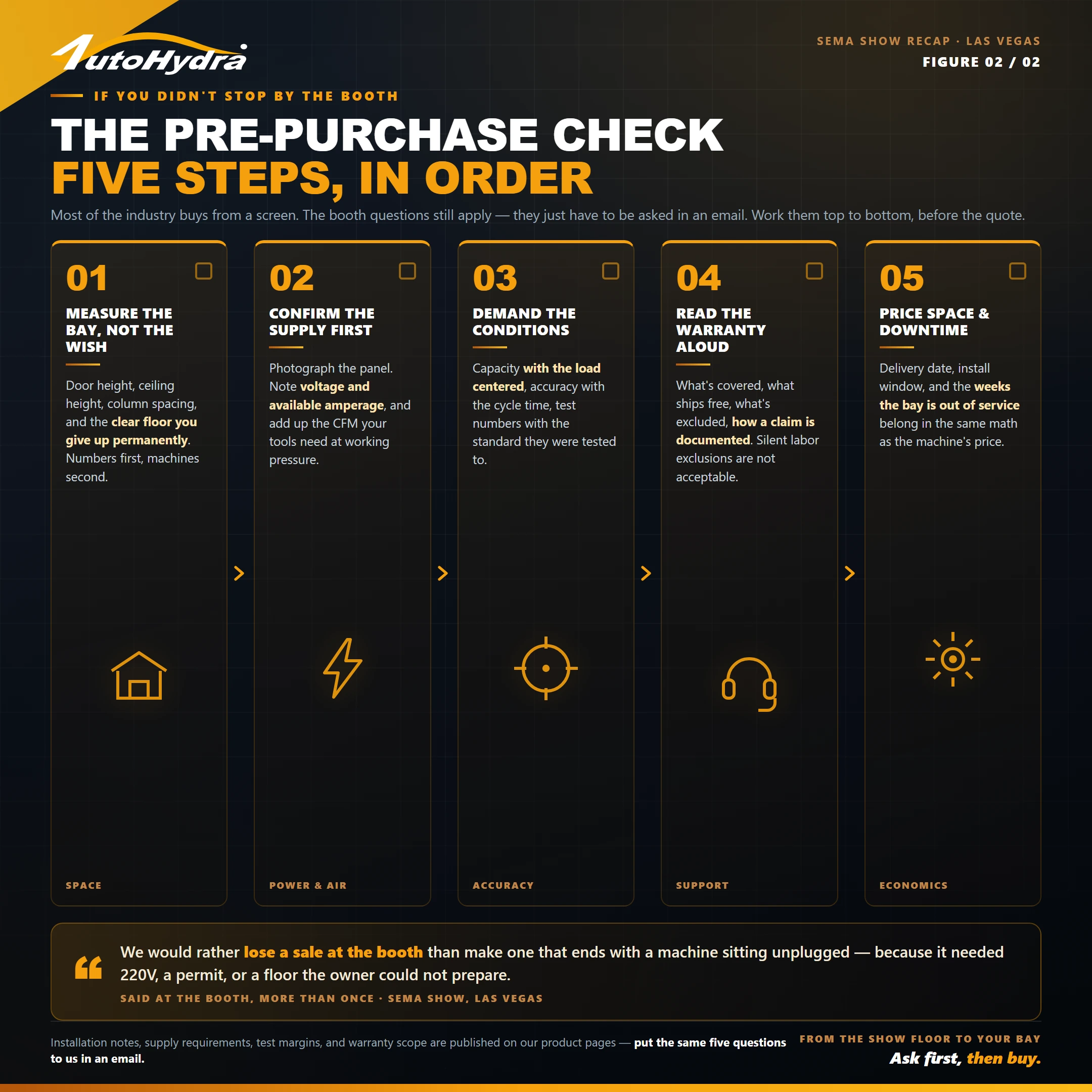
For anyone who buys equipment from a screen — which is most of the industry, most of the time — the show's questions still apply, they just have to be asked in an email instead. Here is the version we would send ourselves.
The five-question pre-purchase check
● Write down the bay, not the wish. Measure door height, ceiling height, column spacing, and the clear floor you are willing to give up permanently. Numbers first, machines second.
● Confirm the supply before the spec. Photograph the panel, note voltage and available amperage, and add up the CFM your tools need at working pressure — not the tank's volume.
● Demand the conditions behind every number. Capacity with the load centered, accuracy with the cycle time, and test percentages with the standard they were tested to.
● Read the warranty out loud. What is covered, what ships free, what is excluded, and how a claim gets documented. Labor exclusions are common; silent ones are not acceptable.
● Price the space and the downtime. Delivery date, installation window, and the weeks the bay is out of service belong in the same calculation as the machine's price.
We will keep building to those questions, because that is what the floor is for. Standing behind a machine while a stranger tries to find the reason not to buy it is uncomfortable, and it is the best product review available.
Frequently Asked Questions
Is exhibiting at SEMA a meaningful signal when buying shop equipment?
Only if you use it as a test rather than a badge. Presence at a show tells you a manufacturer has the volume and organization to build and ship display-quality machines, and it gives you a chance to ask hard questions face to face. It says nothing about whether a specific model suits your slab, circuit, or bay. Judge the answers, not the booth.
Should I avoid anchor-bolt-free lifts because they are less solid?
No. A properly designed portable or wheeled lift carries its load through its own structure and a floor that is rated for the point loads, and it can be just as stable as an anchored machine when used within its stated capacity. The real risk is treating "no anchors" as "no installation requirements." Check floor loading, levelness, door height, and whether you will actually move the machine.
How do I know whether my shop electrical supply is enough?
Read the nameplate for voltage, phase, and motor power, then compare it with the circuit available at the install location, including the breaker and wire size. Most residential-duty machines run on 110V single-phase; many commercial lifts need 220V single-phase on a dedicated circuit. Photograph your panel before ordering, and have an electrician confirm the run to the bay.
Does compressor size really affect tire equipment performance?
It is one of the most common causes of dissatisfied shops. Tire machines and impact guns need pressure at the tool, not just pressure at the tank, and line length, fittings, and simultaneous use all reduce it. Add the CFM the tool list actually consumes, compare it with the compressor's delivered flow at working pressure, and size for the busiest hour rather than the average.
What should I ask a vendor that I would have asked at the show?
Five things, in this order: the installation requirements for your specific bay, the electrical and air supply needed, the accuracy or capacity figure together with the conditions that produced it, the written warranty scope including shipping and labor, and the spare-parts horizon with expected lead times. If a supplier answers all five in writing, the rest of the decision is comparison shopping.
From the Show Floor to Your Bay
Everything on this list — installation notes, supply requirements, test margins, and warranty scope — is published on our product pages, so you can put the same five questions to us in an email and get the same answers we gave in Las Vegas.
🛒 Browse tire and garage equipment
📞 Talk to an equipment specialist
✔ Factory-direct pricing · ✔ 20+ years building lifts and tire equipment · ✔ In-stock U.S. warehouses · ✔ Lifetime technical support
Recommended News
View all