Vehicle Hoist Technology: Smarter, Safer, and Ready for Electric Vehicles
Summary
The vehicle hoist is quietly going through its biggest technological shift in thirty years. For decades, a hoist was a simple equation: an electric motor, a hydraulic pump, two cylinders, and a set of mechanical locks. In 2026, the equation has changed. Electro-hydraulic control, sensor-based diagnostics, and the rapid rise of electric vehicles — which weigh 20–30% more than comparable gasoline vehicles — are reshaping what a modern vehicle hoist looks like, how it is specified, and how it is maintained.This guide is written by Auto-Hydra’s engineering and technology team to help U.S. shop owners, fleet managers, and home-garage builders understand the technology inside today’s vehicle hoists — and make a purchase decision based on engineering reality rather than marketing claims.
1. The Evolution of the Vehicle Hoist: From Mechanical to Smart
Understanding where the technology came from makes it much easier to evaluate where it is going. Four generations define the modern vehicle hoist.
📌 Generation 1 — Pure hydraulic (1960s–1980s)
● Single-speed motors, gear pumps, and manually engaged safety locks.
● No certification regime; failures were common and documentation was rare.
📌 Generation 2 — Electro-hydraulic standardization (1990s–2000s)
● Standardized 110V/220V power units, equalizing cables, and automatic lock rails.
● The ALI certification era began — independent structural testing became the market gatekeeper.
📌 Generation 3 — Safety refinement (2010s)
● Anti-surge valves, triple-position locks, and improved seal materials extended service life.
● CE marking opened global trade; U.S. warehouses became the distribution standard.
📌 Generation 4 — Smart and EV-ready (2020s)
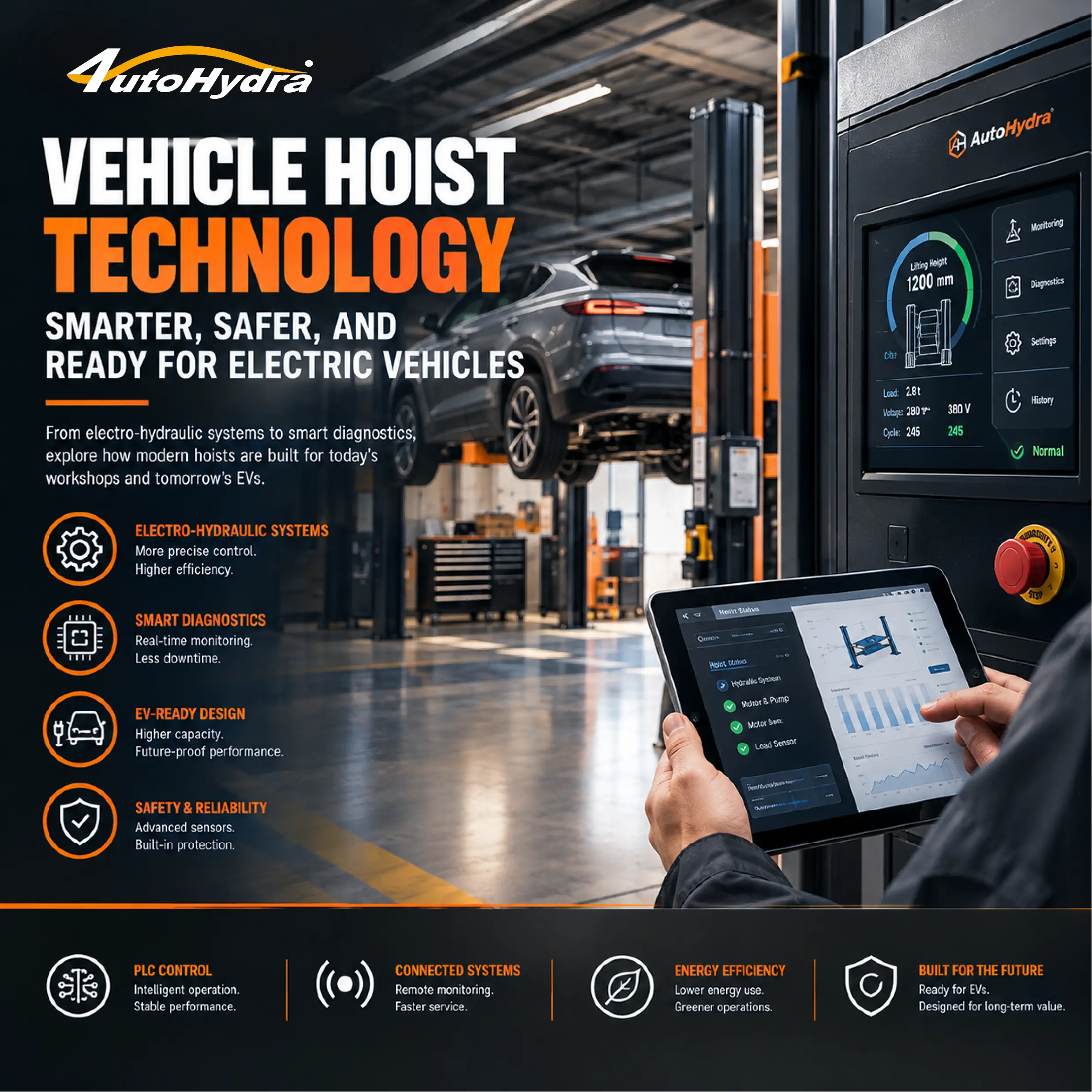
● Cycle counters, lock-position sensors, overload detection, and app-based alerts are entering the market.
● Capacity and lift-point design now account for battery-electric vehicles as a standard load case.
2. The Heart of the Machine: Electro-Hydraulic Power Unit Design
Every vehicle hoist lives or dies by its power unit — the motor, pump, reservoir, and valve block that convert electrical energy into controlled hydraulic force. This is where the real engineering differences between brands hide.
⚙ Gear pump vs vane pump
● Gear pumps are the workhorse: simple, tolerant of contamination, and economical — standard on most 9,000–10,000 lb hoists.
● Vane pumps run quieter and deliver smoother flow; they appear on premium commercial units where noise and cycle smoothness matter.
⚙ Motor sizing and supply
● Typical units use 2–3 HP motors; 110V single-phase suits residential and light-commercial bays.
● 220V single-phase or 3-phase supplies reduce amperage draw and run cooler under high duty cycles.
⚙ Duty cycle: the spec most buyers miss
● Duty cycle is the percentage of a 10-minute window the hoist can run at full load without overheating.
● Residential units are typically rated around 20%; commercial units 50% or higher.
● Buying a 20%-duty hoist for a 15-car-per-day shop is the most common specification error we see in U.S. service tickets.
📖 For the physics behind the power unit — Pascal’s Law, cylinder bore sizing, and pressure math — see our How a Hydraulic Car Lift Works. The fundamentals apply identically to every vehicle hoist regardless of generation.
3. Smart Vehicle Hoists: Sensors, Diagnostics, and Connectivity
“Smart” is an overused word, so let us be precise about what sensor technology actually does on a 2026 vehicle hoist — and what is still marketing vapor.
🧠 What is real today
● Cycle counters: log every raise/lower event so maintenance intervals are usage-based, not calendar-based.
● Lock-position sensors: confirm both safety locks are fully engaged before the operator works under the vehicle.
● Overload detection: pressure transducers flag loads above rated capacity before structural stress accumulates.
● App alerts: Bluetooth or Wi-Fi modules push fault codes and maintenance reminders to a phone or shop tablet.
🧠 What is still vapor
● Fully autonomous lifting without operator input — no certified system exists for general repair bays.
● “Self-diagnosing” hydraulics that replace physical inspection — sensors supplement, never replace, hands-on checks.
💡 The practical value of smart features is predictive maintenance: a hoist that tells you its cable stretch is drifting, or its lock pawl is wearing, fails far less often than one discovered broken on a Monday morning.
🔧 Sensor alerts work best when paired with a disciplined schedule — our Maintenance & Safety Checklist provides the daily-to-annual task list that turns diagnostic data into documented uptime.
4. The EV Factor: Why Electric Vehicles Are Changing Hoist Specifications
Battery-electric vehicles are the single biggest load-case change the vehicle hoist industry has faced since the light truck boom. Three engineering consequences follow directly from the battery pack.
🔋 Consequence 1: Weight
● EVs carry 20–30% more mass than comparable gasoline vehicles; a mid-size electric SUV commonly weighs 4,800–5,500 lbs.
● Full-size electric pickups exceed 7,000–8,500 lbs — at the very edge of a standard 9,000 lb hoist’s comfortable margin.
● Shops planning EV service should specify 10,000 lb or higher capacity as the new baseline.
🔋 Consequence 2: Lift points
● The battery pack occupies the underbody, so OEM lift points move and often require dedicated adapter pads.
● Lifting an EV on the wrong point can crack the battery enclosure — a five-figure repair and a safety incident.
● Arm reach and adapter availability should be verified per vehicle model before the first EV enters the bay.
🔋 Consequence 3: Center of gravity
● The low, centralized battery mass lowers the center of gravity — good for stability once lifted.
● But the extra mass increases inertia during raising and lowering, making controlled descent valves more important.
🚘 For light and mid-size EVs, the 9,000 lb 2-post hoist covers most passenger EVs with correct adapters, while the 8,500 lb 4-post hoist handles EV storage without any frame contact at all — the safest approach when lift-point data is uncertain.
5. Conventional vs Electro-Hydraulic vs Smart Vehicle Hoists
The table below compares the three technology tiers you will encounter when shopping for a vehicle hoist in 2026.
| Feature | Conventional | Electro-Hydraulic | Smart-Connected |
|---|---|---|---|
| Lift Control | Single motor / valve | Proportional valve control | Sensor-closed loop |
| Synchronization | Equalizing cable | Cable or flow divider | Monitored + alerted |
| Overload Protection | Relief valve only | Relief valve + gauge | Transducer + auto stop |
| Lock Verification | Visual / audible | Mechanical indicator | Position sensor |
| Maintenance Alerts | Calendar-based | Calendar-based | Usage-based (cycles) |
| Best For | Home garage | Independent shop | Fleet / dealership |
📊 Table: Technology tiers of modern vehicle hoists. Most 2026 models sold in the U.S. sit in the electro-hydraulic tier.
6. Energy Efficiency and Operating Cost
A vehicle hoist is one of the most energy-frugal machines in a repair bay — but at commercial cycle counts, the numbers still deserve attention.
● Power is drawn only during the rise phase — typically 30–60 seconds per cycle; descent uses gravity and zero motor power.
● A busy shop running 20 cycles per day consumes roughly 0.5–1.0 kWh daily — under $40 per year at average U.S. electricity rates.
● The real cost driver is not electricity but downtime: an efficient power unit that runs cool lasts longer and holds its duty cycle in summer heat.
● Spec tip: if your bay exceeds 90°F in summer, choose a unit with an aluminum reservoir or an optional oil cooler.
7. Safety Technology Advances That Matter in 2026
🛡 Five safety systems worth demanding on any new vehicle hoist:
● Anti-surge (velocity fuse) valves — stop free-fall instantly if a hydraulic line ruptures.
● Automatic lock engagement — locks set on every rise without the operator remembering a lever.
● Mechanical + hydraulic redundancy — the vehicle is always held mechanically, never by fluid pressure alone.
● Overload relief calibration — factory-set and documented, not field-adjustable.
● ALI/CE certification — independent proof the structure passed load testing to ANSI/ALI ALCTV or the Machinery Directive.
None of these features replace operator training. The safest hoist in the world is only as safe as the person running it — train every operator, document every inspection.
8. What This Technology Shift Means for Your Next Purchase
Match the technology tier to your actual operation — paying for fleet-grade connectivity in a one-car home garage is wasted money, while a 15-bay shop running conventional-only hardware is buying future downtime.
Home garage → standard electro-hydraulic unit, 9,000–10,000 lb, ALI-certified
Independent shop → commercial duty cycle (50%+), 10,000 lb+ if EVs are in your future
Fleet / dealership → smart-connected features, usage-based maintenance, documented inspections
Low-ceiling bays → scissor architecture instead of post architecture
🔩 Where ceiling height rules out post hoists, the mid-rise scissor hoist and the full-rise scissor KT-X95 deliver the same electro-hydraulic technology in a column-free footprint.
Frequently Asked Questions
What is an electro-hydraulic vehicle hoist?
An electro-hydraulic vehicle hoist uses an electric motor to drive a hydraulic pump, with electrical valves and controls managing the lift cycle — as opposed to older purely mechanical or manual systems. Nearly every vehicle hoist sold in the U.S. today is electro-hydraulic; the differences between models lie in pump quality, valve design, duty cycle rating, and whether any sensor-based monitoring is added.
Are smart vehicle hoists worth the extra cost?
For fleets and high-volume shops, yes — usage-based maintenance alerts and lock-position verification directly reduce unplanned downtime and liability. For a home garage that lifts two cars a week, the payback is weak; a well-built conventional electro-hydraulic hoist with disciplined manual maintenance will serve just as well for less money.
Can a standard vehicle hoist lift an electric vehicle?
Usually yes, but verify two things: capacity and lift points. Most passenger EVs fit within a 9,000–10,000 lb hoist’s rating, but full-size electric pickups can approach the limit. More importantly, EV underbodies are occupied by battery packs, so you must use the OEM-specified lift points — often with adapter pads — to avoid damaging the enclosure. When in doubt, a 4-post runway hoist avoids frame contact entirely.
How much electricity does a vehicle hoist use?
Very little. The motor only runs during the rise phase — roughly 30–60 seconds per cycle — and descent is gravity-powered. Even a busy shop running 20 cycles a day uses under 1 kWh daily, which is typically less than $40 per year. Energy cost should never be the deciding factor; duty cycle rating and power-unit cooling matter far more.
How long does a modern vehicle hoist last, and can it be upgraded?
A well-maintained vehicle hoist delivers 15–20 years of service. The steel structure rarely fails; the power unit, seals, and cables are the consumables. Many owners extend life by upgrading the power unit or adding monitoring later — but only with manufacturer-approved components, since any structural or load-path modification voids certification.
Ready to Specify Your Next Vehicle Hoist with Confidence?
Auto-Hydra’s engineering team can walk through your vehicle mix, cycle count, ceiling height, and EV plans to match the right hoist technology to your bay — backed by ALI/CE certification, U.S. warehouse stock, and lifetime technical support.
📞 Talk to the Engineering Team
✔ ALI/CE certified · ✔ EV-ready capacity · ✔ U.S. warehouse stock · ✔ Lifetime technical support
Recommended News
View all