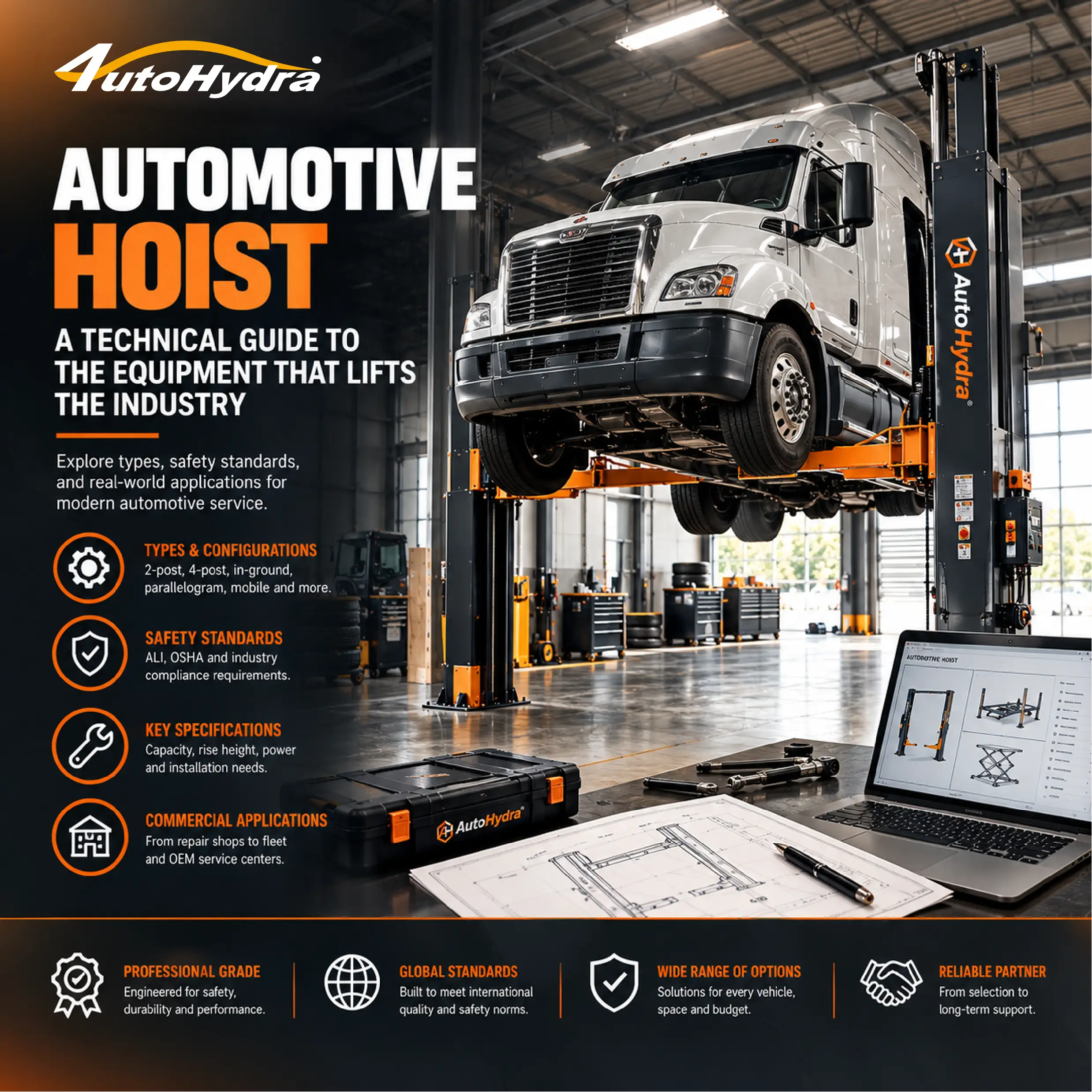
Automotive Hoist: A Technical Guide to the Equipment That Lifts the Industry
Summary
The term automotive hoist describes the broadest category of vehicle lifting equipment used in repair shops, fleet depots, and commercial service bays across the United States. While “car lift” is the common American consumer term, “automotive hoist” is the industry-standard engineering term favored by professional technicians, fleet managers, and equipment buyers — and it encompasses far more than the 2-post and 4-post models most people picture. In-ground hoists, parallelogram hoists, mobile column hoists, and heavy-duty truck hoists all fall under the umbrella, and each is engineered for a specific duty cycle, vehicle class, and facility layout.This guide is written by Auto-Hydra’s commercial equipment division to give U.S. shop owners, fleet managers, and facility engineers a comprehensive technical understanding of automotive hoist types, safety standards, installation requirements, and how to match the right hoist to the right application.
1. Hoist vs Lift: Understanding the Terminology
The words “hoist” and “lift” are often used interchangeably, but they carry different connotations in the automotive equipment industry.
📝 Why the word matters:
● “Car lift” is a consumer and residential term, commonly used in marketing and retail catalogs.
● “Automotive hoist” is the technical and commercial term, used in ALI standards, OSHA regulations, and equipment procurement documents.
● In UK, Australian, and Commonwealth markets, “vehicle hoist” is the standard term across all segments.
Both words describe the same fundamental equipment: a hydraulic or electro-mechanical device that raises a vehicle to a working height for service, inspection, or storage. The difference is in context, not in physics.
⚙ For the underlying hydraulic engineering, our Hydraulic Car Lift Guide covers Pascal’s Law, cylinder design, and pressure calculations that apply to every type of automotive hoist, regardless of what you call it.
2. Six Types of Automotive Hoists and When to Use Each
The automotive hoist family includes six major structural categories, each engineered for a different use case and vehicle class.
🚘 2-Post Hoist (Above-Ground)
● Two columns with symmetric or asymmetric arms lifting by the frame or pinch welds.
● Best for: general repair bays, tire shops, quick lube centers, dealership service departments.
● Capacity: 7,000–15,000 lbs; standard bay model is 9,000–10,000 lbs.
🔧 The 9,000 lbs 2-post overhead hoist is the workhorse of U.S. independent repair shops, offering full undercarriage access with ALI-certified safety.
🚛 4-Post Hoist (Above-Ground)
● Four columns supporting two runways; vehicle drives on, no frame contact needed.
● Best for: storage, alignment bays, emissions testing, light service with rolling jacks.
● Capacity: 7,000–18,000 lbs.
🚗 The 8,500 lbs 4-post parking hoist is the most common 4-post configuration for residential garages and light-commercial storage bays.
✂ Scissor Hoist
● Cross-linked arms that fold flat and rise vertically; no columns, no overhead structure.
● Best for: quick lube, tire service, brake work, low-ceiling facilities, and mobile service.
● Capacity: 6,000–10,000 lbs; mid-rise reaches 48–53 in; full-rise reaches 67–72 in.
🔩 The mid-rise scissor hoist and full-rise scissor hoist KT-X95 cover both mid-rise and full-rise scissor applications.
⚓ In-Ground Hoist
● Hydraulic cylinders recessed into the floor; the vehicle is lifted from below the slab.
● Best for: high-volume dealerships and OEM service centers where floor space and cleanliness are critical.
● Capacity: 8,000–30,000 lbs; some models use twin pistons under the frame.
⚡ Parallelogram Hoist
● Platform lift using parallelogram linkage instead of scissor arms; the platform rises perfectly level.
● Best for: wheel alignment, brake service, and undercarriage inspection where precise horizontal positioning matters.
● Capacity: 9,000–18,000 lbs.
🚚 Mobile Column Hoist
● Two or four free-standing columns on wheels, each with its own lifting mechanism and battery pack.
● Best for: fleet maintenance, heavy-duty truck bays, and facilities where bay layout changes frequently.
● Capacity: 12,000–40,000 lbs per set of columns.
3. Automotive Hoist Type Comparison: At a Glance
The table below summarizes the six automotive hoist types across key specifications and use cases. Use it as a quick filter before diving into detailed evaluation.
| Hoist Type | Capacity | Rise Height | Floor Type | Primary Use | Portability |
|---|---|---|---|---|---|
| 2-Post | 7k–15k lbs | 72–74 in | 6 in concrete | Full service | Fixed |
| 4-Post | 7k–18k lbs | 70–82 in | 4–6 in | Storage / alignment | Caster option |
| Scissor | 6k–10k lbs | 48–72 in | 4–6 in | Tire / brake | Portable |
| In-Ground | 8k–30k lbs | 72–80 in | Floor pit | Dealer service | Permanent |
| Parallelogram | 9k–18k lbs | 68–78 in | 4–6 in | Alignment | Fixed |
| Mobile Column | 12k–40k lbs | 65–72 in | 6 in concrete | Fleet / HD truck | Highly mobile |
📊 Table: Comparison of six automotive hoist types across capacity, rise, floor requirements, use case, and portability.
4. Automotive Hoist Safety Standards: What the Law Requires
An automotive hoist is classified as industrial lifting equipment, and it is governed by federal standards, state regulations, and industry consensus codes. Commercial operators must comply; residential buyers should demand the same standards.
📜 ALI Certification
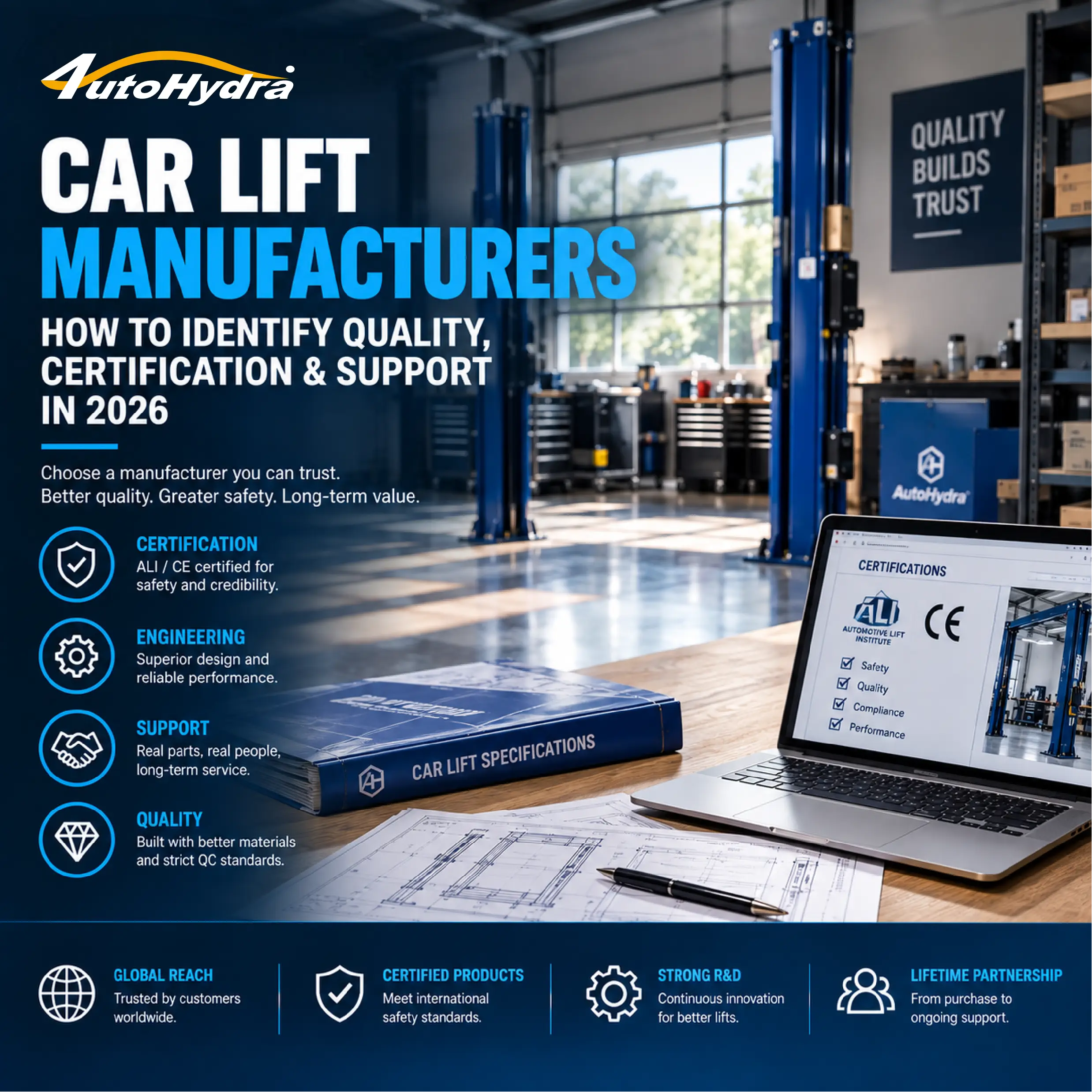
● The Automotive Lift Institute (ALI) is the only independent third-party certification body for vehicle lifts and hoists in North America.
● ALI-certified hoists pass structural load testing, safety lock verification, and label compliance audits per ANSI/ALI ALCTV.
● Insurance companies increasingly require ALI certification for commercial hoist coverage.
📜 ANSI / ALI Standards
● ANSI/ALI ALCTV: Construction, testing, and validation of new automotive hoists.
● ANSI/ALI ALOIM: Periodic inspection and maintenance of installed hoists — required annually for commercial installations.
📜 OSHA Requirements
● OSHA 1910.66 governs powered platforms and lifting equipment in commercial workplaces.
● OSHA requires written maintenance records, documented operator training, and annual inspections.
● Failure to comply can result in citations of $15,000+ per violation.
⚠ The bottom line: if you operate a commercial shop in the United States, your hoist must be ALI-certified, inspected annually, and operated by trained personnel. Anything else is a liability — and not just a financial one.
5. Capacity Sizing: How to Match Hoist Rating to Vehicle Fleet
The #1 mistake commercial buyers make is sizing a hoist to their average vehicle instead of their heaviest vehicle. A hoist must handle the heaviest load you will ever put on it — with margin.
🏋 The 20% margin rule:
● Always choose a hoist with at least 20% more capacity than your heaviest vehicle.
● Example: if your heaviest vehicle is a 7,000 lb 3/4-ton pickup, a 9,000 lb hoist is the minimum.
● This margin accounts for tool weight, fuel load, cargo, and imperfect load distribution.
🚚 Vehicle class reference
● Class 1–3 (cars, light trucks, vans): 7,000–10,000 lb hoist
● Class 4–5 (medium trucks, step vans): 12,000–18,000 lb hoist
● Class 6–7 (heavy trucks, buses): 20,000–40,000 lb hoist
● Class 8 (semi-tractors, trailers): 40,000+ lb mobile column or in-ground hoist
6. Installation Considerations for Commercial Automotive Hoists
Installing a commercial automotive hoist is a construction project, not an equipment unboxing. The site must be engineered to handle the loads before the first bolt is torqued.
(1) Floor engineering — confirm slab thickness, PSI rating, and rebar schedule
(2) Anchor bolt specification — use only manufacturer-approved wedge or sleeve anchors
(3) Electrical service — 220V single-phase for most models; 3-phase for heavy-duty units
(4) Bay layout — clearance for door swing, toolboxes, and adjacent hoists
(5) Oil containment — many jurisdictions require secondary containment for in-ground models
(6) Certification of installation — must be signed off by a qualified installer per ALI requirements
🔧 For ongoing care after installation, our Car Lift Maintenance & Safety Guide provides the daily-to-annual task schedule required by ANSI/ALI ALOIM and OSHA.
7. Heavy-Duty Automotive Hoists: When 9,000 lbs Is Not Enough
Fleet operators, trucking companies, and heavy-duty repair shops need hoists that can handle Class 6–8 vehicles — 20,000 to 80,000 lbs and beyond. These are not scaled-up 2-posts; they are fundamentally different equipment.
🚚 Mobile column hoists
● Four or six battery-powered columns that roll into position, each lifting one wheel end.
● Capacity: 12,000–20,000 lbs per column; four columns = 48,000–80,000 lbs total.
● Key advantage: usable anywhere in the facility, no floor modification required.
⚓ In-ground piston hoists
● Single or twin hydraulic pistons recessed into the floor, lifting by the frame or underbody.
● Capacity: 15,000–30,000 lbs per piston.
● Key advantage: zero above-floor footprint when lowered; keeps the bay clean and flexible.
⚡ Heavy-duty parallelogram
● Full-platform lift with parallelogram linkage for heavy trucks and buses.
● Capacity: 18,000–40,000 lbs.
● Key advantage: perfectly level platform, ideal for alignment and inspection.
8. Common Misconceptions About Automotive Hoists
❌ Five myths we hear from U.S. buyers:
● Myth: “All 9,000 lb 2-post hoists are the same.” — Reality: steel thickness, weld quality, and cylinder design vary dramatically between brands.
● Myth: “In-ground hoists are obsolete.” — Reality: modern in-ground hoists use environmentally sealed pistons and are still preferred by high-volume dealerships.
● Myth: “ALI certification is just a sticker.” — Reality: ALI-certified hoists pass independent structural load testing that uncertified brands may fail.
● Myth: “Mobile column hoists are for trucks only.” — Reality: light-duty mobile columns are increasingly popular in multi-bay shops that reconfigure bays by shift.
● Myth: “Annual inspection is optional for small shops.” — Reality: OSHA requires documented annual inspections for all commercial lifting equipment.
Frequently Asked Questions
What is the difference between an automotive hoist and a car lift?
There is no technical difference — both words describe the same equipment. “Automotive hoist” is the industry and technical term used in standards documents, procurement, and commercial settings. “Car lift” is the consumer and marketing term used in retail and residential contexts. In UK and Australian markets, “vehicle hoist” is the standard term across all segments.
What type of automotive hoist is best for a commercial repair shop?
For a general repair shop doing everything from oil changes to transmission work, a 9,000–10,000 lb 2-post overhead hoist is the most versatile single hoist. It provides full undercarriage access for all service types and is the standard configuration in U.S. independent repair bays. Add a 4-post alignment hoist if wheel alignment is a revenue stream, and a scissor hoist for quick lube and tire service.
Do automotive hoists need to be inspected annually?
For commercial installations in the United States, yes — ANSI/ALI ALOIM and OSHA both require documented annual inspection by a qualified person. The inspection must include load testing, safety lock verification, and structural condition assessment. For residential use, annual inspection is not legally required but is strongly recommended for safety.
What is an in-ground automotive hoist, and is it better than above-ground?
An in-ground hoist has its hydraulic cylinders and lifting mechanism recessed into a pit in the floor, so the lifting surface is flush with the slab when lowered. It offers a cleaner bay with zero above-floor footprint, but requires excavation, environmental sealing, and higher upfront cost. Above-ground hoists are cheaper, easier to install, and portable — the right choice for most independent shops and all residential applications.
Can I use a 9,000 lb hoist for a 7,000 lb truck?
Yes — in fact, that is the right sizing. The 20% margin rule means a 7,000 lb vehicle should be lifted on a hoist rated for at least 8,400 lbs, and a 9,000 lb hoist provides that margin with room to spare. Never size a hoist to the exact weight of your vehicle, because fuel, cargo, and tools add real weight that you may not account for.
Need Help Specifying the Right Automotive Hoist?
Auto-Hydra’s commercial equipment division can help you evaluate vehicle fleet, bay layout, floor condition, and duty cycle to match the right hoist configuration to your operation — all backed by ALI/CE certification, U.S. warehouse stock, and lifetime technical support.
✔ ALI/CE certified · ✔ U.S. warehouse stock · ✔ Commercial-grade builds · ✔ Lifetime technical support
Recommended News
View all