Automatic Pallet Wrapping Machine: The Technology Transforming U.S. Warehouse Logistics
Summary
An automatic pallet wrapping machine is the unsung workhorse of modern American logistics. Every pallet of goods that leaves a U.S. warehouse — from food and beverage to industrial parts — likely passed through a stretch wrapper before it hit the truck. Yet most warehouse managers never think about this equipment until it breaks, or until manual wrapping costs spiral out of control. This guide is written by Auto-Hydra’s industrial equipment team to give U.S. warehouse operators, logistics managers, and facility engineers a clear technical understanding of how automatic pallet wrapping machines work, what to look for when buying one, and which configuration delivers the best ROI for their operation.
1. What Is an Automatic Pallet Wrapping Machine?
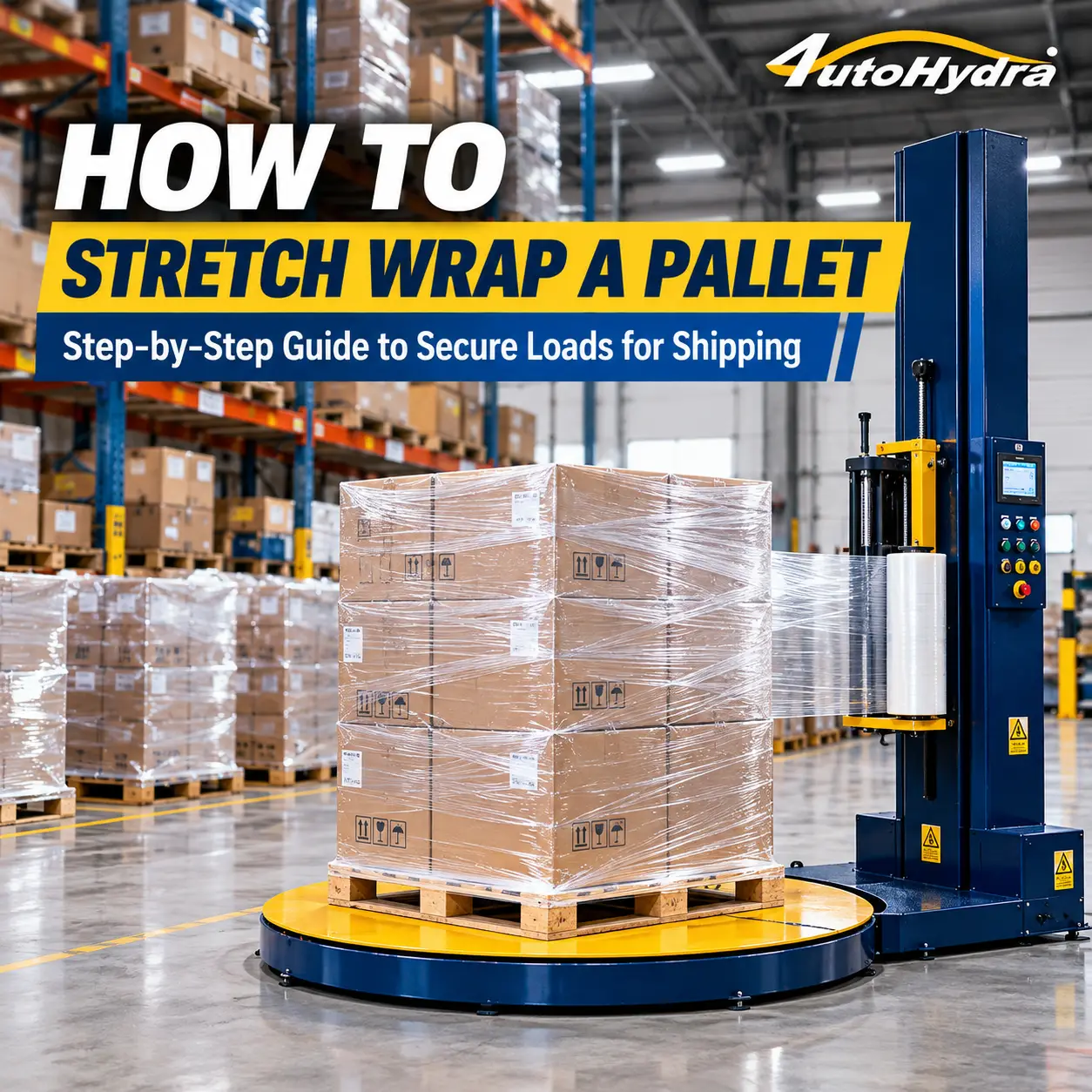
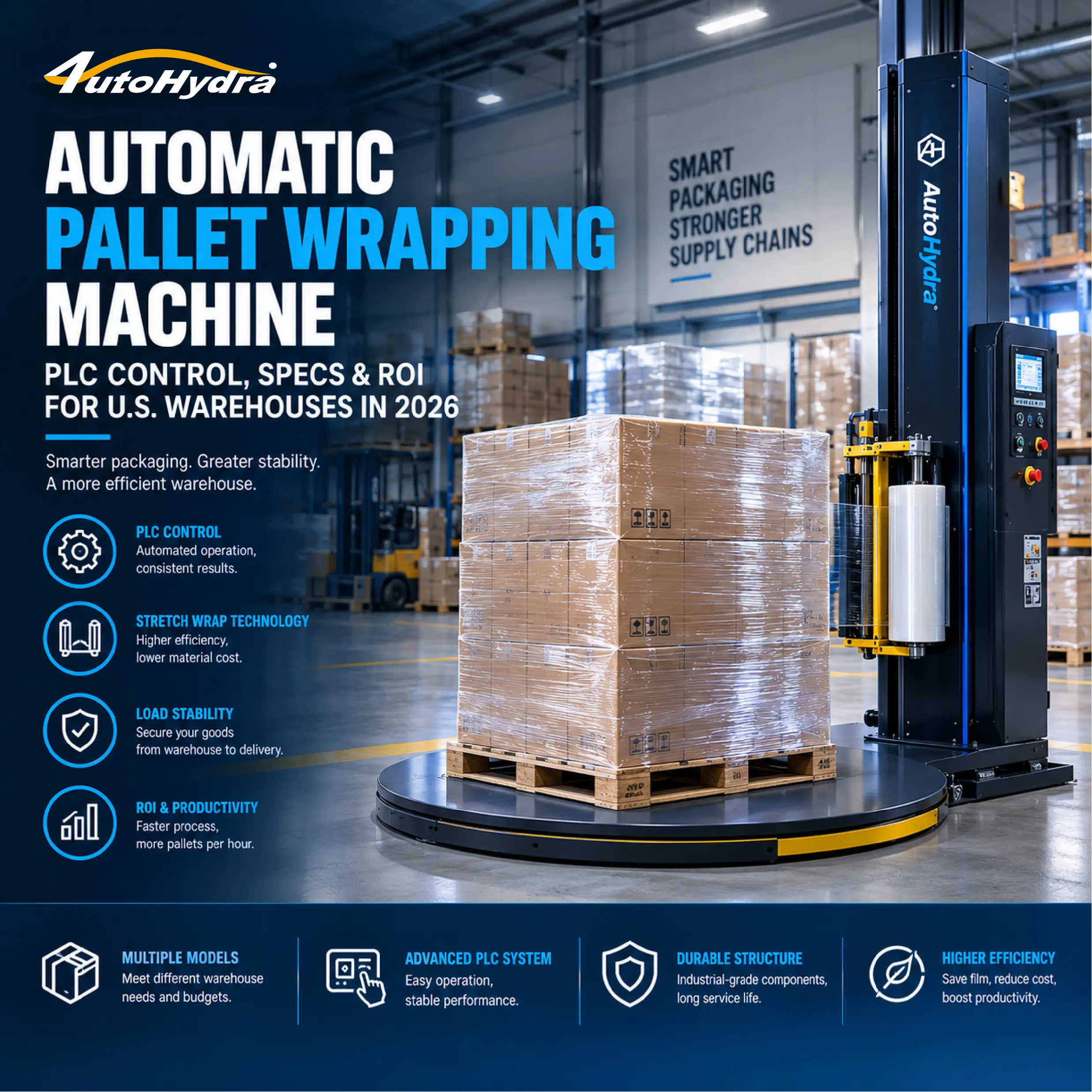
In engineering terms, an automatic pallet wrapping machine is a PLC-controlled packaging system that applies stretch film to a palletized load using a rotating turntable or orbiting film carriage. The machine replaces manual hand wrapping — a process that is slow, inconsistent, and physically demanding — with a repeatable, programmable wrapping cycle that delivers uniform film tension, consistent load containment, and a documented wrap count per pallet.
📦 Three core functions define every automatic pallet wrapper:
● Rotate: a turntable spins the pallet at 12–16 RPM while a film carriage feeds stretch film onto the load.
● Stretch: pre-stretch rollers elongate the film 200–250% before application, maximizing yield and load containment force.
● Secure: auto film cutting and clamp mechanisms complete the cycle without operator intervention, enabling 30–40 pallets per hour.
⚙ Auto-Hydra’s engineering expertise in hydraulic and mechanical systems, detailed in our hydraulic systems guide, directly informs the structural design of our industrial packaging line — the same precision engineering that holds a 9,000 lb vehicle overhead applies to the turntable bearings, gear drives, and PLC logic in a pallet wrapper.
2. How Stretch Wrap Technology Actually Works
The physics of stretch wrapping is more sophisticated than it looks. The film is not simply wrapped around the pallet — it is engineered to deliver specific containment force through controlled elongation.
🧱 Pre-stretch: the key to film economy
● Two rubber-coated rollers turn at different speeds, elongating the film 200–250% before it contacts the load.
● A 1,500 ft roll of pre-stretched film wraps 60–80% more pallets than the same roll applied by hand.
● Pre-stretch also increases film tensile strength, creating a tighter, more stable load.
⚙ Turntable vs rotary arm
● Turntable: the pallet spins on a rotating platform; best for stable loads under 4,400 lbs.
● Rotary arm: the film carriage orbits a stationary pallet; best for unstable or very heavy loads.
● All three Auto-Hydra models use turntable design, optimized for standard warehouse pallets.
3. Three Models Compared: Which Automatic Pallet Wrapper Fits Your Operation?
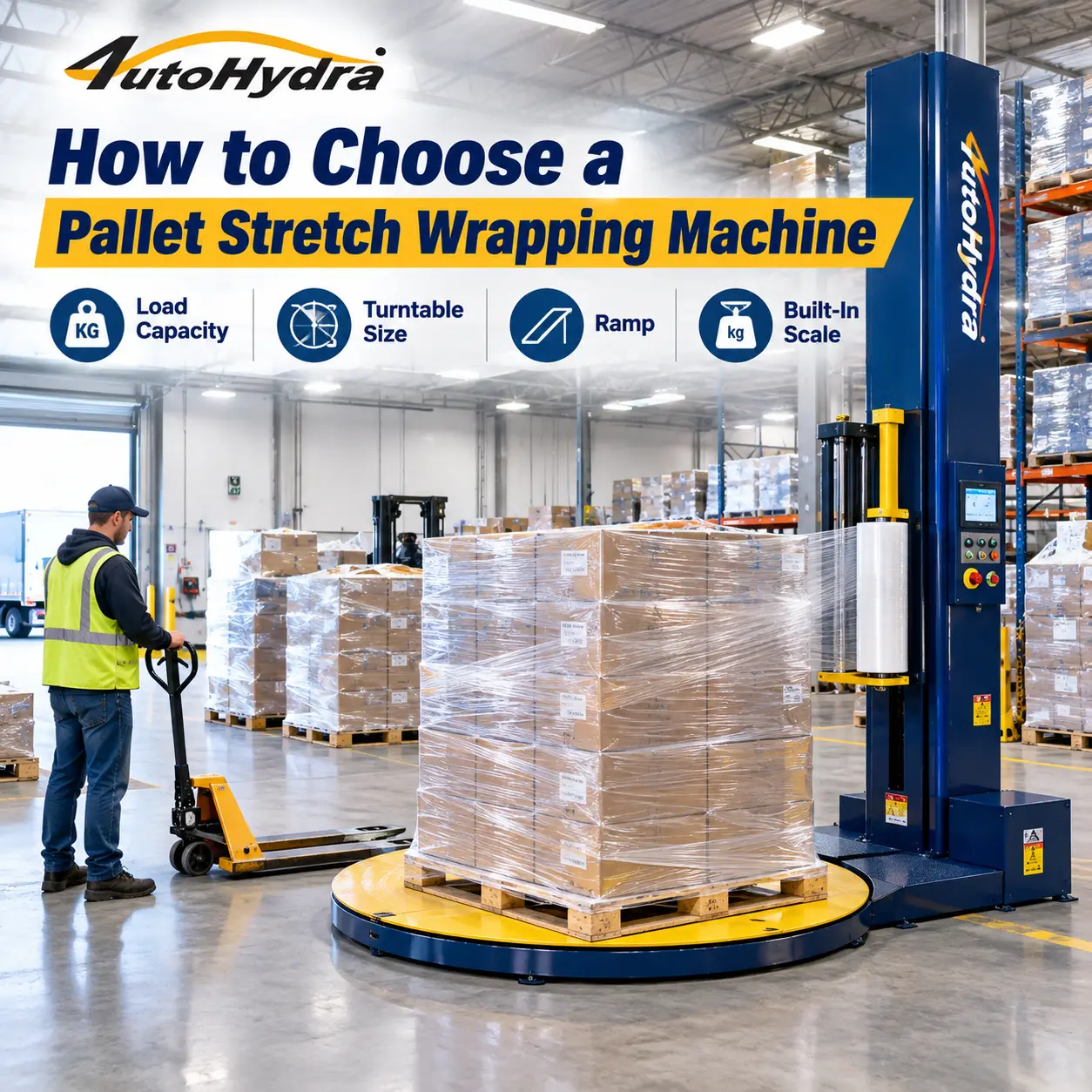
Auto-Hydra’s food and packing machine category includes three turntable stretch wrappers, each engineered for a distinct warehouse profile. The table below compares them at a glance.
| Spec | Stretch Wrapper + Ramp | Auto Shrink Wrapper | Wrapper + Scale |
|---|---|---|---|
| Capacity | 4,400 lbs | 4,400 lbs | 4,400 lbs |
| Turntable Dia | 65 in | 65 in | 65 in |
| Film Cutting | Manual | Automatic | Automatic |
| PLC Control | Standard | Advanced | Advanced |
| Built-in Scale | No | No | Yes |
| Loading Ramp | Included | Not included | Not included |
| Throughput | ~30 pallets/hr | ~40 pallets/hr | ~35 pallets/hr |
| Price | $5,319 | $4,939 | $5,319 |
📊 Table: Comparison of three Auto-Hydra automatic pallet wrapping machine configurations.
4. Model by Model: What Each Wrapper Does Best
📦 Model 1: Stretch Wrapper with Loading Ramp
This configuration pairs a 4,400 lb turntable wrapper with a Q235 hot-rolled steel loading ramp designed for a 1.65m turntable. The ramp allows forklifts, pallet trucks, and stackers to roll palletized goods directly onto the wrapping platform — critical for operations where the pallet is too heavy or too unstable to place by hand.
🗘 See the 4400LBS stretch wrapper with ramp for full specifications.
📦 Model 2: Automatic Shrink Wrapper with Film Cutting
This is the high-throughput model. Rated at 40 pallets per hour, it features automatic film cutting and clamping — the operator places the pallet, presses start, and walks away. The PLC controls film tension, wrap count, top and bottom wrap layers, and carriage speed. It is the model most suited for mid-volume distribution centers that need consistent output without a dedicated wrapper operator.
🗘 See the 4400LBS automatic shrink wrapper for full specifications.
📦 Model 3: Pallet Wrapper with Built-in Scale
This model adds an integrated weighing system to the turntable. Every pallet is wrapped and weighed in a single operation — eliminating a separate scale check, reducing handling steps, and producing a documented weight record for shipping and inventory systems. For operations where freight pricing depends on accurate weight, this model pays for itself in months.
🗘 See the 110V wrapper with built-in scale for full specifications.
5. The Loading Ramp: Why It Matters More Than You Think
The loading ramp that ships with Model 1 is not a generic accessory — it is engineered to match the 1.65m turntable diameter and handle 2-ton loads. Built from Q235 hot-rolled steel plate with a checker plate surface for traction, it bridges the gap between floor level and the 3.1-inch turntable height.
🛋 Why the ramp matters:
● Forklift access: pallet jacks and electric stackers roll directly onto the turntable without lifting.
● Safety: checker plate surface prevents slippage in wet or cold storage environments.
● Throughput: eliminates the 30–60 seconds of manual pallet positioning per cycle.
📸 Browse the full food & packing machine catalog to see all available configurations and accessories.
6. PLC Control: The Brain Behind the Wrapper
The difference between a $2,000 semi-automatic wrapper and a $5,000 PLC-controlled automatic wrapper is not just convenience — it is repeatability. A PLC (Programmable Logic Controller) transforms wrapping from an operator-dependent art into a documented, programmable process.
🧠 What a PLC-controlled wrapper lets you do:
● Set wrap counts: top wraps, bottom wraps, and total revolutions are programmed per load profile.
● Control film tension: pre-stretch percentage is adjustable from the HMI screen — no mechanical gear changes needed.
● Program multiple recipes: store up to 10–20 wrapping profiles for different product types, recalled by SKU or barcode scan.
● Auto film cutting: the PLC signals the film cut mechanism at cycle end — zero operator film handling.
● Cycle counter: total wraps per shift, per day, and per recipe are logged for production reporting.
7. Automatic vs Manual Wrapping: The Real ROI Math
The decision to invest in an automatic pallet wrapping machine comes down to a simple calculation: how many pallets per day, and what does manual wrapping cost per pallet?
💰 Manual wrapping cost (per pallet)
● Labor: 3–5 minutes per pallet at $18–$25/hour = $1.50–$2.08 per pallet in labor alone.
● Film waste: hand wrapping uses 15–30% more film due to inconsistent tension and overlap.
● Inconsistent containment: under-wrapped pallets shift in transit; over-wrapped pallets waste film.
💰 Automatic wrapping cost (per pallet)
● Labor: 30–60 seconds to place pallet and press start = $0.15–$0.25 per pallet in labor.
● Film savings: pre-stretch at 250% elongation reduces film usage by up to 60%.
● Consistency: every pallet receives the same containment force, reducing transit damage claims.
Break-even: at 30 pallets per day, a $5,000 automatic wrapper pays for itself in 8–12 months on labor savings alone. Add film savings and damage reduction, and the payback period shrinks to 4–6 months.
8. Where Automatic Pallet Wrappers Deliver the Most Value
🏭 Industries that benefit most
● Food & beverage: strict load containment standards for FDA-compliant transit; wash-down environments require stainless options.
● E-commerce fulfillment: high daily pallet volume (50–200+) demands automatic cycle and film cutting.
● Building materials: heavy, irregular loads (bricks, tiles, bagged cement) need the 4,400 lb capacity turntable.
● Pharmaceuticals: documented wrap cycles and weight records (built-in scale model) support compliance logging.
● Third-party logistics (3PL): multiple customer load profiles stored as PLC recipes for fast changeover.
9. Installation: What Your Facility Needs Before the Wrapper Arrives
An automatic pallet wrapping machine is a floor-mounted unit that requires a flat, level surface, power, and forklift access for pallet loading. Here is the site preparation checklist.
(1) Floor: flat, level concrete; the turntable base must sit flush with zero wobble.
(2) Power: 110V standard outlet (all three Auto-Hydra models run on 110V).
(3) Clearance: 12×12 ft bay footprint (turntable diameter + forklift approach + film carriage travel).
(4) Film supply: position film roll storage within arm’s reach of the carriage.
(5) Air (optional): some auto-cut models require 60–100 PSI compressed air for the film clamp.
(6) Drainage: if used in food/beverage wash-down environments, ensure floor drain proximity.
10. Maintenance: Keeping Your Pallet Wrapper in Production
Pallet wrappers are simpler than vehicle lifts — fewer moving parts, lower loads — but they still need consistent care. The good news: the maintenance discipline is the same one we preach for all industrial equipment.
🔧 The same preventive maintenance philosophy we outline in our troubleshooting & maintenance guide applies directly to packaging equipment: daily inspection, quarterly lubrication, and annual component testing are the difference between a 10-year wrapper and a 3-year wrapper.
Monthly
● Inspect pre-stretch rollers for rubber wear and film residue buildup.
● Check turntable bearings for smooth rotation and grease per manufacturer spec.
Quarterly
● Verify PLC program integrity; back up recipes to USB or network.
● Inspect film carriage chain/belt drive for stretch or wear.
Annually
● Load test: wrap a known-weight pallet at full capacity; verify turntable speed and film tension.
● Replace pre-stretch roller rubber sleeves if grooved or hardened.
● Calibrate built-in scale (if equipped) against a certified test weight.
Frequently Asked Questions
What size pallet wrapping machine do I need?
The standard sizing metric is turntable diameter and load capacity. For standard 48×40 inch U.S. pallets weighing up to 4,000 lbs, a 65-inch turntable with 4,400 lb capacity covers 90% of warehouse applications. All three Auto-Hydra models use this configuration. For loads exceeding 4,400 lbs, a rotary arm wrapper is recommended instead of a turntable.
How much stretch film does an automatic wrapper save compared to hand wrapping?
Pre-stretch rollers in an automatic machine elongate film 200–250% before application, compared to 10–20% elongation in hand wrapping. This means a 1,500 ft roll yields 3,000–4,000 effective feet of wrapped film. For a warehouse wrapping 50 pallets per day, film savings alone can reach $3,000–$5,000 per year.
Do I need 220V power for an automatic pallet wrapper?
No. All three Auto-Hydra models in the food & packing machine category run on standard 110V power, making them suitable for any U.S. warehouse without electrical upgrades. The turntable motor, film carriage drive, and PLC are designed for 110V single-phase operation.
What is the difference between a stretch wrapper and a shrink wrapper?
A stretch wrapper applies elastic stretch film that clings to the load through tension — it does not require heat. A shrink wrapper applies shrink film (or shrink bags) that contracts when passed through a heat tunnel. The Auto-Hydra models in this category are stretch wrappers with stretch film; the product titles reference “shrink wrapper” because the terms are often used interchangeably in the U.S. market, but the technology is stretch wrapping.
Can I use the built-in scale wrapper for certified shipping weights?
The built-in scale is accurate for internal inventory and freight estimation, but it is not a certified legal-for-trade scale. For LTL freight billing, use a certified floor scale. The built-in scale’s value is in eliminating a separate weighing step for internal documentation and inventory management.
Ready to Automate Your Pallet Wrapping?
Auto-Hydra’s industrial equipment team can help you calculate throughput, film savings, and ROI for your specific pallet volume — then match you to the right wrapper configuration with U.S. warehouse stock and lifetime technical support.
✔ 110V operation · ✔ PLC programmable recipes · ✔ 4,400 lb capacity · ✔ U.S. warehouse stock
Recommended News
View all