Symmetric vs. Asymmetric 2 Post Car Lift: Differences, Pros, and How to Choose
Choosing a two-post car lift involves more than comparing lifting capacity and price. The arm configuration and vehicle positioning also affect how comfortably technicians can access a vehicle, open its doors, and work around the lift.
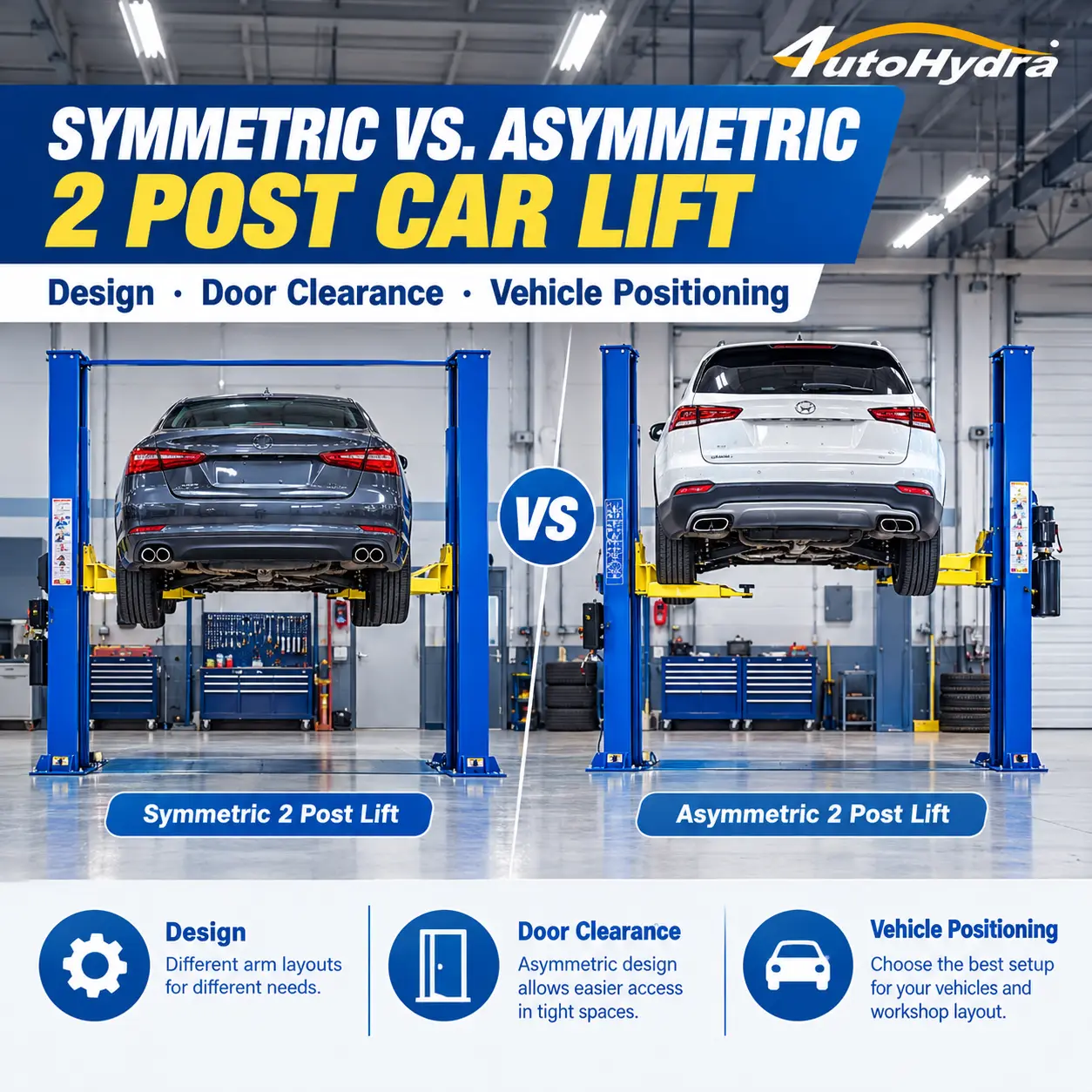
Two common designs are symmetric and asymmetric two-post car lifts. Both use two columns and lifting arms, but they differ in how the vehicle is positioned relative to the columns and how the arms are arranged.
So, which is better: a symmetric or asymmetric 2 post car lift?
The answer depends on the vehicles you service, available bay space, door clearance, lifting-point requirements, and your daily workflow. This guide explains the differences, advantages, limitations, and key factors to consider before purchasing a lift.
📖 If you are still comparing lift types and capacities, start with our complete car lift buying guide.
What Is a Symmetric 2 Post Car Lift?
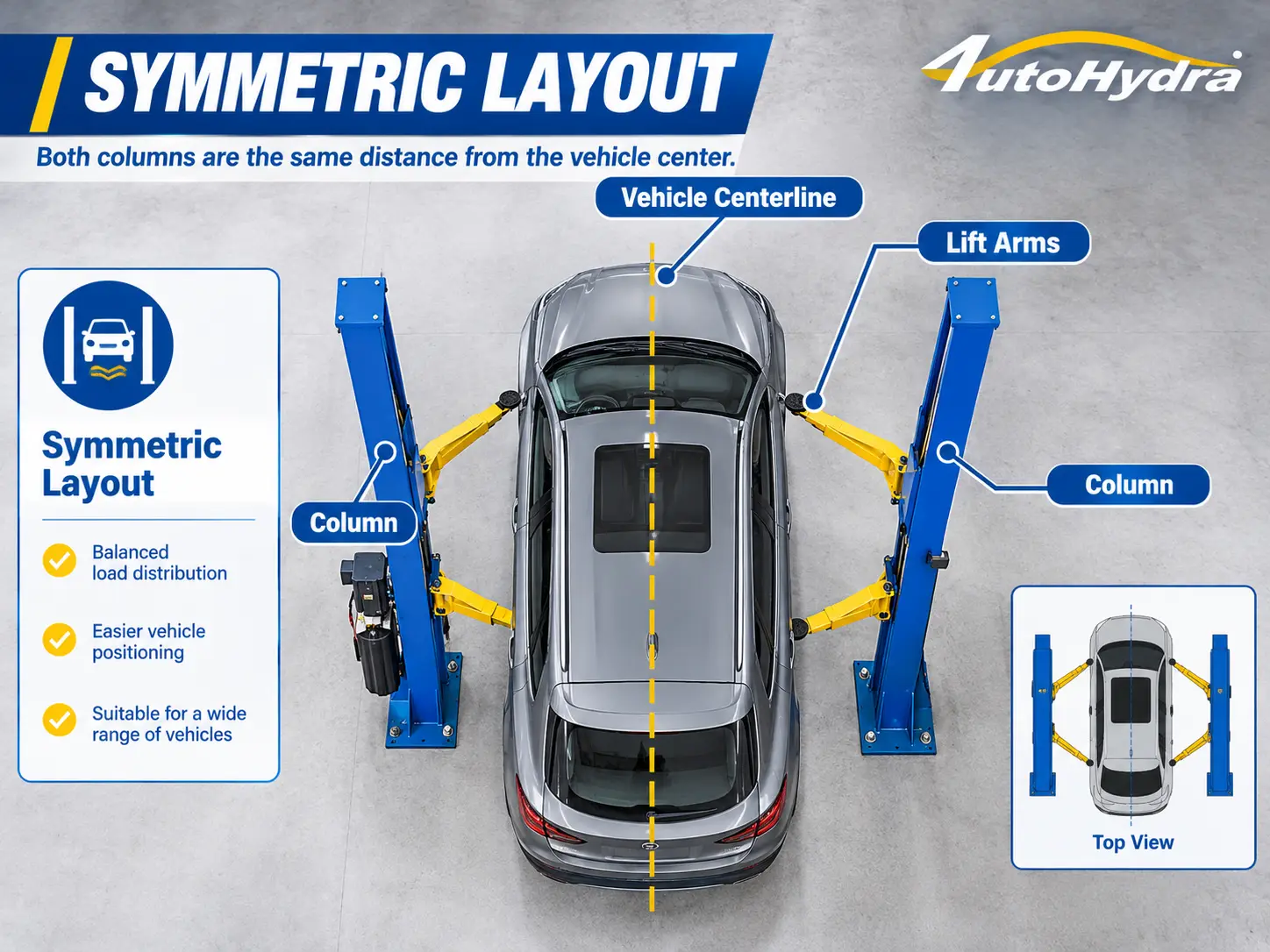
A symmetric two-post car lift generally uses lifting arms arranged so that the vehicle is positioned approximately centrally between the two columns. The front and rear arm geometry is designed to distribute the vehicle's support around the lift's intended centerline.
The exact arrangement varies by model. A symmetric design does not mean that every vehicle's weight is automatically distributed equally between the front and rear arms. Actual loading depends on the vehicle's center of gravity, designated lifting points, arm placement, and the manufacturer's instructions.
✅ Advantages of a Symmetric Lift
1. A straightforward vehicle positioning layout The centered layout can be convenient for workshops that regularly service vehicles with familiar dimensions and established lifting procedures.
2. A practical option for general service work Depending on its specifications, a symmetric lift can support common repair tasks such as undercarriage inspections, suspension service, and other maintenance operations.
3. A familiar layout for technicians Technicians who routinely work with a particular symmetric model can develop consistent positioning and inspection procedures around that equipment.
⚠️ Potential Limitations
A symmetric design may be less convenient for some long vehicles or applications where door clearance and vehicle entry are major concerns.
However, this is not true of every symmetric model. Actual usability depends on column spacing, arm reach, column design, vehicle dimensions, and the available space around the lift.
Before purchasing, check the manufacturer's vehicle positioning instructions and dimensional drawings rather than relying on the design label alone.
What Is an Asymmetric 2 Post Car Lift?
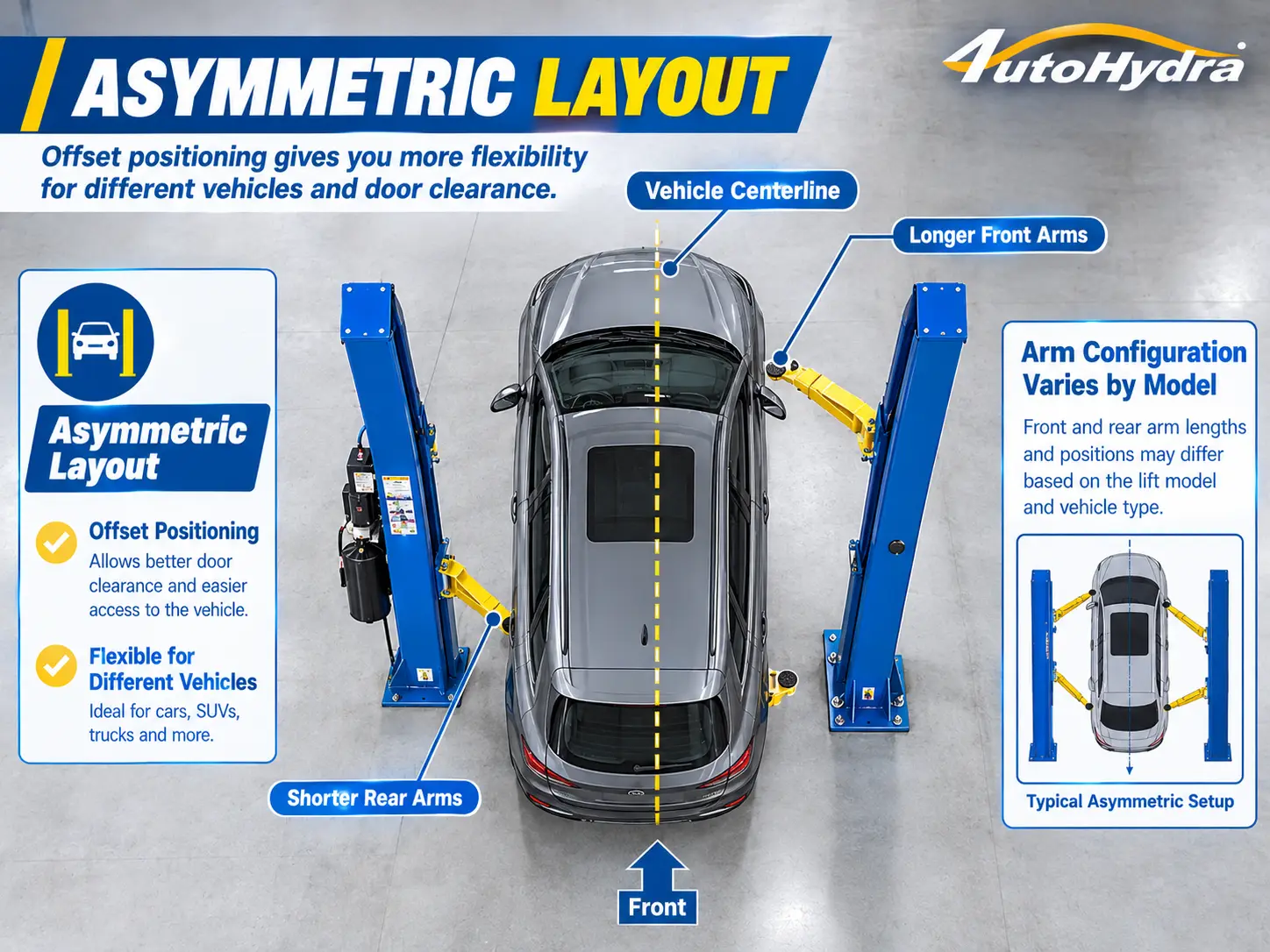
An asymmetric two-post car lift generally uses an offset vehicle position and an arm configuration designed to accommodate that layout. Many designs use shorter front arms and longer rear arms, although the actual arrangement depends on the model.
The goal is often to improve access to the vehicle's doors and provide a useful positioning arrangement for passenger vehicles.
Asymmetric lifts are frequently considered by shops that service a broad range of passenger cars and want to make entry, exit, and side access more convenient.
✅ Advantages of an Asymmetric Lift
1. Potentially improved door clearance The offset vehicle position can create more convenient access to the doors on some vehicles, depending on the lift's column layout and the vehicle's dimensions.
2. Flexible positioning for passenger vehicles Some asymmetric designs are well suited to passenger-car service, particularly when technicians frequently enter and exit the vehicle during inspection or repair.
3. A useful option for space-conscious service bays An asymmetric layout may help a shop organize its working area, but it does not automatically require less floor space. The actual footprint and clearance requirements must be checked for the selected model.
⚠️ Potential Limitations
An asymmetric lift still requires correct vehicle positioning and placement of the lifting arms at approved lifting points.
Its offset arrangement may also require technicians to follow specific positioning instructions for different vehicles. Incorrect positioning can create an unsafe lifting condition.
Do not assume that an asymmetric lift can safely accommodate every long vehicle, heavy SUV, or pickup truck. Check the rated capacity, arm reach, lifting-point compatibility, and manufacturer's vehicle positioning guidance.
Symmetric vs. Asymmetric 2 Post Car Lift: Key Differences
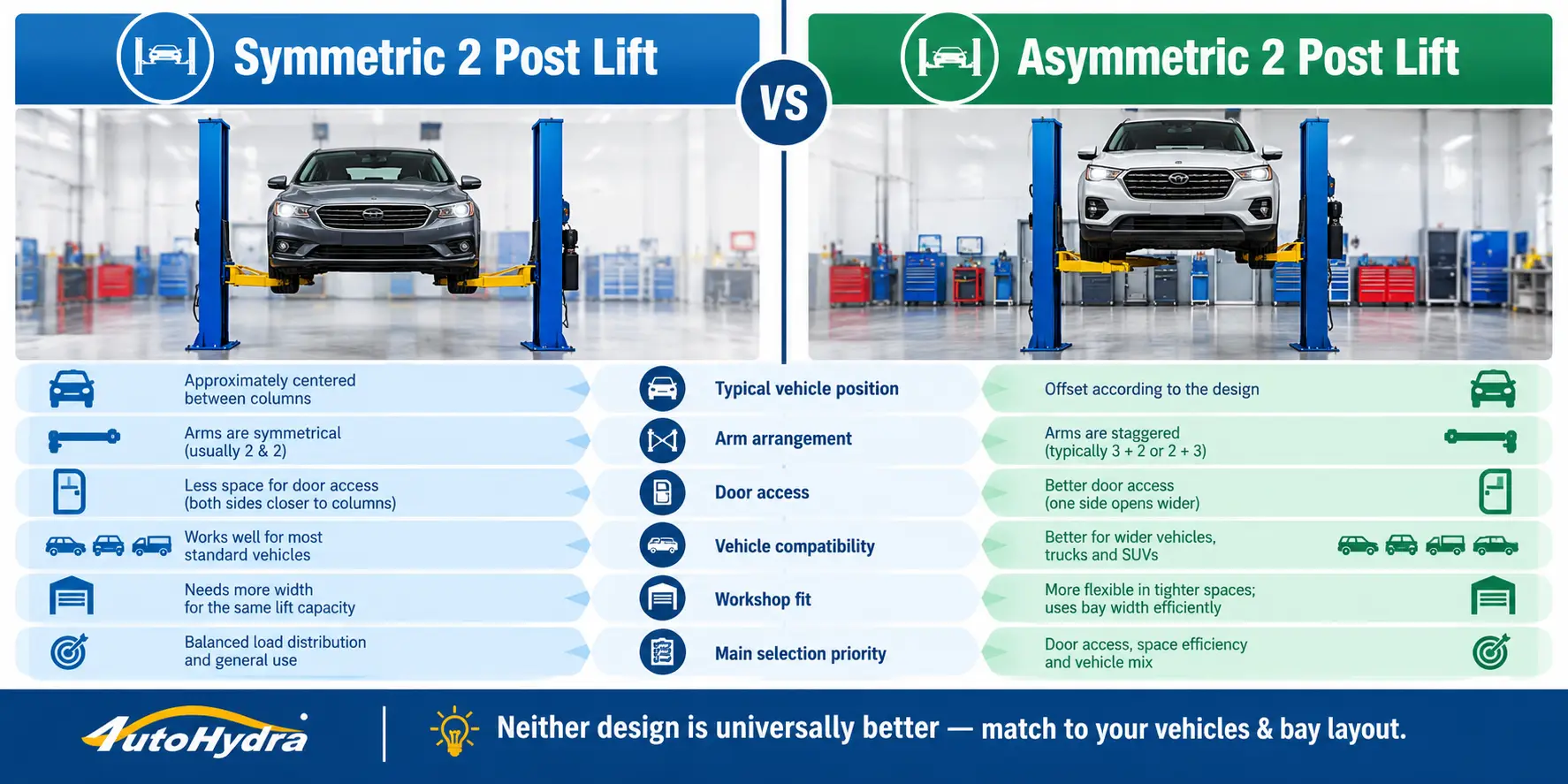
Neither design is automatically safer or better for every workshop. Safe operation depends on the complete lift design, installation, vehicle compatibility, correct positioning, and operator training.
Which Design Is Better for Different Vehicles?
The best lift depends on the vehicles you service most often, not simply on whether the lift is labeled symmetric or asymmetric.
🚗 Passenger Cars and Sedans
For shops that primarily service passenger cars, door clearance and technician access may be important considerations.
An asymmetric design may be attractive when its positioning arrangement provides convenient access to the doors. However, some symmetric lifts may also provide suitable clearance.
Compare the actual column spacing, door opening area, arm reach, and approved lifting points for the vehicles you service.
🚙 SUVs and Crossovers
SUVs vary considerably in weight, wheelbase, ground clearance, and lifting-point location.
For these vehicles, focus on rated capacity, arm reach, pad and adapter compatibility, and the manufacturer's approved lifting procedures. Do not choose a lift based only on its arm configuration.
📖 Our car lift capacity guide explains why rated capacity should be matched to the actual vehicles being serviced.
🛻 Pickup Trucks and Longer Vehicles
Longer vehicles may require careful consideration of arm reach, wheelbase, column spacing, and center-of-gravity location.
A symmetric or asymmetric layout may be suitable depending on the exact model and vehicle. Never assume that one configuration automatically accommodates every pickup truck.
Before purchase, confirm that the lift manufacturer approves the intended vehicle type and provides a suitable lifting-point arrangement.
🔧 Mixed-Fleet Repair Shops
A workshop that services sedans, SUVs, pickups, and other vehicles should prioritize compatibility across its actual fleet.
Create a list of the vehicles you expect to lift, including their weights, wheelbases, and relevant lifting-point requirements. Use that list to compare the manufacturer's approved vehicle range and dimensional drawings.
A lift that suits the majority of your work may be more practical than one selected for a single unusual vehicle.
How to Choose Between Symmetric and Asymmetric Lifts
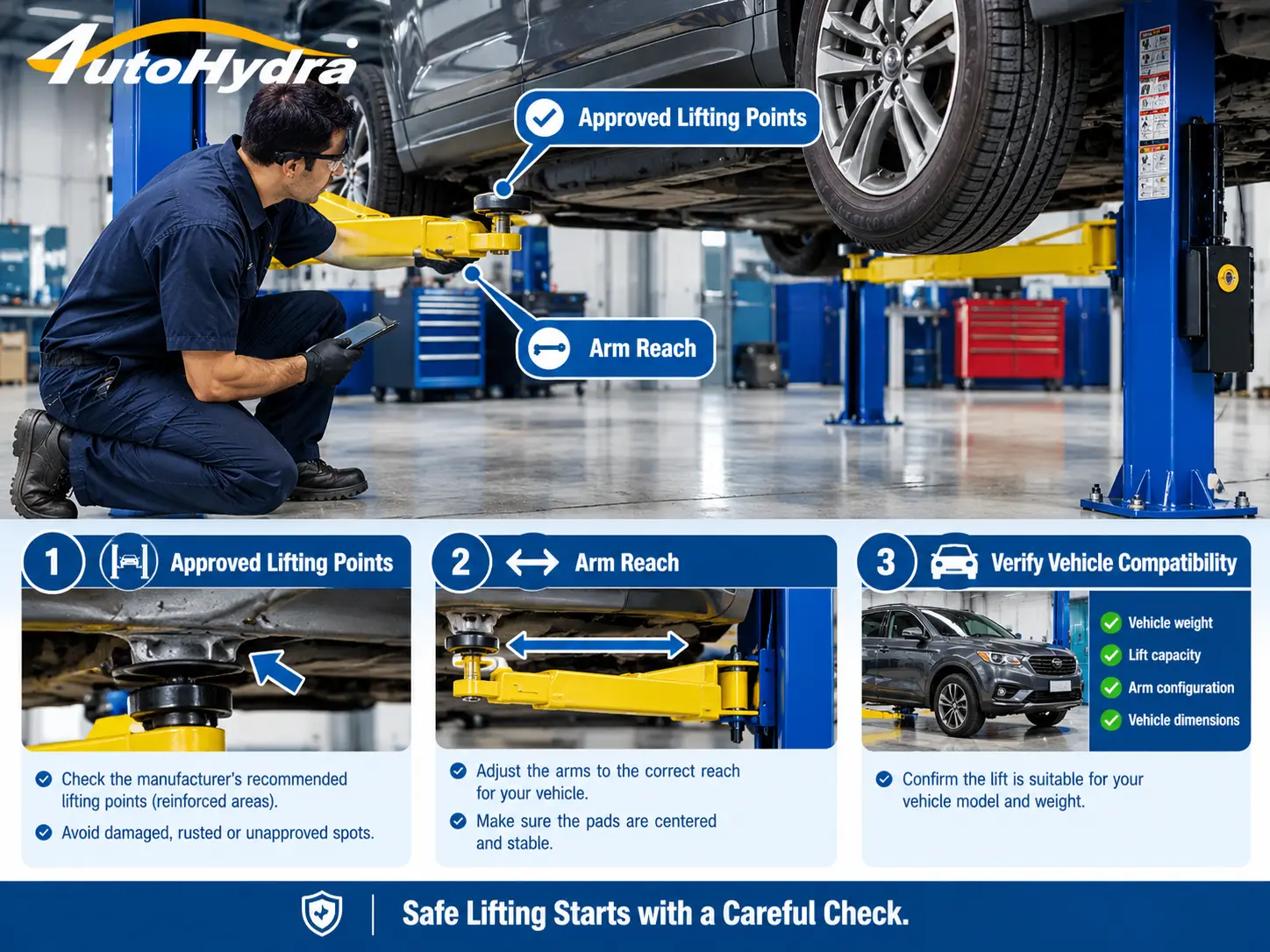
Use the following checklist to compare equipment before making a purchase.
1️⃣ Identify Your Most Common Vehicles
Record the vehicle types and approximate weight range your shop handles most often.
Include long-wheelbase vehicles, larger SUVs, and pickups if they form a meaningful part of your business.
2️⃣ Check the Approved Lifting Points
The vehicle must be supported at the lifting points specified by the vehicle manufacturer and compatible with the lift manufacturer's instructions.
⚠️ Arm configuration cannot compensate for incorrect lifting-point placement.
3️⃣ Compare Column Spacing and Door Clearance
Check the overall dimensions and column positions on the lift's installation drawing.
Measure the width of your service bay and consider whether technicians need to open vehicle doors fully, move tool carts, or access adjacent work areas.
📖 Read our garage space guide for car lifts before finalizing your layout.
4️⃣ Verify Arm Reach and Adapter Compatibility
Review the minimum and maximum arm reach, pad design, available adapters, and any vehicle-specific restrictions.
The lift must be able to reach the approved lifting points without forcing the arms into an unsuitable position.
5️⃣ Match Rated Capacity to Your Workload
Choose a lift with a rated capacity suitable for the heaviest vehicles you intend to service, while also checking the permitted load distribution and positioning requirements.
💡 A higher capacity alone does not guarantee that the lift is appropriate for a particular vehicle.
6️⃣ Confirm Installation Requirements
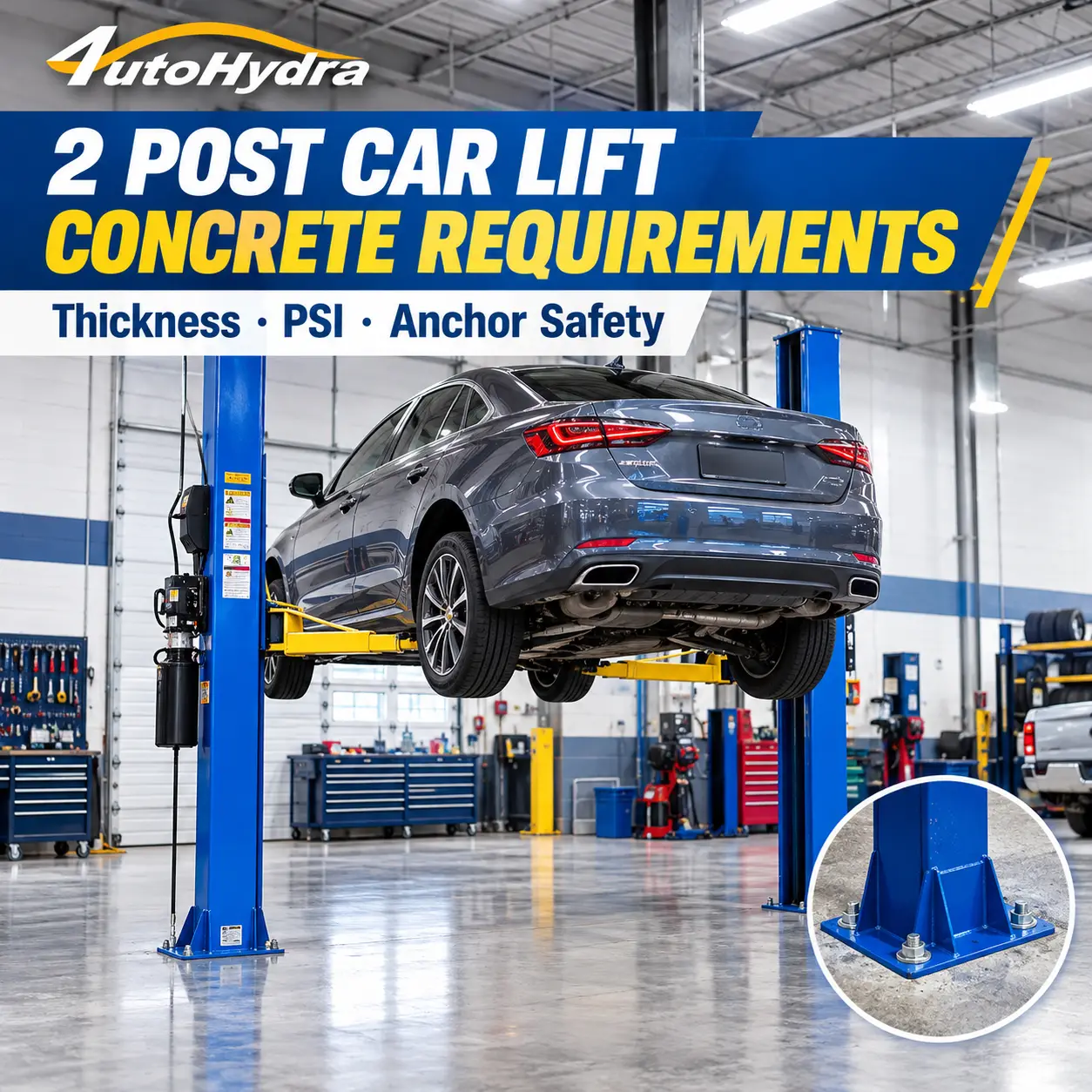
Check the required concrete foundation, ceiling clearance, electrical supply, anchor layout, and overall installation dimensions.
📖 Our guide to 2 post car lift concrete requirements explains the key foundation checks to complete before installation.
7️⃣ Consider Technician Workflow
Think about how vehicles enter the bay, how technicians position them, and how much access is needed around the doors and body.
A good lift configuration should work with the real layout of your shop rather than forcing technicians to adapt to an unsuitable setup.
Common Buying Mistakes to Avoid
❌ Choosing Based on the Design Name Alone
Symmetric and asymmetric describe general positioning and arm-layout concepts. They do not provide a complete picture of vehicle compatibility.
Better approach: Compare manufacturer drawings, rated capacity, arm reach, lifting points, and required clearances.
❌ Assuming Asymmetric Always Provides Better Door Clearance
An offset design may improve access in some situations, but the result depends on the vehicle and lift dimensions.
Better approach: Check the actual door-opening area and positioning instructions for your most common vehicles.
❌ Ignoring Long Vehicles and Weight Distribution
A lift that works well with a compact sedan may not be appropriate for a longer or heavier vehicle.
Better approach: Confirm wheelbase compatibility, approved lifting points, arm reach, and permitted load distribution.
❌ Overlooking the Foundation
Even a suitable arm configuration cannot compensate for an unsuitable concrete slab or incorrect anchoring.
Better approach: Verify the concrete and installation requirements before ordering the equipment.
❌ Failing to Check the Complete Installation Layout
A lift may fit inside a garage while still leaving inadequate clearance for vehicle doors, tool carts, or safe technician movement.
Better approach: Review the manufacturer's layout drawing and measure the entire working area, including ceiling and overhead obstructions.
❓ Frequently Asked Questions
Is a symmetric or asymmetric 2 post car lift better?
Neither design is universally better. The right choice depends on vehicle dimensions, door clearance, arm reach, approved lifting points, and the available service-bay layout.
Does an asymmetric car lift always provide more door clearance?
No. It may improve door access for some vehicles, but the result depends on the column spacing, vehicle position, and body dimensions. Check the actual lift drawing and vehicle compatibility guidance.
Can an asymmetric lift raise trucks and SUVs?
Some models may be suitable for particular trucks and SUVs, but suitability depends on rated capacity, arm reach, vehicle weight distribution, and approved lifting points. Verify compatibility with the manufacturer.
Is a symmetric lift safer than an asymmetric lift?
The design label alone does not determine safety. Proper installation, approved vehicle positioning, correct arm placement, load limits, maintenance, and operator training all matter.
Can I switch between symmetric and asymmetric positioning on the same lift?
Do not assume that a lift can be converted between configurations. Only use positioning arrangements and arm combinations specifically permitted by the manufacturer for the exact model.
What should I compare before buying a 2 post car lift?
Start with vehicle compatibility, rated capacity, arm reach, column spacing, door clearance, ceiling height, concrete requirements, and electrical supply. Then compare the price, warranty, available service support, and parts availability.
💡 Final Thoughts
A symmetric and an asymmetric two-post car lift can both be suitable for professional automotive service, but they serve different positioning preferences and may offer different access advantages.
The best choice is the lift that safely accommodates your actual vehicles, fits your workshop layout, and follows the manufacturer's approved lifting and installation requirements.
Before purchasing, compare the complete specifications rather than relying on the design label alone. Review AUTO HYDRA's guides to car lift capacity, garage space, and concrete requirements to make a more informed decision.
When you have identified the vehicle types and service-bay requirements, use the relevant AUTO HYDRA product pages to confirm the exact arm configuration and determine whether the lift is appropriate for your application.
Recommended News
View all