Hydraulic Auto Lifts The Ultimate Professional Guide to Shop Lifting Equipment
Summary
Hydraulic auto lifts are the backbone of every professional automotive workshop, transforming how technicians access vehicles and perform repairs. This comprehensive guide explores the different types of hydraulic car lifts available, from two-post and four-post lifts to space‑saving scissor lifts, and provides expert advice on selecting the right equipment for your specific shop needs. Whether you operate a commercial repair facility or a home garage, understanding hydraulic lift technology is essential for maximizing productivity and ensuring technician safety. Read our previous news on automotive lift selection and maintenance tips.
1. Understanding Hydraulic Auto Lifts and Their Impact on Workshop Efficiency
Hydraulic auto lifts have revolutionized the automotive repair industry by providing safe, reliable access to every part of a vehicle. Unlike traditional floor jacks that offer limited height and unstable support, hydraulic car lifts elevate vehicles to comfortable working heights, allowing technicians to perform everything from routine oil changes to complex transmission repairs with ease.
The hydraulic principle behind these lifts is straightforward yet powerful: hydraulic fluid is pressurized within cylinders to generate lifting force, enabling heavy vehicles to be raised smoothly and precisely. This technology has made hydraulic auto lifts the preferred choice for professional garages worldwide.
For shop owners, investing in quality hydraulic lifting equipment means:
● Reduced physical strain on technicians
● Faster repair turnaround times
● Improved access to undercarriage components
● Enhanced workplace safety
● Maximized garage floor space utilization
Learn more about the core technology of hydraulic auto lifts.
2. Exploring the Major Types of Hydraulic Car Lifts
Different hydraulic auto lift designs serve different operational purposes. Understanding the distinctions helps shop owners select equipment that aligns with their workflow and facility constraints.
2.1 Two-Post Hydraulic Lifts: The Professional’s Choice
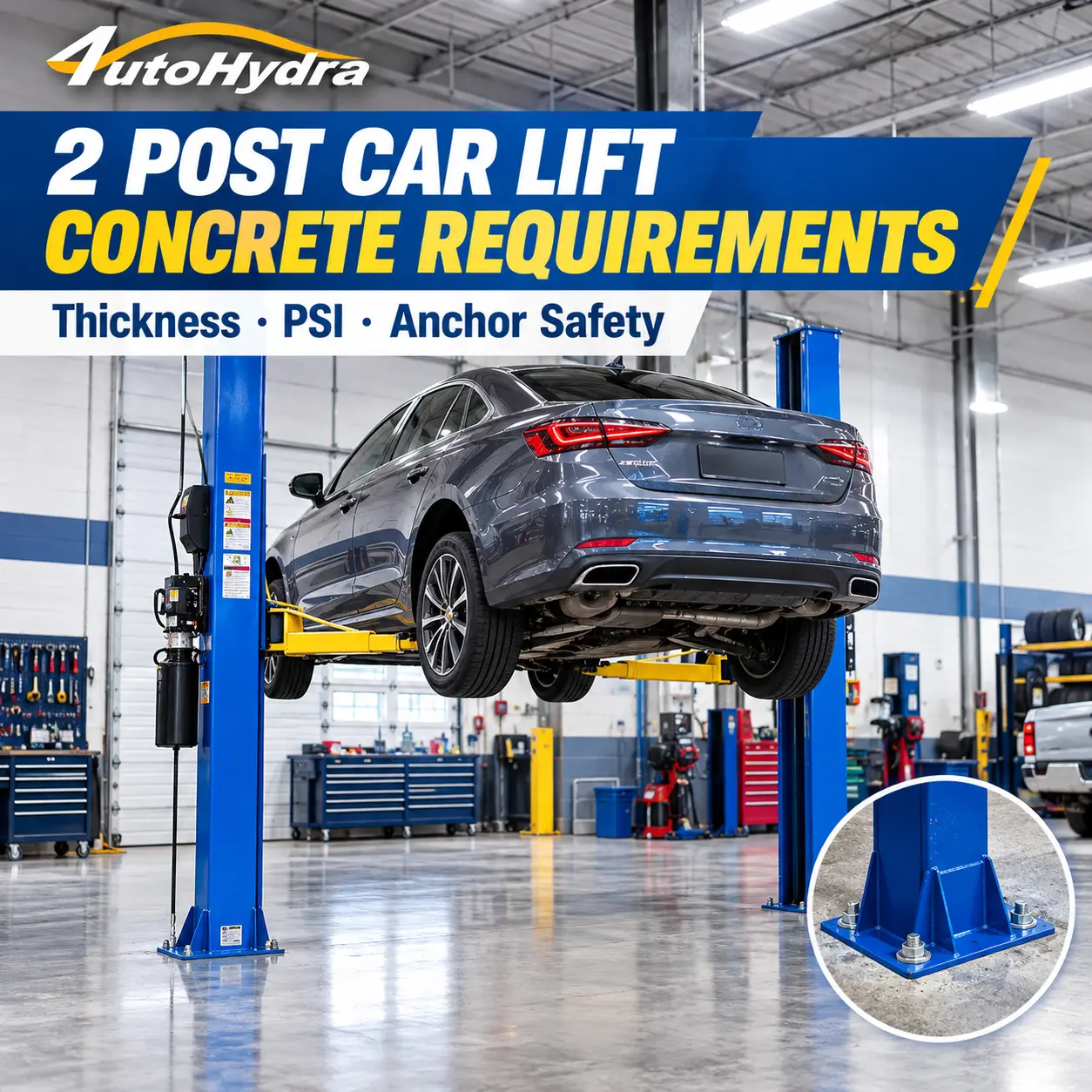
Two-post hydraulic lifts are the most widely used lifting solution in professional automotive shops. These lifts feature two upright columns with adjustable arms that support the vehicle by its frame or suspension points.
🔑Key Advantages:
● Unrestricted undercarriage access — Technicians can easily reach wheels, brakes, suspension components, and exhaust systems
● Space-efficient design — Two-post lifts occupy minimal floor space compared to four-post alternatives
● Versatile application — Ideal for engine repairs, transmission work, suspension overhauls, and tire services
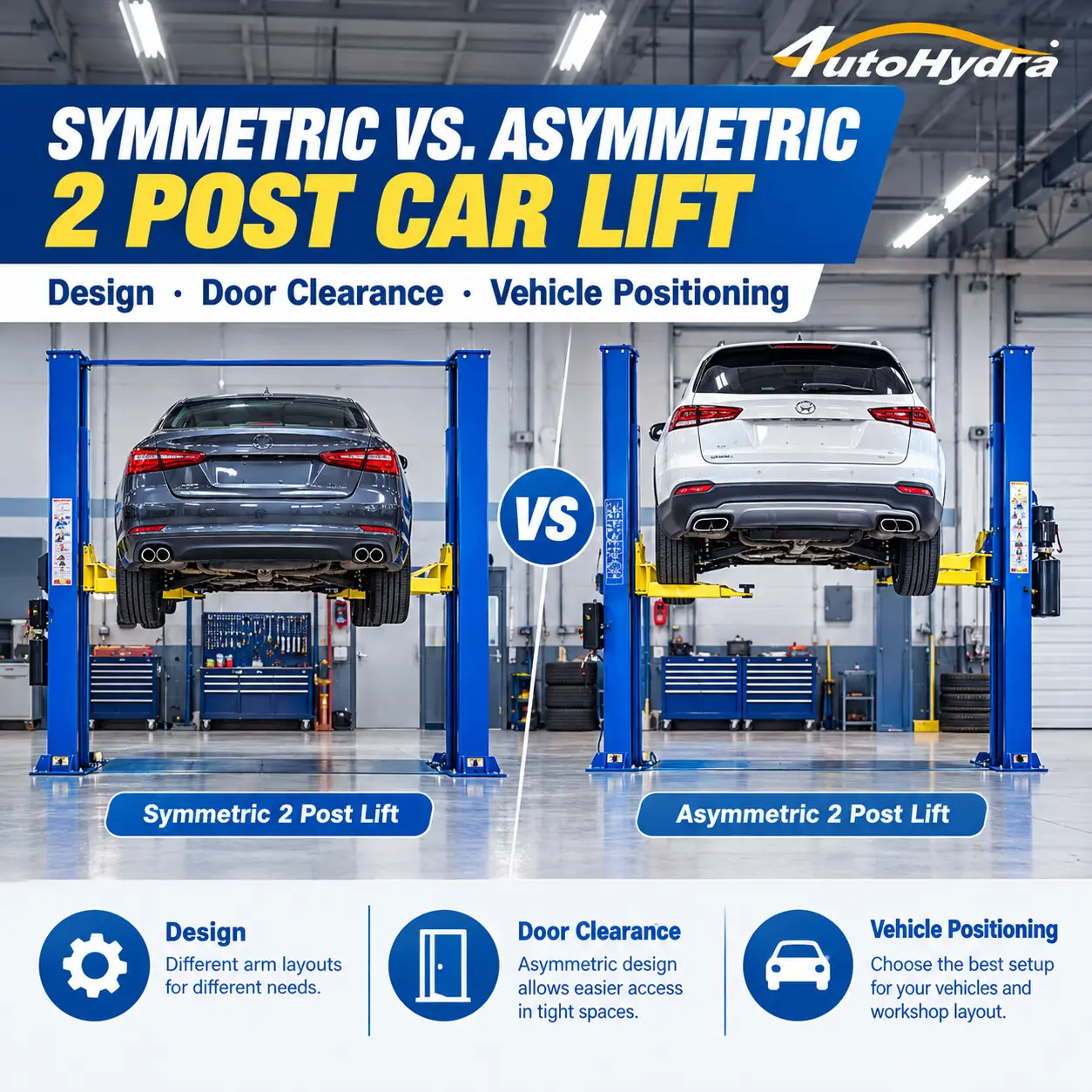
● Symmetric and asymmetric options — Different arm configurations accommodate various vehicle types
2.2 Four-Post Hydraulic Lifts: Stability and Storage Solutions
Four-post hydraulic lifts provide exceptional stability through their runway‑based design, where vehicles drive onto the platform and are lifted by their wheels. This configuration makes four‑post lifts particularly valuable for specific applications.
🔑Key Advantages:
● Superior stability — The four‑post design offers unmatched balance for heavy vehicles
● Wheel alignment capability — Many four‑post lifts accommodate alignment equipment
● Vehicle storage — Stack vehicles vertically to maximize garage space
● Heavy‑duty applications — Ideal for trucks, SUVs, and commercial vehicles
● Rolling jack compatibility — Add rolling jacks for tire and brake service
2.3 Scissor Hydraulic Lifts: Compact Solutions for Tight Spaces
Scissor hydraulic lifts offer a space‑saving alternative for garages with limited ceiling height or floor space. These lifts use a collapsing scissor mechanism powered by hydraulic cylinders to raise vehicles.
🔑Key Advantages:
● Low profile — Scissor lifts sit flush with the floor when not in use
● Space efficiency — Perfect for home garages and compact workshops
● Quick operation — Faster lifting and lowering cycles than post‑style lifts
● Versatile applications — Ideal for tire services, inspections, and detailing work
Check out our previous comparison article on two-post vs. four-post vs. scissor lifts.
3. How to Select the Right Hydraulic Auto Lift for Your Shop
Choosing the appropriate hydraulic car lift requires careful evaluation of multiple factors. Making an informed decision ensures your investment delivers long‑term value and reliability.
3.1 Lifting Capacity Requirements
The most critical specification for any hydraulic auto lift is its lifting capacity. Select a lift rated above the weight of your heaviest regular vehicle, accounting for future equipment purchases and vehicle upgrades.
Recommended capacity guidelines:
● Home garage use: 6,000 – 8,000 lbs
● Professional auto shop: 9,000 – 12,000 lbs
● Truck and SUV specialists: 12,000 – 15,000 lbs
● Heavy‑duty commercial applications: 15,000 lbs and above
3.2 Facility Space and Ceiling Height
The physical dimensions of your garage or workshop fundamentally determine which hydraulic lift types are suitable.
➡️Minimum ceiling height recommendations:
● Low‑rise scissor lifts: 8 – 9 feet
● Two‑post hydraulic lifts: 11 – 12 feet
● Four‑post hydraulic lifts: 12 – 14 feet
Always measure your ceiling at its lowest point, accounting for garage door openers, light fixtures, and structural support beams.
3.3 Power and Electrical Requirements
Most professional hydraulic auto lifts operate on standard 110V or 220V single‑phase power, making them compatible with both residential and commercial garages. Before purchasing, verify your electrical setup can support the lift’s motor requirements. For 220V units, consult a licensed electrician for proper installation.
3.4 Installation and Floor Considerations
Hydraulic auto lifts require proper installation on adequate concrete floors. Two‑post lifts typically need a minimum of 4 inches of reinforced concrete, though 6 inches is recommended for optimal safety. Four‑post lifts may have different requirements depending on their design and weight distribution.
Find detailed installation guides and shop preparation checklists on our website.
4. Essential Maintenance Practices for Hydraulic Auto Lifts
Proper maintenance dramatically extends the service life of any hydraulic car lift. Following a consistent maintenance schedule prevents unexpected breakdowns and protects your investment.
4.1 Daily Pre‑Operation Safety Inspections
Before each use, conduct a thorough visual inspection of all lift components. Check for:
● Deformation or excessive wear on structural components
● Condition of hydraulic hoses and fittings
● Cable and chain integrity
● Control functionality and emergency stops
● Safety lock operation
● Hydraulic fluid levels and leaks
4.2 Proper Lifting Techniques and Safety Protocols
When lifting a vehicle, raise it to full height and then lower it onto the mechanical safety locks. This practice relieves pressure on the hydraulic system, allowing the lift to function primarily for raising rather than bearing the load continuously during repairs. Most hydraulic lifts feature automatic locking systems that engage as the vehicle is raised.
4.3 Regular Lubrication and Cleaning
Apply appropriate lubricants to all rollers, pivot points, and moving components to prevent premature wear. Keep the lift and surrounding area clean and free of debris, grease, and obstructions. Regular cleaning prevents contaminants from damaging hydraulic seals and moving parts.
4.4 Annual Professional Inspections
Schedule comprehensive professional inspections annually. A qualified technician should perform a thorough examination of all mechanical and hydraulic components, issuing a formal inspection report. This proactive approach identifies potential issues before they become safety hazards or costly failures.
Read our previously published news about lift maintenance best practices and safety case studies.
5. Frequently Asked Questions About Hydraulic Auto Lifts
Q: What is the difference between a two‑post and four‑post hydraulic auto lift?
A: Two‑post hydraulic lifts support vehicles by their frame or suspension points, providing unrestricted access to wheels, brakes, and undercarriage components — ideal for comprehensive mechanical repairs. Four‑post hydraulic lifts use drive‑on runways and support vehicles by their wheels, offering superior stability for alignment work, vehicle storage, and heavy‑duty applications. Two‑post lifts are more common in professional repair shops, while four‑post lifts are often preferred for storage and quick‑service facilities.
Q: What ceiling height do I need for a hydraulic car lift?
A: Ceiling height requirements vary by lift type. Low‑rise scissor lifts can operate in ceilings as low as 8–9 feet. Two‑post hydraulic lifts typically require 11–12 feet of clearance, while four‑post lifts need 12–14 feet depending on vehicle height. Always measure your ceiling at its lowest point, accounting for garage door openers, light fixtures, and support beams before purchasing.
Q: Can I install a hydraulic auto lift in my home garage?
A: Yes, many hydraulic lifts are designed specifically for home garage installation. However, you must verify adequate ceiling height, sufficient concrete floor thickness (minimum 4 inches for two‑post lifts, though 6 inches is recommended), and proper electrical service. For home use, scissor lifts and low‑rise portable lifts are popular choices due to their compact footprint and lower clearance requirements.
Q: How often should I perform maintenance on my hydraulic lift?
A: Perform a visual safety inspection before every use, checking for wear on cables, hydraulic hoses, and structural components. Conduct thorough monthly maintenance including lubrication of pivot points, checking bolt torque, inspecting safety locks, and testing hydraulic fluid levels. Schedule a comprehensive professional inspection annually to ensure compliance with safety standards and identify potential issues before they become failures.
Q: Does AUTO HYDRA provide installation and warranty support for hydraulic auto lifts?
A: Yes, AUTO HYDRA INC provides professional installation services through a nationwide network of certified technicians. With strategically located warehouses across the United States, AUTO HYDRA ensures fast delivery and professional installation to meet diverse customer needs. For detailed warranty terms on specific hydraulic auto lift models, contact the sales team directly.
6. Complete Your Auto Repair Shop with Premium Hydraulic Equipment from AUTO HYDRA
Ready to equip your auto repair shop? Browse AUTO HYDRA’s curated selection of professional garage equipment designed to maximize efficiency and productivity.
🛒 Heavy‑Duty Tire Changer with Tire Balancer — Professional tire changer featuring adjustable locking device and durable alloy steel tire removal head, paired with automatic tire balancer with intelligent self‑calibrating capabilities. Perfect complement to any hydraulic auto lift installation.
🛒 Heavy‑Duty Rolling Utility Cart — 500 lbs Capacity — 2‑tier service cart with ergonomic handle design and 5‑inch industrial‑strength wheels. Essential for organizing tools around your new hydraulic car lift.
🛒 Heavy Metal Garage Storage System — Complete garage organization system featuring all‑welded cold‑rolled steel construction, corner cabinets, wall cabinets, and workbenches. Keep your shop organized and productive alongside your hydraulic lifting equipment.
7. Explore More Automotive Equipment Solutions at AUTO HYDRA
💡 Visit Our Main Website — Discover the full range of automotive, garage, and warehouse equipment.
💡 Explore Our Online Store — Browse professional tire changers, balancers, garage cabinets, work carts, and more.
Stay Updated with AUTO HYDRA News
📰 Browse our complete news list for the latest industry insights and product announcements.
📰 Read more helpful articles and tips from our previous news posts.
Contact AUTO HYDRA INC
For technical support, product inquiries, or order assistance:
Phone: (626) 888-0601
Address: 968 W Foothill Blvd, Azusa, CA 91702
Trust AUTO HYDRA for quality hydraulic lifting solutions and exceptional service for all your automotive equipment needs.
Recommended News
View all