Post Vehicle Lift: The Engineering Behind 2-Post and 4-Post Designs
Summary
A post vehicle lift is the most recognizable piece of equipment in any automotive service bay — two or four vertical columns rising from a concrete slab, holding a vehicle at working height through hydraulic pressure and mechanical safety locks. The term “post vehicle lift” encompasses two fundamentally different structural designs: the 2-post lift, which supports a vehicle by its frame at two lifting points, and the 4-post lift, which supports a vehicle by its tires on two runways. Each design has distinct engineering trade-offs in capacity, stability, installation requirements, and serviceability.This guide is written by Auto-Hydra’s structural engineering team to give U.S. shop owners, fleet managers, and serious home mechanics a clear technical understanding of how post vehicle lifts are built, how they differ, and which configuration is correct for their operation.
1. What Defines a Post Vehicle Lift?
In structural engineering terms, a post vehicle lift is any lifting device that uses vertical columns (posts) as its primary load-bearing structure. The posts transfer the weight of the raised vehicle through the column steel, into the base plate, through anchor bolts, and into the concrete slab.
🔑 The post is not the lifting mechanism — it is the load path.
● Hydraulic cylinders inside or alongside the posts provide the lifting force.
● Carriages ride inside the columns on rollers or slides, guided by the post structure.
● Mechanical safety locks (ratchet-and-pawl) engage at every tooth to hold the vehicle mechanically — never on hydraulic pressure alone.
● Anchor bolts transfer the entire load to the concrete; bolt pattern and torque are engineered per model.
⚙ The hydraulic engineering behind post lifts — Pascal’s Law, cylinder bore ratios, and pressure calculations — is covered in depth in our Hydraulic Car Lift Guide. Understanding the fluid side is essential before evaluating the structural side.
2. The 2-Post Vehicle Lift: Engineering and Configuration
A 2-post vehicle lift uses two columns placed roughly 10–11 feet apart. Each column houses a hydraulic cylinder and a carriage with swinging or telescoping arms that contact the vehicle at designated lifting points on the frame or pinch welds.
🧱 Overhead vs Floor-Plate
● Overhead (top beam): a steel beam connects the two columns at the top, providing lateral rigidity and housing the overhead shut-off bar. Requires 12+ ft ceiling.
● Floor-Plate (bottom cross): a steel plate connects the columns at floor level, routing hydraulic lines underneath. Saves 6 inches of ceiling but sacrifices the overhead safety bar.
📐 Symmetrical vs Asymmetrical Arms
● Symmetrical: arms are equal length on both sides; vehicle is centered between the columns. Best for trucks and vans with balanced weight distribution.
● Asymmetrical: front arms are shorter than rear arms; vehicle is positioned so the front wheels are ahead of the columns. Best for passenger cars — allows full door opening without hitting the post.
🚘 The 9,000 lbs 2-post overhead lift is an overhead, asymmetrical configuration — the most popular 2-post design in the U.S. market because it combines full door clearance with the overhead safety bar.
3. The 4-Post Vehicle Lift: Engineering and Configuration
A 4-post vehicle lift uses four corner columns supporting two parallel runways. The vehicle is driven onto the runways and lifted as a unit — no frame contact, no arm positioning, no pinch-weld adapters needed.
🚛 Structural characteristics
● Load is distributed across four columns and four base plates instead of two — significantly lower point loading on the concrete.
● Runways are typically 16–18 ft long, accommodating vehicles from compact cars to long-bed trucks.
● Many 4-post models are portable — they roll on casters and do not require anchor bolts, making them the only post lift approved for rental properties or leased bays.
🧭 Rolling bridge jack (optional)
● A rolling jack sits on the runways and lifts the vehicle by its frame while the 4-post holds it at height — turning a storage lift into a service lift.
● Without a rolling jack, a 4-post only provides access to wheels, brakes, and undercarriage by lying on a creeper.
🚗 The 8,500 lbs 4-post parking lift ships with casters, a drive-through runway, and an optional rolling bridge jack — a configuration that serves both storage and light service in a single footprint.
4. 2-Post vs 4-Post: Structural Comparison
The table below breaks down the engineering differences between the two post vehicle lift designs. It is the fastest way to understand why these are not interchangeable products.
| Spec | 2-Post Overhead | 4-Post Runway |
|---|---|---|
| Vehicle Contact | Frame / pinch weld | Tires on runway |
| Columns | 2 | 4 |
| Capacity Range | 9,000–12,000 lbs | 7,000–15,000 lbs |
| Concrete (min) | 6 in / 3,000 PSI | 4 in (portable ok) |
| Anchoring | Anchor bolts required | Casters optional |
| Ceiling (min) | 12 ft | 11 ft |
| Service Access | Full undercarriage | Wheels/brakes only* |
| Storage | Not designed for | Primary use case |
| Portability | Fixed installation | Rolls on casters |
📊 Table: Structural comparison of 2-post vs 4-post vehicle lift designs. *A rolling bridge jack adds frame-lift capability to a 4-post.
5. Inside the Post: Structural Components That Define Quality
The difference between a post vehicle lift that lasts 20 years and one that develops column twist in year 3 is found in components you cannot see from the outside.
🔩 Column steel
● Boxed or C-channel construction; boxed is stiffer and resists torsional twist under asymmetric loading.
● Wall thickness: minimum 3/16 inch for commercial-grade; thinner steel flexes and fatigues welds over time.
🧱 Base plate and anchor system
● Full-penetration weld between column and base plate — not intermittent fillet welds.
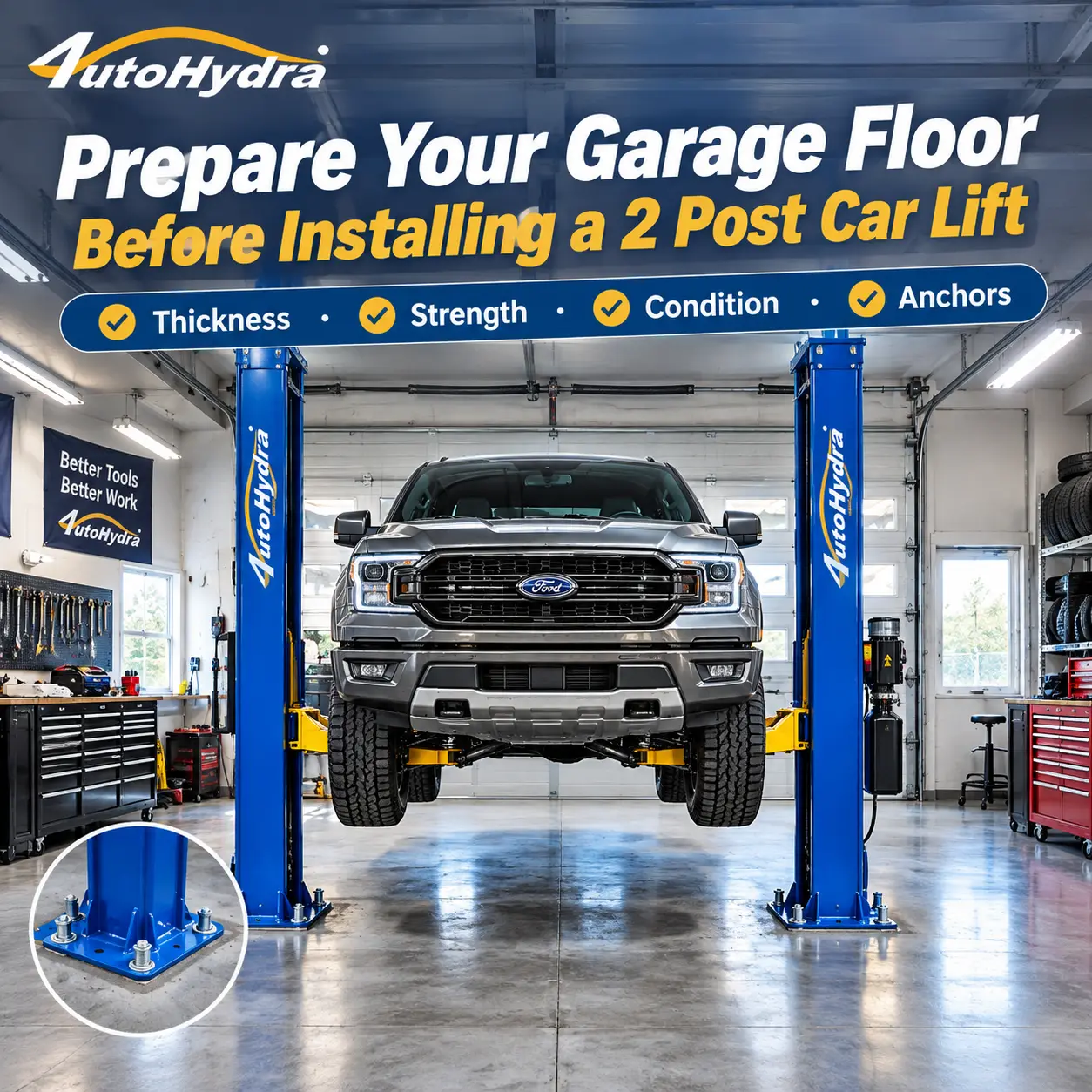
● Anchor bolts: typically 3/4 or 5/8 inch diameter, minimum 4 per column, torqued to 80–150 ft-lbs.
● Bolt spacing: minimum 6 inches from any concrete seam or crack.
⚙ Carriage and roller system
● Carriage rides on nylon or steel rollers inside the column; nylon is quieter, steel is more durable.
● Adjustment cams allow roller tension to be set so the carriage moves smoothly without lateral play.
🛡 Safety lock mechanism
● Ratchet-and-pawl: each column locks independently at every tooth (typically 2-inch spacing).
● Anti-surge valve: prevents free-fall if a hydraulic hose bursts; mandatory on all ALI-certified lifts.
● Overhead shut-off bar (overhead models only): cuts motor power on contact — the last line of defense.
6. Synchronization: The Hidden Engineering Challenge
On a 2-post vehicle lift, both columns must rise at the same rate. If one side leads by even 1/2 inch, the vehicle is held at an angle — and the strain is transferred to the slower column’s carriage, rollers, and anchor bolts.
🔗 How manufacturers achieve synchronization
● Equalizing cable: a single steel cable routed through pulleys to mechanically link both carriages — the most common and reliable method.
● Equalizing chain: same principle as cable but uses roller chain; heavier and noisier but more resistant to stretch.
● Dual hydraulic cylinders with flow dividers: splits pump output equally to both cylinders; less common on residential lifts.
⚠ Synchronization drift is a maintenance issue, not a design flaw.
● Cables stretch over time — typically 1/8 inch per year under commercial use.
● Quarterly measurement of rise height on both columns at full lock is the only way to catch drift early.
● A 6 mm difference is the threshold for adjustment; beyond that, the equalizing cable or chain must be re-tensioned.
🔧 For the full synchronization maintenance procedure and schedule, see our Car Lift Maintenance Checklist — it covers cable tension measurement, re-torque intervals, and lock-engagement testing.
7. Decision Framework: When to Choose 2-Post vs 4-Post
The choice is not about which is “better” — it is about which structural design matches your primary use case. Here is the decision framework our engineering team uses with U.S. customers.
🔧 Choose a 2-post when:
● Primary goal is service work — exhaust, transmission, suspension, brake.
● You need full undercarriage access without a creeper.
● Ceiling height is 12 ft or more.
● Concrete is 6 inches minimum and crack-free.
🚛 Choose a 4-post when:
● Primary goal is storage — parking one vehicle above another.
● You need alignment capability (with alignment-ready runways).
● You want portability — casters, no anchor bolts, moveable between bays.
● Concrete is 4 inches and you cannot pour a reinforced pad.
✂ Consider a scissor lift when:
● Ceiling is under 10 ft and neither post design fits.
● Primary service is tire and brake work only.
🔩 For low-ceiling garages, the mid-rise scissor lift and full-rise scissor KT-X95 provide post-lift functionality without the column footprint — useful when bay width or ceiling height rules out both post configurations.
8. Post Vehicle Lift Installation: The Critical Path
A post vehicle lift is only as safe as its installation. The structural design assumes the columns are plumb, the anchors are torqued, and the concrete is adequate. Here is the path from delivery to first cycle.
(1) Slab verification — confirm 6-inch minimum thickness, 3,000 PSI, no active cracks
(2) Column layout — mark bolt holes per the manufacturer template; do not estimate
(3) Drilling — use a hammer drill with the correct bit diameter; holes must be 1/4 inch deeper than bolt length
(4) Column placement — set columns, plumb within 1/4 degree using a digital level
(5) Anchor bolt torque — follow manufacturer spec; most require 80–150 ft-lbs per bolt
(6) Hydraulic connection — route equalizing cable or chain, connect hoses, fill reservoir
(7) Line bleeding — cycle the lift 3–4 times with no load to purge air from the system
(8) Load test — lift a known weight to full rise; verify both safety locks engage simultaneously
(9) Descent test — lower slowly; confirm controlled, even descent with zero drift
9. Common Structural Failures and Their Root Causes
⚠ Four failures we see in U.S. service tickets:
📦 Column twist / drift
● Root cause: anchor bolts loosened over time, or concrete is under spec, or synchronization cable was never re-tensioned.
📦 Carriage roller failure
● Root cause: rollers never lubricated, or nylon rollers used in a commercial-duty cycle environment where steel was required.
📦 Base plate weld cracking
● Root cause: intermittent fillet welds instead of full-penetration welds — a manufacturing quality issue, not a maintenance issue.
📦 Safety lock disengagement failure
● Root cause: ratchet strip corroded or pawl spring fatigued — both are preventable with quarterly cleaning and annual spring inspection.
Frequently Asked Questions
What is the difference between a post vehicle lift and a scissor lift?
A post vehicle lift uses vertical columns to achieve lifting height and full undercarriage access. A scissor lift uses crossed arms that fold flat and rise vertically — no columns, lower maximum height, and limited undercarriage access. Post lifts are for full service; scissor lifts are for tire, brake, and quick-lube work in low-ceiling environments.
Is a 2-post or 4-post vehicle lift better for a home garage?
It depends on your primary use. For service work, a 2-post provides full undercarriage access. For storage — parking one car above another — a 4-post is the correct tool. If your garage ceiling is under 10 ft, neither post design may fit, and a scissor lift is the alternative.
What is the difference between symmetrical and asymmetrical 2-post lifts?
Symmetrical lifts have equal-length arms on both sides, centering the vehicle between the columns — best for trucks and vans. Asymmetrical lifts have shorter front arms, positioning the vehicle forward of the columns so doors can open fully — best for passenger cars. Most modern 2-post lifts are asymmetrical or semi-asymmetrical.
Do 4-post vehicle lifts need to be anchored to the concrete?
Portable 4-post models do not require anchoring — they distribute weight across four long runways and roll on casters. Fixed 4-post models that will be used for heavy-duty service or alignment should be anchored. Always check the manufacturer installation manual and local code requirements.
How often should I check synchronization on a 2-post lift?
Measure rise height on both columns at full lock every quarter under commercial use, or every 6 months for residential use. A 6 mm (roughly 1/4 inch) difference is the threshold for adjustment. Beyond that, re-tension the equalizing cable or chain per the service manual.
Which Post Vehicle Lift Fits Your Bay?
Auto-Hydra’s engineering team can help you evaluate ceiling height, concrete specs, and vehicle weight to determine whether a 2-post or 4-post configuration is correct for your operation — all backed by ALI/CE certification and U.S. warehouse stock.
🛸 Browse the Post Lift Catalog
📞 Talk to a Structural Engineer
✔ ALI/CE certified · ✔ Full engineering specs · ✔ U.S. parts warehouse · ✔ Lifetime technical support
Recommended News
View all