What Size Car Lift Do I Need? A Complete Guide to Lift Capacity
Choosing the right car lift size is about more than finding a lift that can physically raise your vehicle. The lift must have enough rated capacity for the vehicles you plan to service, while also providing the appropriate lifting height, dimensions, and working clearance for your garage or workshop.
A common question among home mechanics and automotive repair professionals is:
❓ What size car lift do I need?
The answer depends on: Vehicle weight · Vehicle type · Future vehicles · Lift capacity · Lifting height · Garage space · Type of automotive work
In this guide, we'll explain how to choose the right car lift capacity for cars, SUVs, trucks, and heavier vehicles.
1. What Does Car Lift Capacity Mean?
Car lift capacity is the maximum weight that a lift is designed to safely support according to its manufacturer rating.
Capacity is commonly expressed in pounds (lb) or tons. For example: 7,000 lb · 9,000 lb · 10,000 lb · 12,000 lb.
⛔ A vehicle should never exceed the rated capacity of the lift.
⚠️ However, simply matching the vehicle's curb weight to the lift capacity isn't always the best purchasing strategy. You should also consider what other vehicles you may need to lift in the future.
2. How Do I Calculate the Capacity I Need?
Start with the heaviest vehicle you expect to lift.
📌 Example: Vehicle weight = 6,000 lb. You should not automatically choose a 6,000-lb lift. Instead, select a lift with a rated capacity appropriate for your application and with sufficient margin according to the manufacturer's specifications.
🔑 The Key Principle:
Choose the lift based on the heaviest vehicle you plan to service, not the average vehicle you currently own.
3. Common Car Lift Capacity Ranges
Different capacity ranges are suitable for different applications.
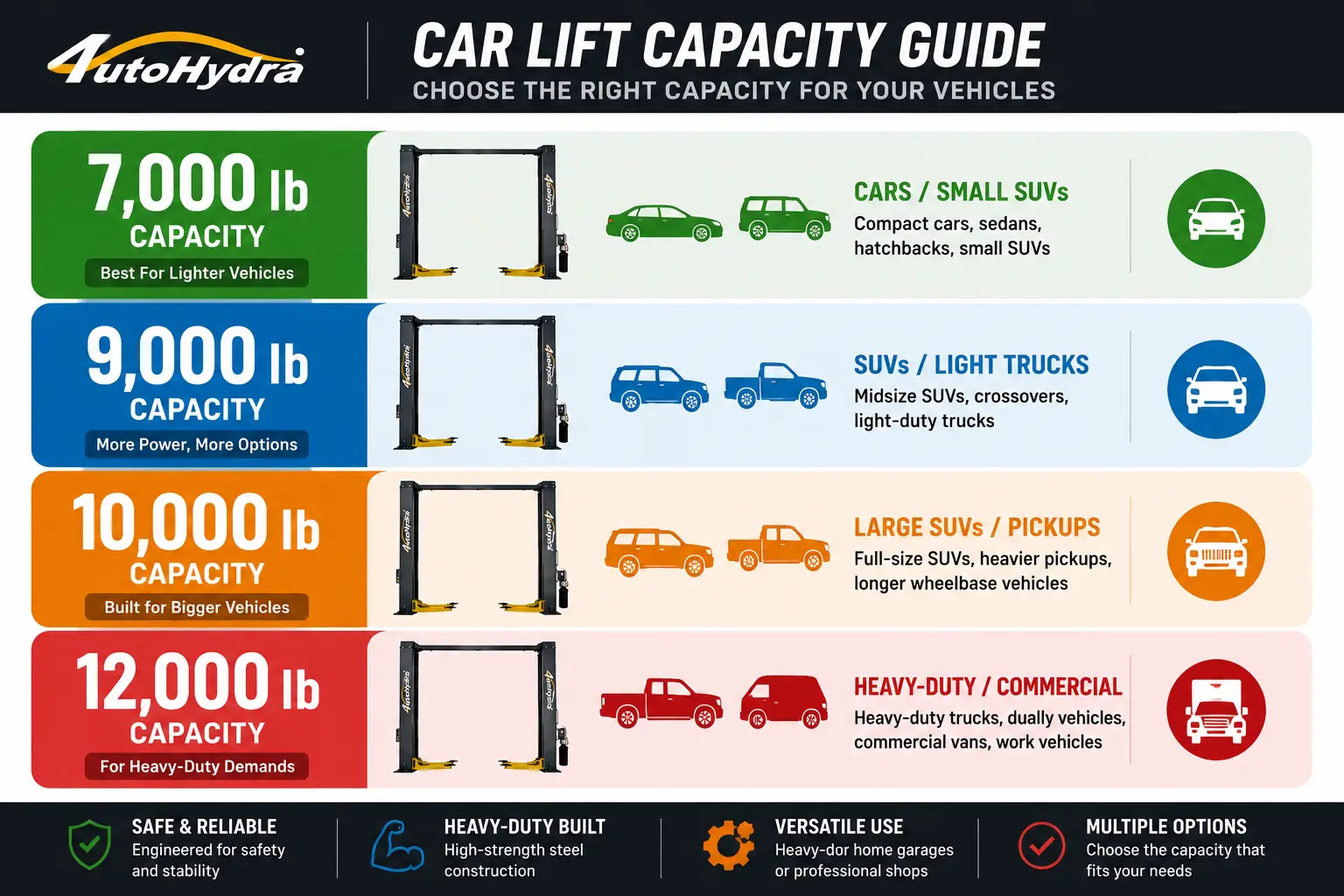
⚠️ These are general application categories rather than universal rules. Always verify the exact vehicle weight and the manufacturer's rated capacity for the specific lift model.
4. What Size Car Lift Do I Need by Vehicle Type
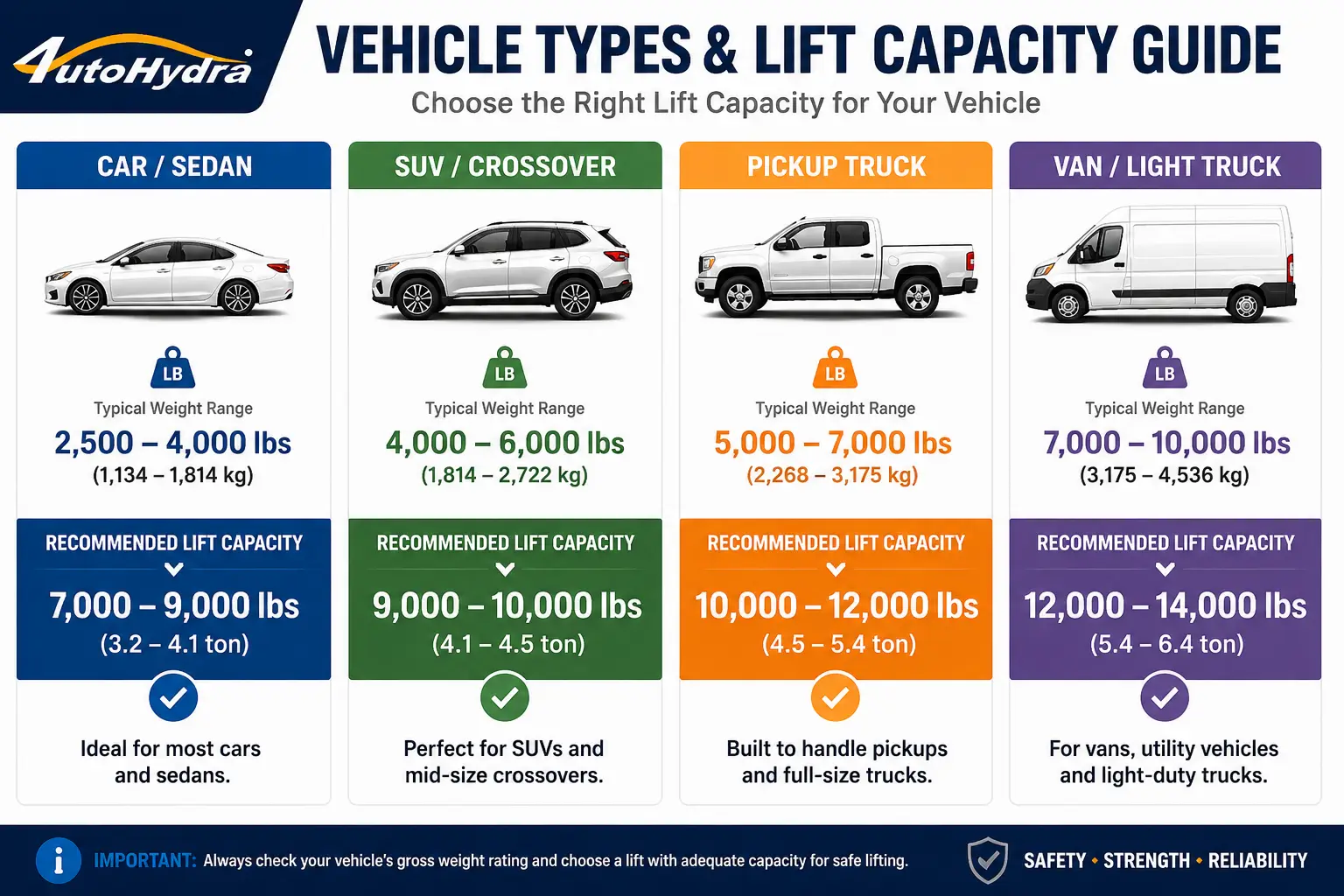
📖 Related Guide: Car Lift Capacity Guide
5. 7,000 lb vs 9,000 lb vs 10,000 lb vs 12,000 lb Car Lift
This is where the article captures valuable long-tail searches. Here's a side-by-side comparison:
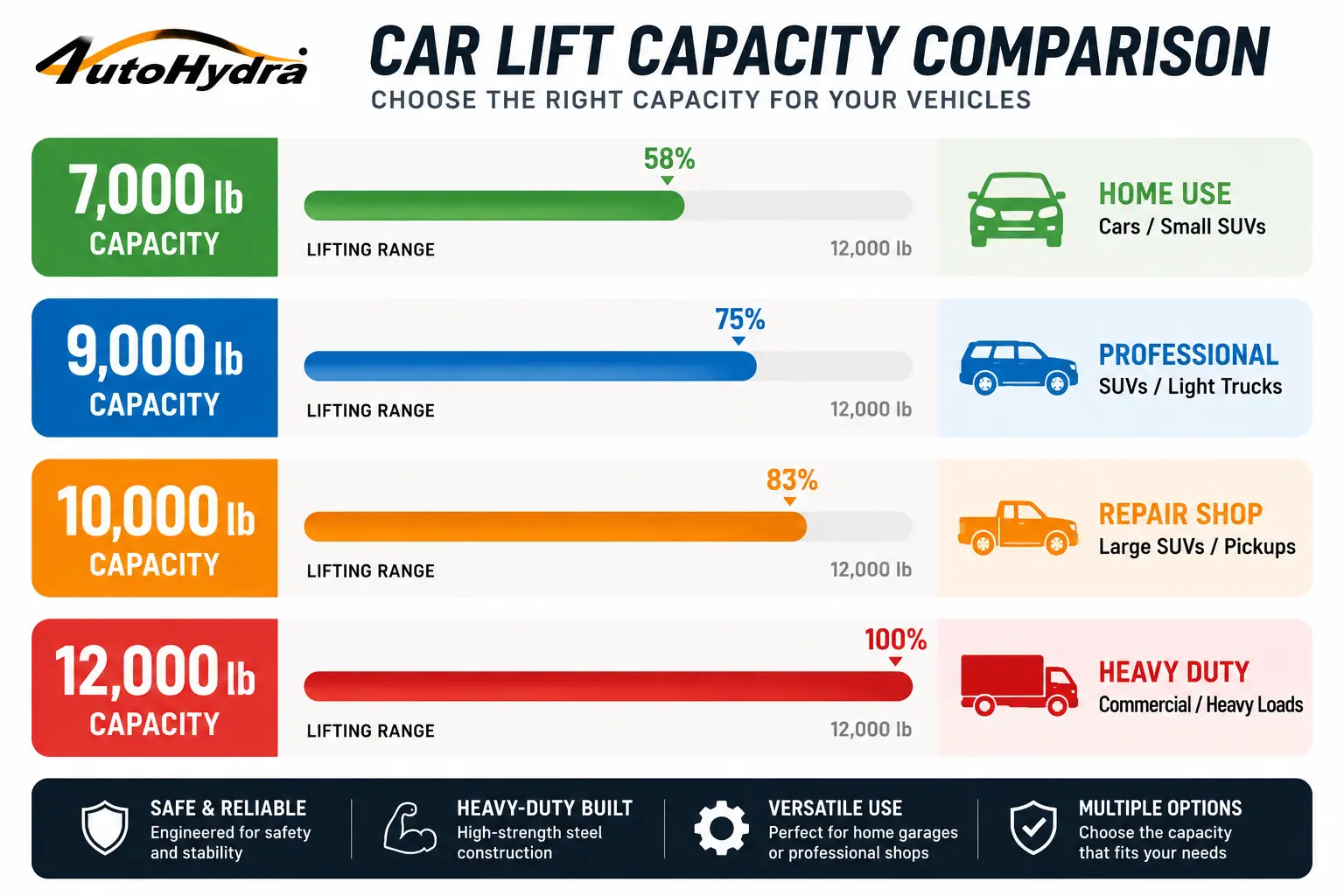
⚠️ These are general guidelines. Vehicle weight and the exact lift's specifications should always be checked before purchase.
6. Should I Buy a Higher-Capacity Car Lift?
Not necessarily. A higher capacity does not automatically mean a better lift for every garage.
A larger lift may require:
● More floor space
● Higher ceiling clearance
● Greater concrete requirements
● Different electrical requirements
● Higher purchase cost
💡 The goal is to find the right capacity for your application, not simply the highest capacity available.
7. What About Future Vehicles?
📌 Example: Your current vehicle weighs 5,000 lb, but you expect to work on full-size SUVs, pickup trucks, or work vans in the future. In that case, buying a lift with additional capacity may provide greater flexibility. This is particularly important for professional repair shops.
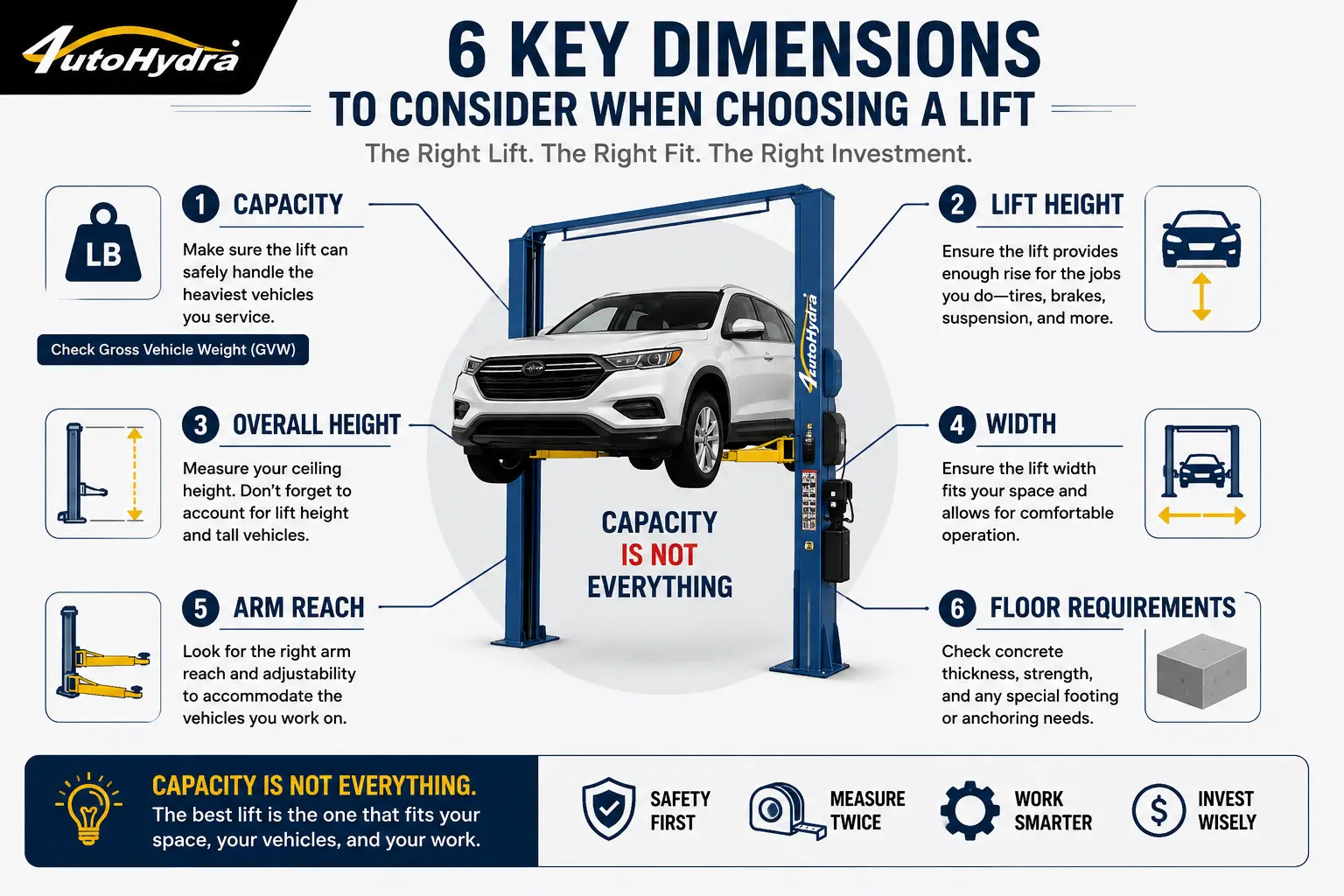
8. Car Lift Capacity Is Not the Only Specification
When choosing a lift, don't look at capacity alone. You should evaluate:
📖 Related Guide: How Much Garage Space Do You Need for a Car Lift?
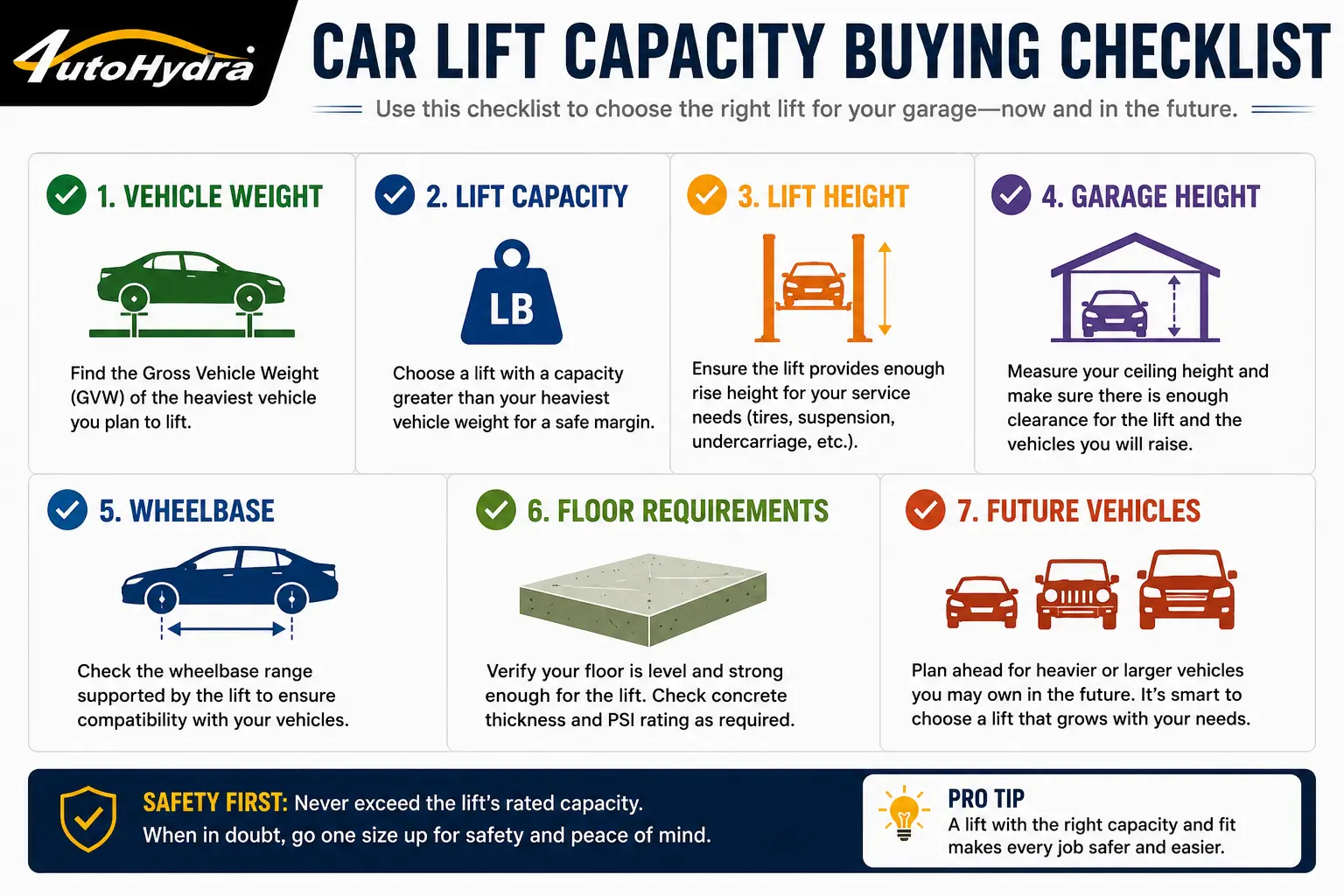
Car Lift Capacity Buying Checklist
Before purchasing a lift, confirm:
Frequently Asked Questions
What size car lift do I need for a 5,000 lb vehicle?
Choose a lift whose rated capacity is appropriate for the vehicle and application, with all manufacturer requirements satisfied. Do not select a lift solely by matching its capacity to the vehicle's weight — add a safety margin for future vehicles and load variations.
Is a 7,000 lb car lift enough for an SUV?
It depends on the specific SUV's weight and the lift's specifications. A compact crossover may be fine, but a full-size SUV (e.g., Suburban, Expedition) often exceeds 7,000 lb. Always compare the vehicle's actual weight with the manufacturer's rated capacity.
Is a 9,000 lb lift enough for a truck?
Some light-duty pickup trucks (e.g., Ford F-150, Ram 1500) can be accommodated by a 9,000-lb lift, but heavier trucks (F-250, Silverado 2500) typically require 10,000–12,000 lb. Always check the specific truck's weight, dimensions, and lifting points against the lift's specifications.
Should I buy a 10,000 lb or 12,000 lb car lift?
Choose based on the heaviest vehicle you expect to service and your garage's requirements. A 10,000 lb lift handles most light-duty trucks and SUVs. A 12,000 lb lift is better if you plan to service heavy-duty pickups, commercial vans, or fleet vehicles. A higher-capacity lift isn't automatically better if you don't need the additional capacity — it may cost more and require stronger floors.
What is the most important car lift specification?
Capacity is important, but it is only one part of the decision. Lift height, overall dimensions, floor requirements, vehicle compatibility, and intended use should also be evaluated. A lift with perfect capacity but insufficient height or improper fit for your garage is not a good choice.
Can I lift a heavy-duty truck with a 9,000 lb lift?
Most heavy-duty pickups (e.g., F-250, Ram 2500) weigh between 6,500–8,000+ lb, which may be near or exceed the capacity of a 9,000 lb lift once passengers and cargo are considered. Always factor in the vehicle's Gross Vehicle Weight Rating (GVWR), not just curb weight. For heavy-duty trucks, 10,000–12,000 lb is generally recommended.
How much clearance do I need for a 2 post lift?
You need ceiling clearance for the lift's overall height plus vehicle height. For a typical 10,000 lb 2 post lift with 110″ overall height, you'll need at least 10–12 feet of ceiling clearance. Also consider garage door tracks, openers, lighting, and other overhead obstructions. Always measure your lowest overhead point, not just the highest part of the ceiling.
What concrete thickness do I need for a car lift?
Most 2 post lifts require 4–6 inches of reinforced concrete with a minimum compressive strength of 3,000–3,500 PSI. Scissor lifts may have lower requirements (3–4 inches). Always check the manufacturer's specifications for your exact model — requirements vary by lift capacity and design. Never assume your existing garage floor meets the requirements without verification.
Not Sure Which Capacity Fits Your Vehicles?
Get a free capacity assessment from AUTO HYDRA's lift experts — we'll help you match the right lift to your current and future vehicles.
✔️ Free consultation · ✔️ Expert capacity advice · ✔️ Fast shipping from US warehouses
Recommended News
View all