
Choosing a car lift for a home garage is not simply a matter of choosing the lift with the highest capacity or the lowest price.
For most home garage owners, the real decision comes down to one question:
❓ Should you buy a 2 post car lift or a 4 post car lift?
Both designs can safely raise vehicles when properly installed and operated. However, they serve different purposes.
The right choice depends on your vehicle, garage dimensions, ceiling height, floor conditions, and what you actually plan to do with the lift.
📖 Related Guide: What Size Car Lift Do I Need? Complete Capacity Guide
1. 2 Post vs 4 Post Car Lift: Quick Comparison
Before looking at individual features, here is the basic difference.
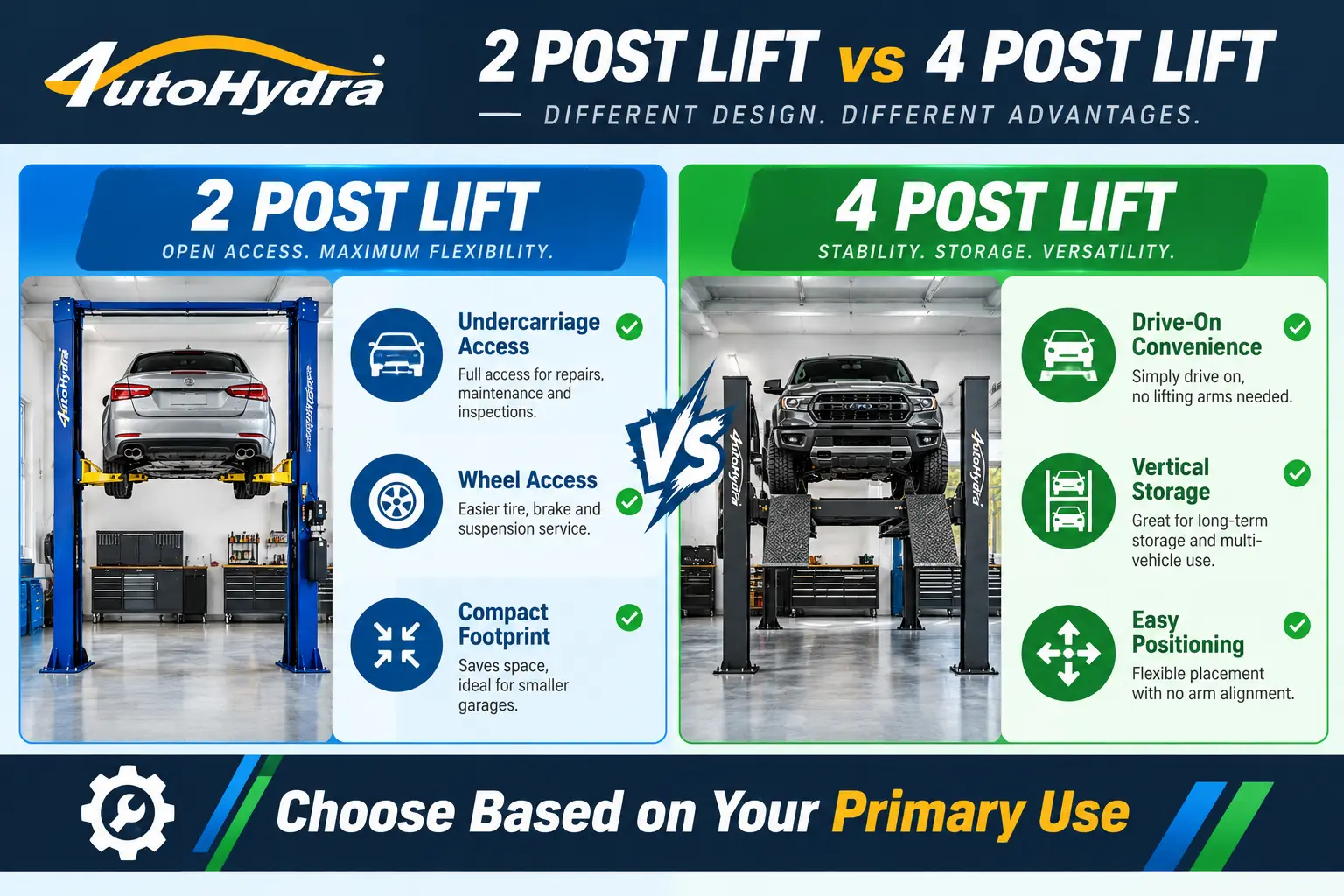
💡 The key point is simple:
2 post lifts prioritize repair access.
4 post lifts prioritize stability, drive-on convenience, and storage flexibility.
2. What Is a 2 Post Car Lift?
A 2 post car lift uses two vertical columns and lifting arms to raise a vehicle from designated lifting points. Because the vehicle is supported by the lifting arms rather than sitting on full-length runways, much of the underside and wheels remain accessible.
Common applications include:
● Brake repairs
● Suspension work
● Exhaust repairs
● Steering components
● Oil changes
● Wheel and tire service
● Undercarriage inspection
● Drivetrain-related work
📖 Learn more: Two Post Garage Lifts: Complete Buyer's Guide
3. Why Choose a 2 Post Lift for a Home Garage?
A 2 post lift can be a strong choice when your home garage is primarily a workshop rather than a vehicle storage area.
✅ 1. Excellent Undercarriage Access
The biggest advantage is the open space underneath the vehicle. There are no full-length runways supporting the tires, so technicians or DIY mechanics can access many components directly — especially useful for suspension, exhaust, brakes, and other repairs.
✅ 2. Efficient Floor Use
Compared with many 4 post configurations, a 2 post lift can provide a relatively compact lifting area. This can be important when your garage has limited floor space. However, you also need room to open doors, walk around, position tools, and operate the lift safely.
📖 Related: How Much Garage Space Do You Need for a Car Lift?
✅ 3. Better for Mechanical Repairs
If your garage is primarily used for DIY automotive repair, a 2 post lift often makes more sense. You can raise the vehicle and work directly underneath it without having the runways of a 4 post lift beneath the vehicle.
4. What Is a 4 Post Car Lift?
A 4 post car lift uses four vertical posts and two or more runways. Instead of positioning lifting arms at specific frame points, the vehicle is normally driven onto the runways — making the lifting process more straightforward for many users.
A 4 post lift is particularly popular for:
●Vehicle storage
●Parking
●Long-term storage
●General inspection
●Oil changes
●Light maintenance
●Larger vehicles
●Garage space optimization
📖 Learn more: 4 Post Car Lift: Parking, Storage & Repairs Guide
5. Why Choose a 4 Post Lift for a Home Garage?
A 4 post lift becomes especially attractive when your garage has a second purpose beyond repair — storing a second vehicle, keeping a classic car off the floor, or creating additional parking space.
✅ 1. Excellent for Vehicle Storage
A vehicle can be elevated, creating usable space underneath. For homeowners with multiple vehicles or limited garage parking, this can make a major difference. A 4 post lift works not only as a lifting system but also as a vertical storage solution.
✅ 2. Easier Drive-On Design
With a 4 post lift, the vehicle is driven onto the runways. This can be more intuitive for many home users because you do not have to position lifting arms at four specific points underneath the vehicle.
✅ 3. Good for Long-Term Storage
If your main objective is to store a classic car, project car, seasonal vehicle, or second vehicle, a 4 post lift can be particularly practical. The vehicle remains supported on the runways while the lift's mechanical locking system is engaged.
6. 2 Post vs 4 Post for Home Garage: Which Is Better?
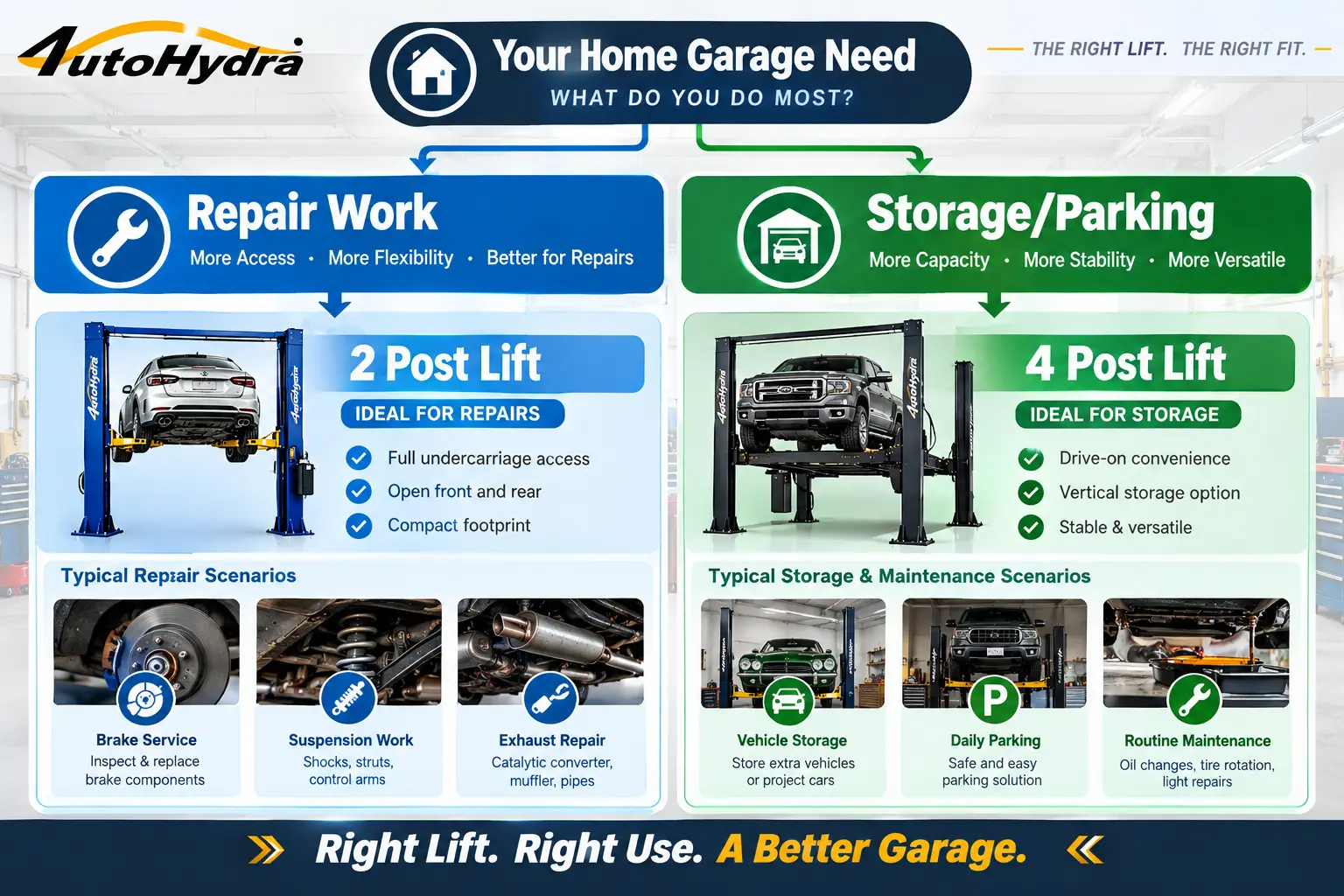
There is no universal winner. The better lift depends on what you want to do.
7. 2 Post vs 4 Post for a Small Garage
Garage size is one of the most important factors in your decision.
A common mistake is to ask: "Which lift takes up less space?"
A better question is: "Which lift gives me the functionality I need within my available space?"
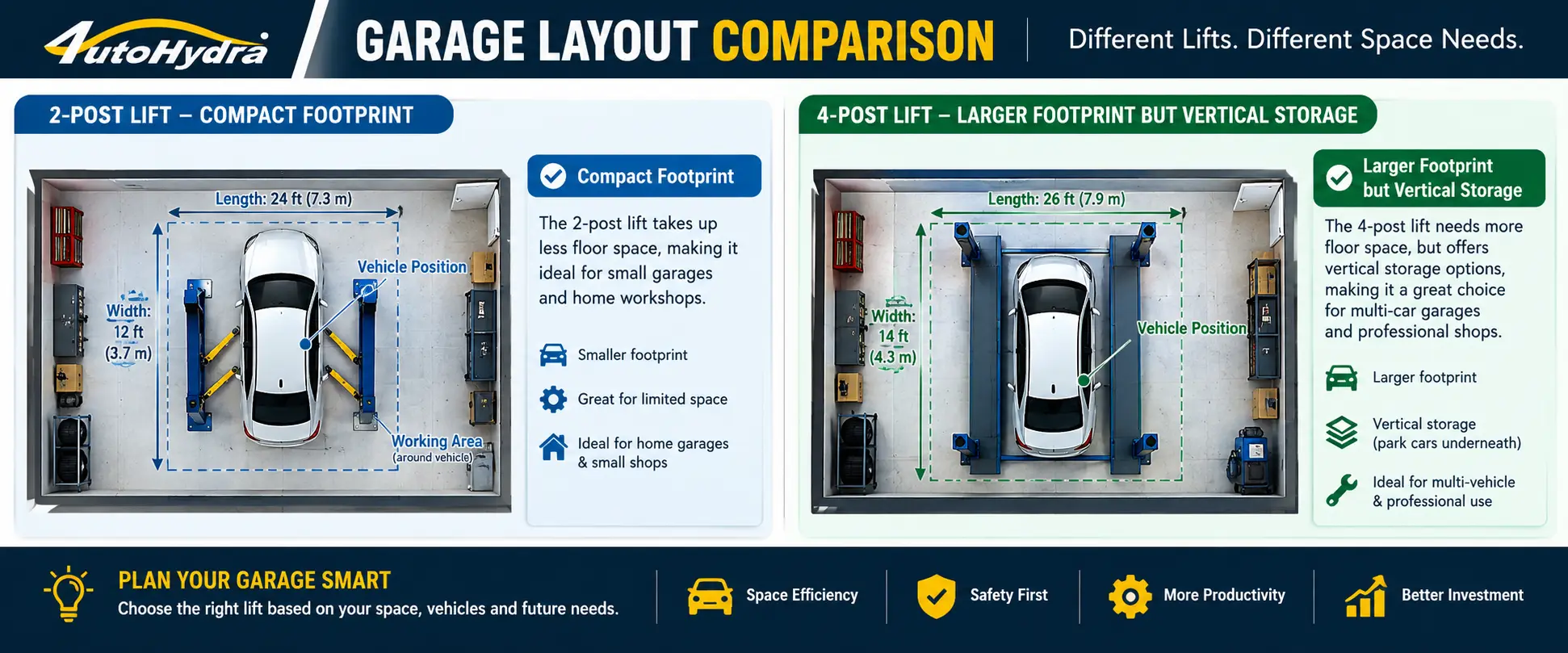
A 2 post lift may have a more compact lifting footprint, but you still need adequate clearance around the vehicle. A 4 post lift may require more floor length because of its runways, but it can provide valuable vertical storage.
Before buying either type, measure:
📖 Complete guide: How Much Garage Space Do You Need for a Car Lift?
8. What About Garage Ceiling Height?
Ceiling height can determine whether a lift is practical at all. Do not simply measure the garage from floor to ceiling.
You also need to identify the lowest overhead obstruction, such as:
●Garage door tracks · Garage door openers · Lighting
●HVAC equipment · Storage racks · Structural beams
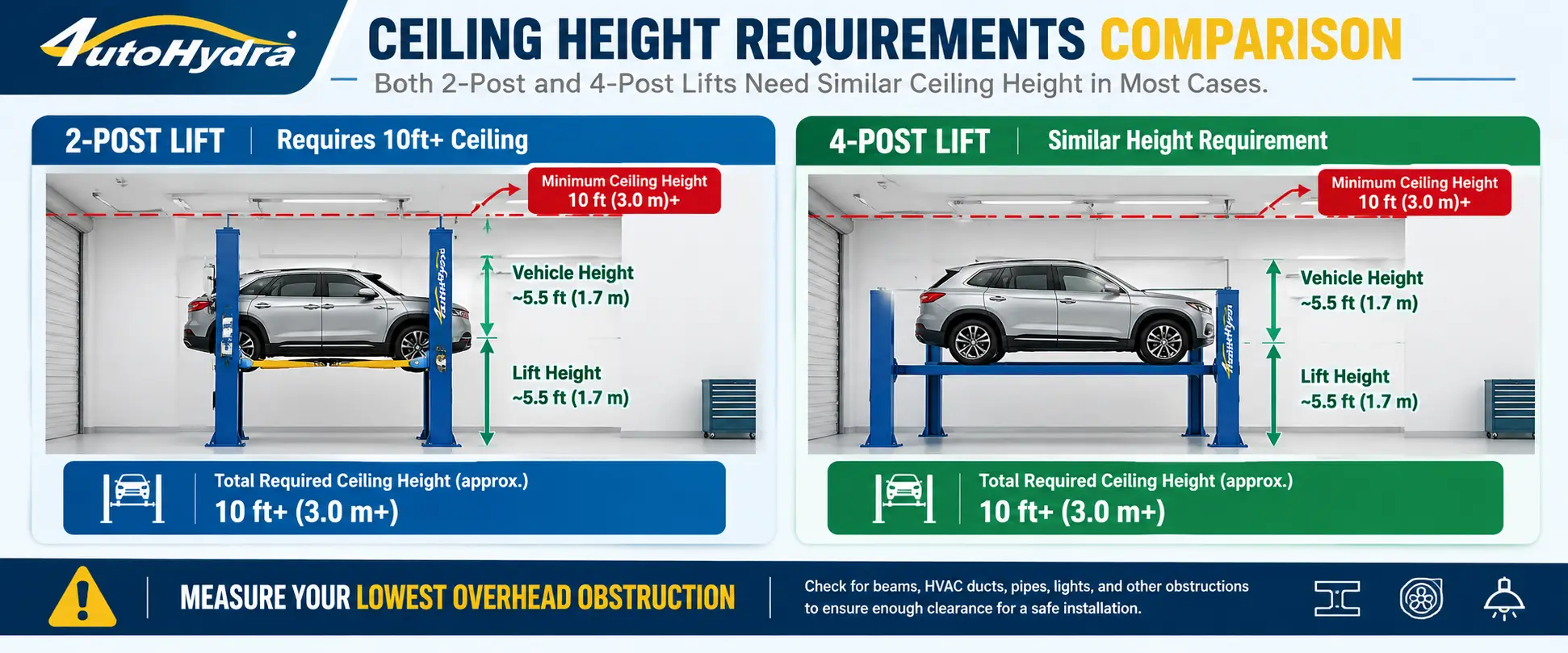
⚠️ If your garage has limited ceiling height, neither a full-height 2 post nor a full-height 4 post lift may be the ideal solution. Consider mid-rise scissor lifts, low-rise lifts, or portable lifting equipment.
9. Which Is Easier to Use?
For many homeowners, the 4 post lift has an advantage in basic vehicle positioning — you drive the vehicle onto the runways and follow the manufacturer's lifting procedure.
A 2 post lift requires more attention to lifting points and arm positioning. This does not make it difficult to use — it simply means the operator needs to understand:
●Manufacturer-specified lifting points
●Arm positioning · Vehicle balance
●Adapter placement · Safety-lock operation · Maximum capacity
⚠️ Correct setup is essential regardless of lift type. A lift should never be selected solely because one design appears easier to operate.
10. 2 Post vs 4 Post for SUVs and Trucks
SUV and truck owners should pay particular attention to capacity, vehicle dimensions, lifting points, and available garage space.
Consider:
●Vehicle curb weight · Possible cargo · Accessories
●Wheelbase · Overall height · Overall width
●Manufacturer lift points · Lift capacity
●Runway length or arm reach
📖 Detailed capacity discussion: What Size Car Lift Do I Need?
11. What About Safety?
Safety should be considered separately from the lift design. A 2 post lift is not automatically unsafe, and a 4 post lift is not automatically safe.
Safe operation depends on:
●Correct installation · Suitable concrete and foundation
●Correct vehicle positioning · Proper lift points
●Staying within rated capacity · Proper use of safety locks
●Regular inspection · Correct maintenance · Following manufacturer's instructions
⛔ Never assume that an existing residential garage floor is automatically suitable for a vehicle lift.
📖 Installation guide: How to Install a Car Lift: Step-by-Step Guide
12. Which One Should You Buy?
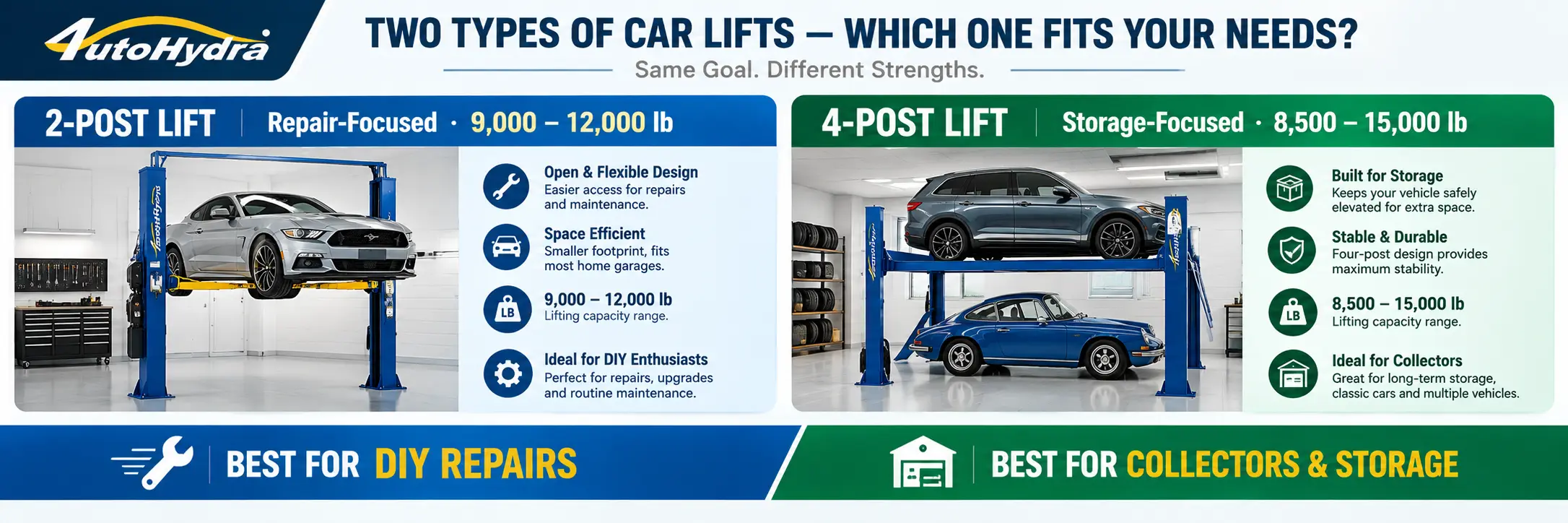
✅ Choose a 2 Post Lift If: Repair is your priority. You want maximum access to the underside of the vehicle and expect to perform mechanical work regularly.
✅ Choose a 4 Post Lift If: Storage and convenience are your priorities. You want to raise one vehicle and potentially use the floor underneath for another vehicle or storage.
Frequently Asked Questions
Is a 2 post or 4 post lift better for a home garage?
Neither design is universally better. A 2 post lift is generally better for mechanical repairs and undercarriage access, while a 4 post lift is generally better for storage, parking, and easy drive-on positioning. The right choice depends on how you plan to use your garage.
Is a 2 post lift good for home use?
Yes, provided the garage, concrete floor, vehicle, and installation requirements are suitable for the specific model. A 2 post lift can be an excellent choice for homeowners who perform regular mechanical repairs.
Is a 4 post lift better for storing a car?
Yes. A 4 post lift is often a practical choice for vehicle storage because the vehicle sits on runways and the lift can be used to create additional vertical parking space. This makes it particularly valuable for classic car collectors or homeowners with multiple vehicles.
Which takes up less space, a 2 post or 4 post lift?
A 2 post lift generally has a more compact lifting configuration, while a 4 post lift typically requires additional floor length for its runways. However, actual space requirements depend on the specific model and garage layout. Measure your garage before choosing.
Can I use a 4 post lift for repairs?
Yes. A 4 post lift can be used for many maintenance tasks, especially when equipped with suitable accessories such as a jack tray that allows wheel removal. However, a 2 post lift generally provides more direct access to the underside and wheels.
Can I put a car lift in a residential garage?
Potentially, but you must first verify the lift's installation requirements, including ceiling clearance, garage dimensions, concrete condition, electrical requirements, anchoring, and vehicle compatibility. Never assume that every residential garage is suitable for every vehicle lift.
What should I check before buying a home garage lift?
At minimum, check: Garage ceiling height · Garage width and length · Vehicle weight and dimensions · Lift capacity · Maximum lifting height · Concrete requirements · Electrical requirements · Available workspace · Manufacturer installation requirements.
How much ceiling height do I need for a 2 post vs 4 post lift?
Most 2 post lifts require 10–12 feet of ceiling clearance. 4 post lifts have similar height requirements but may offer lower profile options. Always measure your garage's lowest overhead obstruction (door tracks, openers, lights) — not just the highest point — and factor in the height of your tallest vehicle when raised.
Not Sure Which Lift Fits Your Home Garage?
Get a free space assessment and lift recommendation from AUTO HYDRA's experts — we'll help you choose between 2 post and 4 post lifts based on your garage dimensions and work needs.
✔️ Free consultation · ✔️ Expert layout advice · ✔️ Fast shipping from US warehouses
Recommended News
View all