2 Post vs Scissor Lift: Which Car Lift Is Better for Your Garage?
Choosing a car lift for your garage is about more than lifting capacity or price. The right lift should match your garage space, ceiling height, vehicle type, repair needs, and installation requirements.
Two of the most popular options for home garages and automotive workshops are 2 post lifts and scissor lifts.
Both can provide convenient access to a vehicle for maintenance and repair, but their designs serve different purposes.
💡 Quick Takeaway: A 2 post car lift is typically preferred when full undercarriage and wheel access are important. A scissor lift can be a practical choice when garage space or ceiling height is limited.
So, which one is better? It depends on how you plan to use your garage.
In this guide, we'll compare 2 post and scissor lifts based on space, lifting height, vehicle access, installation, applications, and overall garage suitability.
📖 Related Guide: How Much Garage Space Do You Need for a Car Lift?
1. What Is a 2 Post Car Lift?
A 2 post car lift uses two vertical columns and adjustable lifting arms to raise a vehicle from designated lifting points on its frame or chassis. This design leaves much of the vehicle's underside accessible after the vehicle is raised.
That makes 2 post lifts particularly useful for:
●Brake repairs
●Suspension work
●Exhaust repairs
●Oil changes
●Steering and chassis work
●Transmission service
●General undercarriage maintenance
⚠️ A 2 post lift normally requires careful consideration of ceiling height, concrete floor requirements, column placement, and vehicle lifting points.
📖 Learn more: Two Post Garage Lifts: Complete Buyer's Guide
2. What Is a Scissor Car Lift?
A scissor lift uses crossed lifting mechanisms beneath or around the vehicle platform to raise the vehicle vertically. Unlike a conventional 2 post lift, a scissor lift does not require two tall columns extending upward along the sides of the vehicle.
This can make certain scissor lift designs particularly useful for:
●Low-ceiling garages
●Small workshops
●Routine maintenance
●Brake work
●Tire service
●Vehicle detailing
●Inspection
●Flexible garage layouts
💡 Example: Auto-Hydra's 8,000-lb mid-rise scissor lift for home garages features a compact footprint, 110V operation, and approximately 39.5-inch lifting height.
⚠️ Scissor lifts vary significantly in design and lifting height — always evaluate the specifications of the exact model you are considering.
3. 2 Post vs Scissor Lift: Key Differences
The easiest way to compare the two designs is to look at the factors that matter most when buying a car lift.
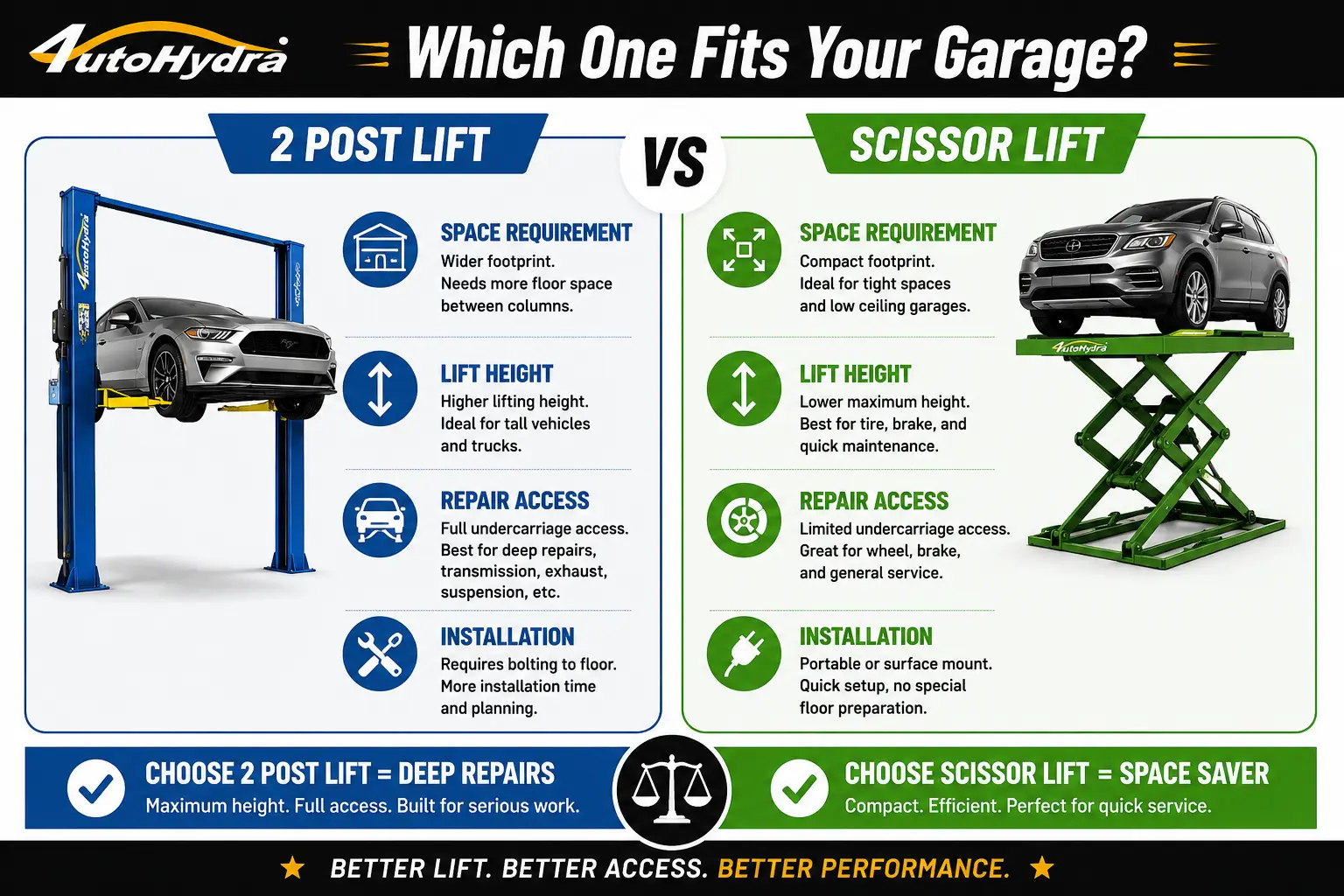
💡 The key difference is not simply size. It is the way the vehicle is supported and how much access you need around and underneath the vehicle.
4. 2 Post vs Scissor Lift for Garage Space
Garage space is one of the first things you should evaluate.
A 2 post lift has a relatively compact floor footprint, but its vertical columns require careful positioning. You need to consider:
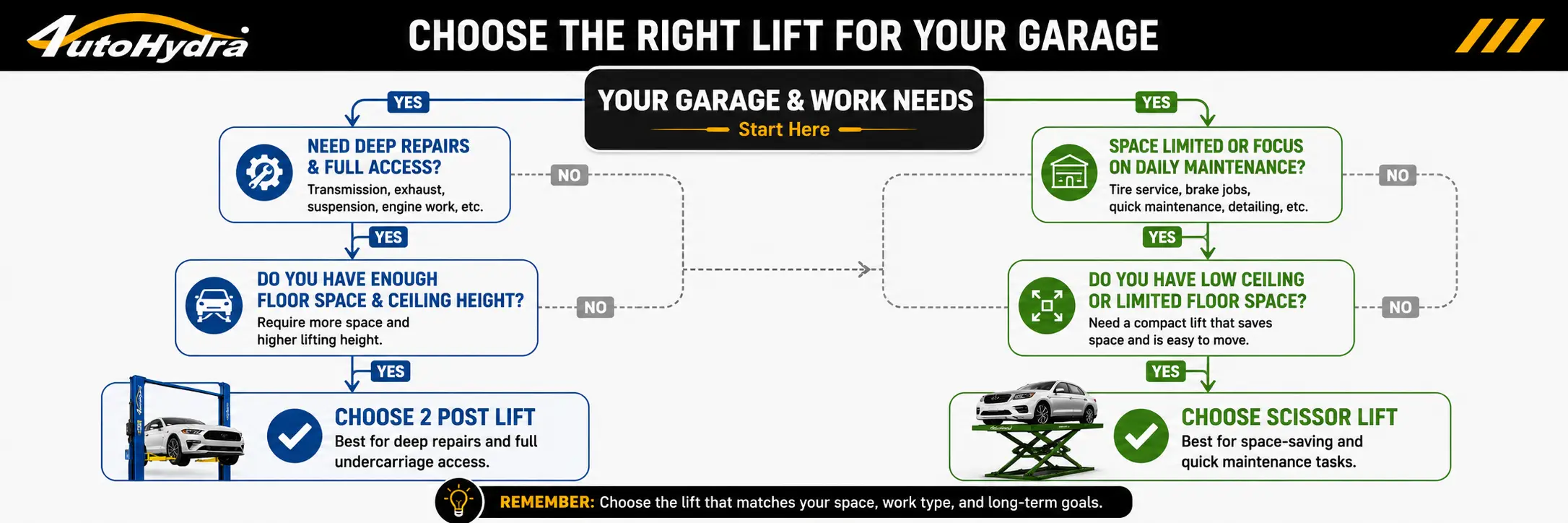
A scissor lift can eliminate the need for tall columns, which may make it easier to work with certain garage layouts. However, the platform itself still occupies floor space, and you need sufficient room to position the vehicle correctly.
📐 The best choice depends on the actual dimensions of your garage rather than the lift type alone.
📖 Step-by-step measurement: How Much Garage Space Do You Need for a Car Lift?
5. Which Is Better for a Low-Ceiling Garage? → Scissor Lift
If your garage has a relatively low ceiling, a scissor lift may be more practical.
Many mid-rise scissor lifts are designed to raise a vehicle to a moderate working height without requiring the vehicle to reach the same elevation as a full-height 2 post lift.
This is especially useful for:
●Brake work
●Tire rotation
●Suspension inspection
●Detailing
●Undercarriage cleaning
⚠️ Don't assume every scissor lift is suitable for a low ceiling. Always check: Lift height + vehicle height + overhead clearance.
6. Which Is Better for Undercarriage Repairs? → 2 Post Lift
For serious mechanical work, a 2 post lift is usually the stronger choice.
When the vehicle is properly positioned and lifted, the design provides excellent access to:
●Wheels
●Suspension
●Brakes
●Exhaust
●Driveshaft
●Transmission
●Chassis components
✅ This is one of the biggest reasons 2 post lifts are common in professional repair environments.
7. Which Is Better for Routine Maintenance? → It Depends
For routine maintenance, either system can work.
🔧Scissor Lift — Convenient For:
●Tire rotation
●Brake inspection
●Detailing
●Undercarriage cleaning
●Oil service
●General inspection
⚙️2 Post Lift — Better For:
●Suspension components
●Exhaust systems
●Wheels
●Steering
●Transmission
●Deeper undercarriage work
💡 The important question: How much access do you need underneath the vehicle?
8. 2 Post vs Scissor Lift for a Home Garage
For home garages, there is no single answer.
🏗️Choose a 2 Post Lift If:
●You have sufficient ceiling height
●You perform mechanical repairs
●You want extensive undercarriage access
●You work on multiple vehicle types
●You want a professional repair setup
📐Choose a Scissor Lift If:
●Your ceiling is relatively low
●Floor space is limited
●You primarily perform routine maintenance
●You want a compact lifting system
●You prefer a design without tall columns
9. Installation Requirements
Installation requirements can vary substantially between models.
🔩For a 2 Post Lift, evaluate:
●Concrete thickness
●Concrete strength
●Anchor requirements
●Column positioning
●Electrical requirements
●Overhead clearance
🛠️For a Scissor Lift, check:
●Floor condition
●Level surface
●Hydraulic power unit location
●Electrical supply
●Vehicle positioning
●Safety lock operation
⛔ Never choose a lift solely because its physical dimensions appear to fit your garage. The garage floor and installation requirements must also be compatible with the specific model.
📖 Installation guide: How to Install a Car Lift: Step-by-Step Guide
10. Quick Decision Guide
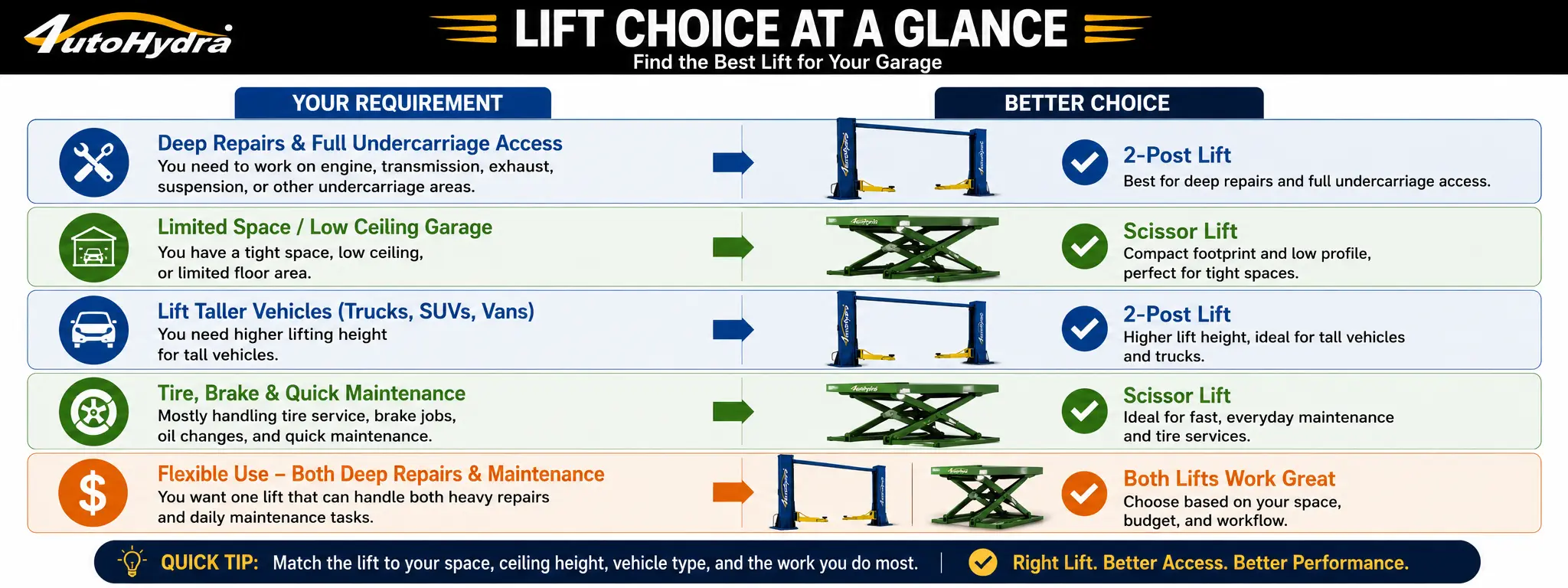
Safety Considerations for Both Lift Types
Regardless of the lift design, safe operation depends on proper installation, correct vehicle positioning, rated capacity, functioning safety locks, and regular maintenance.
Before lifting a vehicle:
●Check the lift's rated capacity
●Confirm the vehicle's approved lifting points
●Inspect lift arms or platforms
●Check hydraulic components
●Keep the lifting area clear
●Follow the manufacturer's operating instructions
●Engage the appropriate safety locks before working beneath a raised vehicle
📖 Maintenance guide: Car Lift Maintenance Checklist & Safety Guide
📖 Troubleshooting: Car Lift Troubleshooting Guide: Common Problems
Frequently Asked Questions About 2 Post vs Scissor Lifts
Is a 2 post lift better than a scissor lift?
Neither is universally better. A 2 post lift is generally better for extensive undercarriage and wheel access, making it the preferred choice for professional mechanical repairs. A scissor lift can be more suitable for low-ceiling or space-constrained garages where routine maintenance is the primary use case. The best choice depends entirely on your garage dimensions, ceiling height, and the type of work you perform.
Are scissor lifts good for home garages?
Yes. Certain mid-rise scissor lifts are designed specifically for home-garage applications. They provide a compact solution for routine maintenance, tire service, brake work, and detailing — especially in garages with limited ceiling height. However, always verify the model's capacity, lifting height, floor requirements, and installation instructions before purchasing.
Which lift is better for a low ceiling garage?
A suitable mid-rise scissor lift is often a strong option for a low-ceiling garage because it does not require the same vertical structure as a full-height 2 post lift. However, you must still check that the combination of lift height + vehicle height + overhead clearance fits within your garage's dimensions. Some 2 post lifts also have "low-rise" configurations, so always compare specifications of the exact model.
Can a scissor lift be used for brake work?
Many scissor lifts are suitable for brake and wheel service, but the exact access depends on the platform and lifting design. Some scissor lifts feature open-center platforms that provide good wheel access, while others have solid platforms that can restrict access. Always check whether the specific model provides sufficient wheel access for the work you plan to perform.
Which car lift takes up less space?
There is no universal answer. A scissor lift can have a very compact footprint when lowered, while a 2 post lift can also be relatively space-efficient compared with 4 post systems. The key is to compare the complete operating footprint — including the space needed around the vehicle for technicians to work — rather than only the lift's base dimensions.
Is a 2 post lift suitable for a home garage?
Yes, provided the garage meets the lift's requirements for ceiling height, floor construction, available space, electrical supply, and installation. Many home garages can accommodate a 2 post lift if they have at least 10–12 feet of ceiling height and a concrete floor of adequate thickness and strength. Always verify the manufacturer's specifications before purchasing.
How much ceiling height do I need for a 2 post lift vs a scissor lift?
A full-height 2 post lift typically requires 10–12 feet of ceiling clearance, depending on the vehicle height and lift design. A mid-rise scissor lift often requires significantly less — sometimes as little as 8 feet — because it raises the vehicle to a moderate working height (typically 36–48 inches) rather than full standing height. Always calculate: lift height + vehicle height + required clearance for your specific model and tallest vehicle.
Can I install a car lift in my garage myself?
Some experienced DIY enthusiasts can install certain lifts, but professional installation is strongly recommended, especially for 2 post lifts that require precise anchoring and leveling. Incorrect installation is one of the leading causes of lift failure and safety incidents. For scissor lifts, installation is often simpler but still requires a level floor, proper electrical supply, and correct hydraulic connections. Always follow the manufacturer's installation instructions and consult a professional if you're unsure.
Not Sure Which Lift Fits Your Garage?
Get a free space assessment and lift recommendation from AUTO HYDRA's experts — we'll help you choose between 2 post and scissor lifts based on your actual garage dimensions and work needs.
✔️ Free consultation · ✔️ Expert layout advice · ✔️ Fast shipping from US warehouses
Recommended News
View all